
Genocide is among the most horrific words in the language. Polish-Jewish lawyer Raphael Lemkin coined the term in 1944 to describe the deliberate destruction of “a national, ethnic, racial or religious group”.
The definition was rooted in personal tragedy: much of Lemkin’s family was murdered during the Holocaust. Yet, as with so many words in today’s overheated public debate, genocide has increasingly been stripped of its precise meaning. Positions ranging from support for tighter immigration controls to the refusal to describe biological males as women are now sometimes branded “genocidal”.
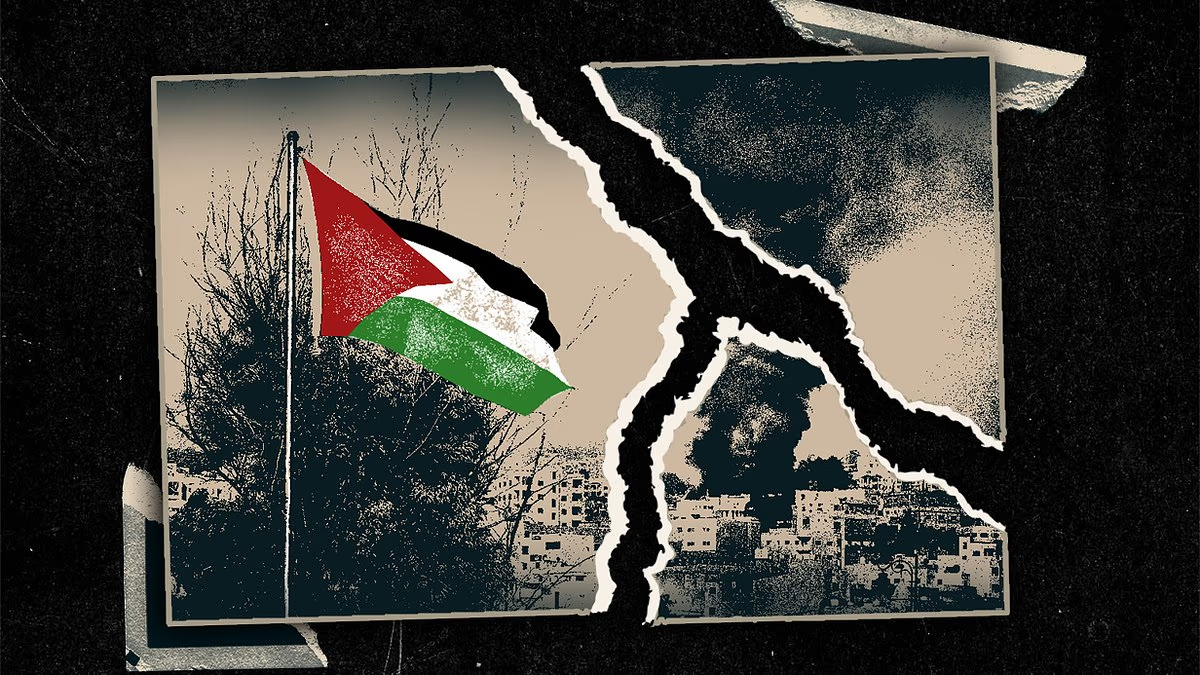
Nowhere is the term used more frequently or controversially than in accusations directed at Israel over its military campaign in Gaza. UN officials, Amnesty International activists, left-wing politicians, Islamist groups and, inevitably, the BBC have repeatedly condemned the Jewish state in the strongest possible terms.
Last week, rapper Macklemore criticised Israel’s conduct in Gaza during an Ed Sheeran concert, prompting a dispute that led to his removal from the tour. Other support acts and members of Sheeran’s backing band subsequently withdrew in “solidarity”, leaving the singer to apologise publicly on stage in Philadelphia on Saturday.
Earlier this month, more than 5,000 people from the worlds of entertainment, academia and public life signed an open letter rejecting the genocide allegation. Their numbers, however, remain far smaller than the crowds using the Gaza conflict to signal what they regard as moral virtue.
The result is more than an attack on Israel for waging war. It also risks obscuring responsibility for the conflict’s outbreak and providing cover for Hamas, the terror group whose own conduct has been described as genocidal.

Gaza is a human catastrophe. But “genocide” does not describe the number of people killed, buildings destroyed or bridges demolished, writes David Patrikarakos
The Gaza war began on October 7, 2023, when Hamas and other Palestinian gunmen killed roughly 1,200 people and seized 251 hostages. Victims were raped, mutilated and tortured, according to accounts of the attack. Israel launched its offensive the following day, seeking to dismantle the Iranian-backed terror enclave on its border and restore the deterrence it considers essential to its survival.
None of those facts justifies genocide—and nothing could. But no serious assessment of the war can ignore the circumstances that led to it or the way the conflict began.
Gaza remains a human catastrophe. The images of deaths and destruction have appalled me, as similar scenes have in other wars I have covered. Yet the number of people killed, the buildings flattened and the infrastructure destroyed do not, by themselves, establish genocide. The crime has a specific legal meaning under the 1948 Convention on the Prevention and Punishment of the Crime of Genocide.
That definition requires evidence of an intention to destroy a people. Article II states: “Genocide means any of the following acts committed with intent to destroy, in whole or in part, a national, ethnical, racial or religious group.”
Jeffrey Blackett, who served as Judge Advocate General of the Armed Forces from 2004 to 2020, told me: “The charge of genocide against Israel is absolute nonsense. It simply doesn’t accord with the law.
“There is no evidence that the Israelis are trying to destroy the Palestinians, Gazans or any other nation. They are involved in a war against terrorists, and it may be that some of their actions are disproportionate. But that doesn’t make it genocide—the deliberate destruction of a human group. This definition must be rigidly adhered to.”
How, then, can Israel’s intentions be assessed? More than 70,000 people in Gaza have reportedly been killed, out of a total population of approximately 2.3 million.
Israel possesses the military capability to kill every Palestinian in Gaza within days. If extermination were its objective, the argument goes, it would have happened long ago. I have reported from Gaza myself: its densely packed apartments, maze-like alleys and large civilian population present an extraordinary challenge for any military force.

Ed Sheeran and rapper Macklemore perform together at the 2014 iHeartRadio Music Festival in Las Vegas
Hamas has established positions beneath hospitals and mosques, built hundreds of miles of tunnels and booby-trapped thousands of homes. The group uses civilian sites and people as part of its military strategy, critics say.
John Spencer, executive director of the Urban Warfare Institute, told me: “I would assess Israel’s conduct in Gaza as being in strict adherence to the law of armed conflict.” He added that, among the cases he had examined, Israel had taken more measures than most to reduce harm to civilians.
Those measures have included leaflets, phone calls and text messages warning residents of impending attacks, as well as humanitarian corridors and pauses in fighting intended to help civilians leave dangerous areas. “To say that Israel is trying to destroy, in whole or in part, the entire people of Gaza is counter to everything they’ve done since October 7,” Spencer said. “If you want to wipe a people out, you don’t text them where the bombs are going to fall.”
There is, nevertheless, evidence of disturbing rhetoric from some Israeli officials. Yoav Gallant was defence minister—not merely a provocative commentator—when, on October 9, 2023, he announced a “complete siege” of Gaza, declaring: “No electricity, no food, no fuel … We are fighting human animals and we are acting accordingly.”
Repugnant words, which the International Court of Justice (ICJ) itself noted. But Gallant was talking about Hamas, not the civilian population – ‘the Isis of Gaza’, he called the terror group.
And what happened next? The ‘siege’ was only temporary. Aid subsequently entered Gaza in vast quantities. The rhetoric was ugly, but policy was softer.
Genocidal intent need not be stated explicitly. It can be inferred from a pattern of conduct. For example, the UN tribunal for the former Yugoslavia – later upheld by the ICJ – ruled that the 1995 Srebrenica massacre constituted genocide not because more than 7,000 Bosnian Muslim men and boys were murdered, but because the killings, combined with the forcible removal of women, children and the elderly, demonstrated a wider intent to destroy Srebrenica’s entire Bosnian Muslim community.

Ed Sheeran speaks on stage as he addresses the controversy over Macklemore being pulled from his tour
Accusers argue that Israel’s conduct – mass displacement, destruction of infrastructure and restrictions on food and aid – permits a similar ‘inference of intent’.
But genocidal intent inferred from a pattern of conduct must be the only reasonable inference available – not merely a ‘possible’ one.
Gaza is a war against a savage, pitiless, Islamo-fascist enemy embedded in tunnels, hospitals and homes, fought by a military that delays offensives for months and evacuates the population its accusers insist it is trying to destroy. Far from being the ‘only’ reasonable inference from Israel’s conduct, genocide is among the hardest to sustain.
The other charge is famine. In August last year, the international Famine Review Committee confirmed famine in Gaza Governorate, finding that thresholds for extreme food deprivation, acute malnutrition and deaths had been crossed. This matters because the Genocide Convention covers not only killing but ‘deliberately inflicting conditions of life calculated to bring about physical destruction’.
But after the October ceasefire brought increased humanitarian and commercial access, the Integrated Food Security Phase Classification found that famine conditions had been reversed, even though severe food insecurity remained.
That does not erase the suffering or excuse Israel’s earlier 11-week aid blockade. But it undermines the argument of intent.
Not least because aid continued to enter Gaza: UN data show humanitarian organisations collected some 54,000 tons of food from crossings between May 19 and August 18, although distribution inside Gaza was severely disrupted. Nobody feeds and vaccinates a population it intends to exterminate.
If the case for genocide is this thin, why does the charge still carry such weight? First, the world is repeatedly told the ICJ found a ‘plausible’ case of genocide in Gaza. This is false. Joan Donoghue, ICJ president at the time, told the BBC that the court ‘didn’t decide that the claim of genocide was plausible’. Judgment is not expected before 2028.
Israel’s enemies have levelled the genocide charge for decades – much as they have done with charges of ‘apartheid’ and ‘colonialism’. Beneath much of this lies an older impulse.
The great obstacle for modern anti-Semites has always been the Holocaust: a crime against the Jews so vast, well-documented and horrifying that it became impossible to explain away. Once, the answer was reassuringly crude: just deny it happened. Now, in this area at least, things are more sophisticated.
If Israel can be cast as ‘genocidal’, the moral equation is reversed. The victims of the Nazis become Nazis themselves. The Jews lose their claim on the Holocaust’s memory because, in the end, they are said to have become guilty of the same crime. Yes, Israel has fought a brutal war and made grievous errors. But genocide is a legal term with a legal test, and Gaza does not meet it.
There is, however, one party in this war that is genocidal. That, of course, is Hamas. The terror group’s 1988 founding charter makes its intentions plain. ‘Israel will exist and will continue to exist until Islam will obliterate it,’ it reads. Article Seven goes further, invoking the hadith in which Muslims fight the Jews until even the stones and trees cry out: ‘There is a Jew hiding behind me, come and kill him.’
Hamas qualified this in its 2017 political document, declaring that its conflict was with ‘the Zionist project’ rather than Jews because of their religion. But critics dismissed the change as a cynical exercise in rebranding.
As former judge Jeffrey Blackett observes: ‘Hamas, Hezbollah, the Houthis, Iran all want to get rid of Israel. If there’s any genocidal intent, it’s from them, not from Israelis.
‘I think a failure of Israel has been they have not spent enough time countering what their enemies have been saying. They’ve allowed the terrorists and their sympathisers to infiltrate Western democracies with what’s effectively a blood libel.’