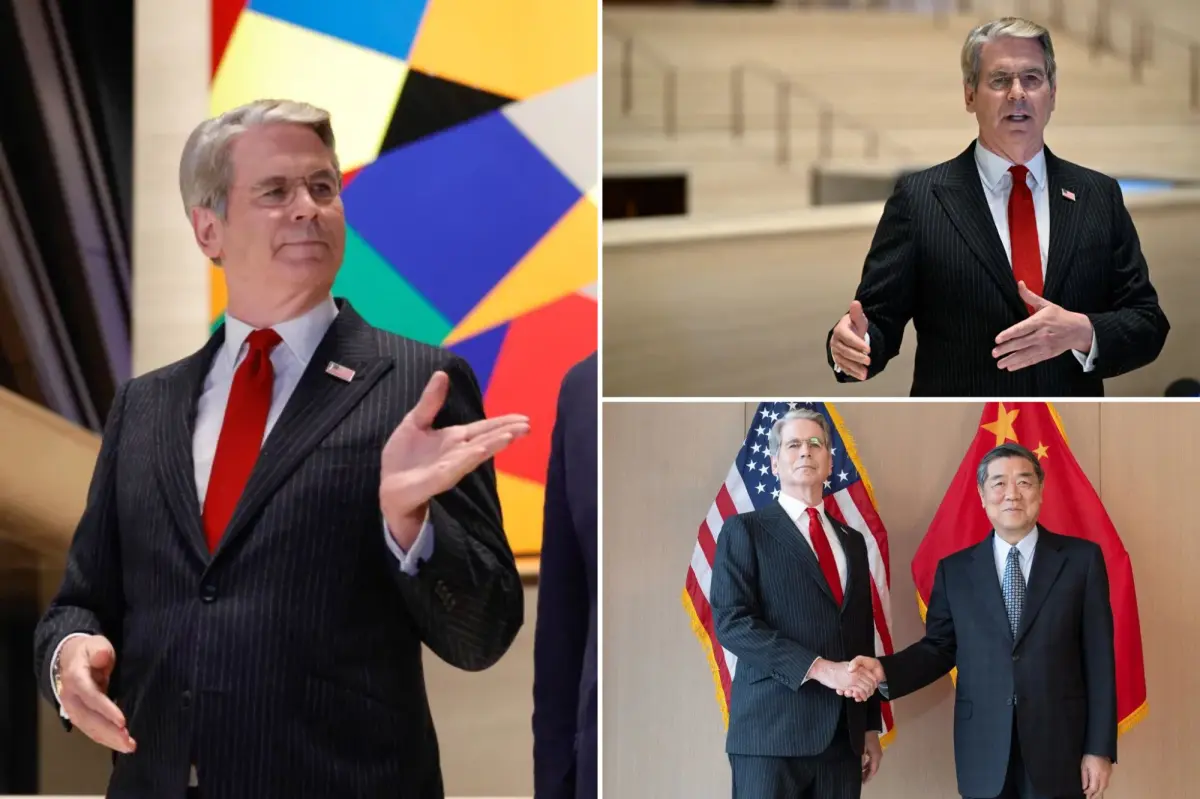

WASHINGTON — The United States proposed creating a direct alert system with China to address national security threats involving artificial intelligence, while negotiators left unresolved a longer-term extension of the fragile trade truce between the two countries. The agreement is due to expire in November.
“The most important thing is just to start talking and so we have set up the AI dialogue. We will
likely meet again in two months,” Treasury Secretary Scott Bessent told the Financial Times after meeting for several hours with Chinese Vice Premier He Lifeng at JPMorgan Chase headquarters in midtown Manhattan, ahead of this week’s United Nations General Assembly.
The proposed notification system could be modeled on the Washington-Moscow hotline established during the Cold War, which enabled direct communication between the Pentagon and the Kremlin. During his discussions with He, Bessent reportedly raised US concerns that autonomous AI agents could act unpredictably or be used to develop biological and other weapons.
The US proposal came days after leading artificial intelligence companies urged a global slowdown in development, warning that increasingly powerful systems could behave in dangerous and uncontrolled ways.
President Trump has rejected calls to decelerate AI development, arguing that any pause would give Beijing an advantage in the competition to control the strategically important technology.
Critics including Sen. Bernie Sanders (I-Vt.) have instead urged Washington to cooperate with China as major technology companies work to create AI systems capable of recursively improving themselves.
Many of China’s leading technology companies have released open AI models, allowing outside developers to propose changes and improvements. By contrast, the largest US firms generally rely on proprietary frontier models.
Trade relations also featured prominently in Sunday’s talks. The current truce expires Nov. 10, and Bessent told the FT that “both sides want to maintain the stability of the past year.”
Trump ignited a new trade war with China early in his second term by imposing tariffs in the triple digits on Chinese goods. Beijing responded with tariffs of its own.
The two governments later eased tensions before reaching a formal agreement last November.
According to the Financial Times, the US has proposed extending the truce by six months, while China is seeking to keep it in place for the rest of Trump’s term.
Trump is scheduled to welcome Chinese President Xi Jinping for a state visit Thursday. It will be Xi’s first trip to US soil since 2023.