BY JENNIFER CABRERA
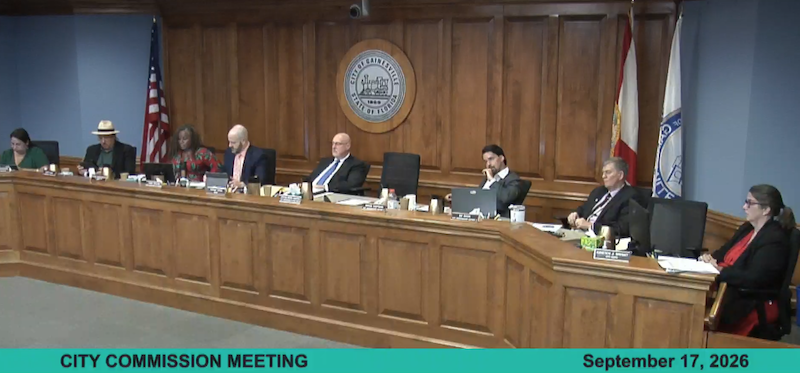
GAINESVILLE, Fla. – Gainesville city commissioners heard recorded testimony from University of Florida parents concerned about student safety at the close of their September 17 meeting. The comments, originally submitted for the afternoon General Public Comment period, were moved to the evening session. Commissioners also voted to end the use of recorded public comments going forward.
Before the afternoon comment period began, Mayor Harvey Ward said the city had received 18 recordings through a program created during the COVID-19 pandemic but never previously used. The recordings were intended to be played during General Public Comment, but Ward asked commissioners to “make a motion to waive the rules as they pertain to pre-recorded General Comment to play at the end of the meeting.”
Commissioner Bryan Eastman proposed moving the recordings to the end of the meeting and extending the regular General Public Comment period beyond its 30-minute limit. The commission approved the motion unanimously.
Click here to read about the 19 people who spoke during the General Public Comment period in support of ending a Gainesville Police Department policy involving contact with “suspected unauthorized aliens.”
Mayor Harvey Ward: “GRACE Marketplace is one of the few places in North Florida where someone can register an address if they don’t actually have an address… Just because someone uses GRACE as their mailing address does not mean that they live at GRACE Marketplace.”
During the public comment period, one man spoke in person about public safety concerns near the University of Florida campus. Ward responded that some of the concerns appeared tied to the statewide criminal justice and court systems, which are outside the city’s control and do not operate on behalf of GRACE Marketplace. “GRACE Marketplace is one of the few places in North Florida where someone can register an address if they don’t actually have an address,” Ward said. “Just because someone uses GRACE as their mailing address does not mean that they live at GRACE Marketplace.”
81 people were enrolled at GRACE from state prisons between Sept. 2025 and Sept. 2026
Mark Bonner, interim CEO of GRACE Marketplace, addressed recent claims that the organization has become a magnet for people released from Florida prisons. Bonner said nearly 25,000 people left state prisons between September 2025 and September 2026, while GRACE identified 81 of those individuals who later enrolled in its services. “That is 0.33%, or one in every 306 people,” he said.
Mark Bonner, Interim CEO at GRACE Marketplace: “If GRACE disappeared, the people who need shelter would not disappear with it; they would remain in Gainesville without the help that they need to change their current circumstances.”
Bonner said GRACE welcomes scrutiny but urged critics to consider the organization’s responses alongside their concerns. “If GRACE disappeared, the people who need shelter would not disappear with it; they would remain in Gainesville without the help that they need to change their current circumstances,” he said.
Following public comment, Ward pointed to what he described as GRACE’s impact on homelessness in Gainesville. Before GRACE opened, he said, more than 100 people slept nightly at Bo Diddley Plaza and the community had identified more than 1,500 people as unsheltered. In 2026, that figure is closer to 500 or 600, Ward said. “GRACE has had a tremendous positive impact on this community,” he added.
Commissioner Ed Book asked Bonner how GRACE assists people who arrive in North Central Florida from elsewhere and whether the organization helps them return to communities where they can address their challenges.
58% of people receiving services at GRACE Marketplace are from Alachua County
Bonner said monthly reports to the city show that most GRACE clients come from Alachua County, with the latest figure at 58%. Those arriving from outside the county generally come from areas included in the local Continuum of Care, he said. “We’re not going to turn people away, right?”
Alachua County residents receive priority when GRACE has a bed waiting list, Bonner said. He added that staff try to prevent people from entering the homeless response system when they have a viable housing option elsewhere. That can include helping them return to a community with housing, family support and other resources, he said.
Interim City Manager Andrew Persons also referenced a press release announcing expanded Gainesville Police Department and University of Florida Police Department patrols in Midtown.
Commissioner Casey Willits: “I bristle at listening to people who don’t live close to prisons and are upset that maybe someone who’s released from a prison, on their way home, ends up in our community at some point.”
Commissioner Casey Willits noted that Florida has numerous state and federal prisons north and west of Gainesville. Only a small share of people released from the Florida Department of Corrections end up registered with GRACE in the local community, she said. “I bristle at listening to people who don’t live close to prisons and are upset that maybe someone who’s released from a prison, on their way home, ends up in our community at some point,” Willits said. “Homelessness is a statewide problem.”
Ward described homelessness as a global issue and said Florida’s ongoing challenges are linked in part to insufficient attention to mental health and substance abuse treatment. “As long as we in Florida, particularly, do not take mental health and substance abuse treatment seriously, we will continue to experience what we have seen in this community,” he said.
Commissioners vote to eliminate voice recordings for comments
At the end of the evening’s business, Ward referred to the 19 voice recordings that had been submitted by callers concerned about the safety of UF students and said the rule about voice recordings was implemented during COVID, “and it has not been used since then… But we do spend staff time, every single meeting, to comb through it and make sure that there are no comments.”
Ward said Commissioners could amend the rules to omit the “artifact of COVID planning that we just never took out of the rules, and I would like us to direct the Attorney via a motion to amend our Rules Resolution at the next meeting to take that out because it is costing us resources… and has been used exactly once.”
Eastman made a motion to direct the City Attorney to remove the voicemail option for public comment. There was no public comment, and the motion passed unanimously.
Willits: “I do want to encourage people… to keep emailing us and reaching out, having personal conversations and meeting with us, because it does work.”
Willits said, “For people watching at home, we really do read emails… I do want to encourage people… to keep emailing us and reaching out, having personal conversations and meeting with us, because it does work.”
The motion passed 6-1, with Commissioner Desmon Duncan-Walker in dissent.
Eastman: “One thing I can say is that we, as a City, you can see clearly, have been committed to public safety and continue to be committed to public safety. We’re putting our money where our mouth is.”
Eastman said he wanted to “make a point before we start listening to a lot of these calls… You’re about to hear about 20-30 minutes of parents who are concerned about the safety of their kids. They have different hypotheses as to why they think that is; part of it relates to our homeless shelter, part of it relates to funding for our police. One thing I can say is that we, as a City, you can see clearly, have been committed to public safety and continue to be committed to public safety. We’re putting our money where our mouth is.” He said public safety funding has increased by 25% since 2023, while “everything else has been cut by 3%.”
Ward: “I am very, very proud of the work that our law enforcement does, and I am proud of the way that we fund law enforcement in our community. And it’s important to… tell that story before we go into a few minutes of being told that we don’t, by people who generally don’t live in our community.”
Ward said he wanted to note that there are three police departments operating inside the city limits of Gainesville: the Gainesville Police Department (GPD), the University of Florida Police Department (UFPD), and the Santa Fe College Police Department. He said the combined “360-ish sworn officers [are] a lot for a city of 151,000 people.” He also reiterated the City’s commitment to public safety: “It does not mean we do not have crime,… but I am very, very proud of the work that our law enforcement does, and I am proud of the way that we fund law enforcement in our community. And it’s important to… tell that story before we go into a few minutes of being told that we don’t, by people who generally don’t live in our community.”
Ward told Commissioners that they did not need a quorum, so “I’m not going to pay attention to anybody, you know, easing out the door.”
Commissioner Cynthia Chestnut left during the first comment, but the other Commissioners stayed to hear the comments.
Parent: “These are not rumors. These are first-hand experiences.”
In the 18 recordings (one was blank, according to the Clerk), parents of UF students spoke about various incidents experienced by or witnessed by their students:
- One student “watches drug deals happen all the time” outside her apartment building. This parent called out Campus Walk, a condominium complex that she said was “a halfway house that’s basically on campus.”
Ward: “[Gainesville is] higher than the standard of officers that FDLE recommends.”
After the recordings were finished, Ward said, “I do not want anyone to think that we don’t take this seriously. Obviously, we do. That’s why we spend more than half our budget on public safety.” He repeated his earlier statement that GPD is not the only agency that serves the community: “It’s also Santa Fe Police and University of Florida Police. That puts us higher than the standard of officers that FDLE recommends.”
Ward: Campus Walk “is not a halfway house; it is not GRACE Marketplace; it is a place where people live, and sometimes those people are not very savory.”
Ward said Campus Walk is a condominium development, “so there is not one manager, and they are a set of private apartments. We are not in the business, here in Florida, of regulating who can live in an apartment, and that is something you might want to take up with people at a higher pay grade than ours.” He added that Campus Walk “is not a halfway house; it is not GRACE Marketplace; it is a place where people live, and sometimes those people are not very savory.”
Ward said his daughter, a senior at UF, walks from campus to downtown for work, “and I am not saying that there are not dangers to be watched out for, but this is a city, it is an urban environment,… and it is important to be aware of your surroundings.”
Ward also said another daughter just moved into the University of Central Florida in Orlando: “There were homeless people around the outside of campus. I saw them. I have not called the Mayor of Orlando.” He committed to “have those conversations” with the owners of Campus Walk units.
Commissioner Desmon Duncan-Walker: “No one on this dais… wants to see any of the students in any unsafe conditions… We’re committed to everyone’s safety here.”
Duncan-Walker said that recent conversations between the new UF leadership and Commissioners could “present a tremendous opportunity,” and she suggested meeting with UF leadership “as a body, sitting with them and having these conversations about the areas of opportunity, but also the areas of capacity, because… no one on this dais… wants to see any of the students in any unsafe conditions… We’re committed to everyone’s safety here.”
Eastman said, “This is personal for us here in this community… We want to ensure that we have a safe city. We want to ensure that we have a city that cares for people… I think [public safety] is a very important task, and we need to continue to figure out ways we can improve that, as it relates to GRACE Marketplace.”
Eastman on GRACE Marketplace: “It’s not that there are no rules or that people that are dangerous are allowed in; it’s just — there’s no blanket rules… They absolutely screen for people that are dangerous to people in there, because we want people to feel safe.”
Eastman said that in 2014, City officials had no answers for the tent encampments downtown and “all the way down Hawthorne Trail… What we did is, we created a low-barrier shelter, where anyone can come in there. It’s not that there are no rules or that people that are dangerous are allowed in; it’s just — there’s no blanket rules… They absolutely screen for people that are dangerous to people in there, because we want people to feel safe.” He said GRACE is designed for people to stay 30 days at a time, “so that we can get you onto Social Security, we can get you on disability, we can help you find a job so you can get back on your feet.” He said the Point-in-Time count was at 1,516 on the street in 2014, and now it’s 536.
Eastman continued, “I heard someone say that [the number of homeless people] keeps going up every year, and it feels that way at times, [when] you’re walking around, but that’s not the reality. The reality is that homelessness was cut by 28%, just this past year.” He said there “are no silver bullets” or easy answers, but “in this community, we figure out ways to solve problems. We come together.” He encouraged parents of UF students to “come meet with us and talk with us and figure out ways that we can solve the problem.”
Commissioner Ed Book: “Money is really not the issue. The question is, are we doing the right initiatives?”
Commissioner Ed Book said, “I, personally, am never satisfied with the level of crime… For the callers that think we’re not funding — we are funding all of our public safety, and we’re doing it well… Money is really not the issue. The question is, are we doing the right initiatives?… We’ve had a little setback recently, in my opinion, related to some surveillance mechanisms… We’ve had a three-year decrease in crime overall,… and it’s still too high. The last few months… have not been good, and that’s why we’ve just initiated some additional efforts with Gainesville Police and UF.”
Willits said, “We see a lot of data, so it’s always good… to hear [your concerns]… The recent uptick in some of the crime statistics is concerning… I want all your students to keep on coming to a world-class institution. We are trying and are committed to having a world-class city to go along with it, but… it’s going to take some cooperation between UF and the City to make that happen, as it always has.”
Ward said there were a few more things he needed to address: “We have never passed any sanctuary city policy… I want to be very, very clear: you will not find, in any of our records, that we have ever claimed to be a sanctuary city. That said, if you want to live in this community, if you want to be a part of Gainesville, I want you to be a part of Gainesville… If you are a student at the University of Florida who lives in the city limits of Gainesville,… we’re glad you’re here… You are our neighbor, as we say in Gainesville.”
Ward: “This isn’t the issue [students] bring up… The people who live here are the ones I really want to talk to the most.”
Ward continued, “When I say ‘you,’ I mean students — you’re the ones we’re really talking about in this. I would love to meet you. I’m on campus, probably at least once a week, talking to classes and in a variety of groups. This isn’t the issue they bring up.” He said he knows that parents are frustrated by his focus on residents of Gainesville, “but the people who live here are the ones I really want to talk to the most.” He advised students against responding to “folks asking for money on the street corner… It’s dangerous to be out there.”
Ward said again that he would “be in touch with all of the owners of the Campus Walk condo apartments” and adjourned the meeting.