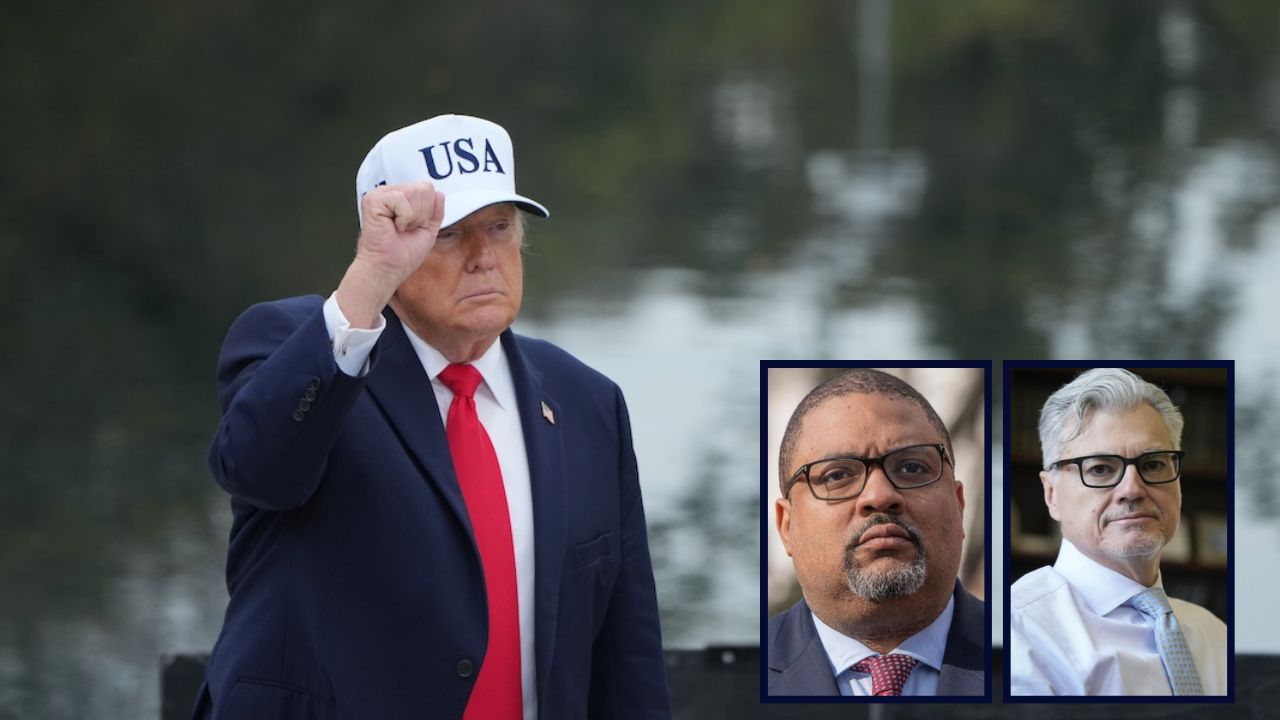

Main: President Donald Trump speaks before a crowd gathered at the Lincoln Memorial Reflecting Pool on Monday, Nov. 2, 2026, in Washington (AP Photo/Mark Schiefelbein). Left inset: Manhattan District Attorney Alvin Bragg attends an event where Senator Kirsten Gillibrand unveiled a report on illegal-gun arrests and seizures outside New York Police Headquarters on Dec. 4, 2023. (Photo by Lev Radin/Sipa USA)(Sipa via AP Images). Right inset: Judge Juan Merchan sits for a portrait in his New York chambers on Thursday, March 14, 2024. Merchan presided over Donald Trump’s hush-money trial (AP Photo/Seth Wenig).
President Donald Trump’s personal lawyer told a New York appellate panel Thursday that Trump’s convictions and sentence for falsifying business records should be overturned as a matter of law. Manhattan prosecutors countered that even if the trial judge improperly admitted evidence protected by presidential immunity, the mistake was harmless given the strength of the case.
Presiding Justice Troy Webber chaired the First Department panel of the New York Supreme Court’s Appellate Division. Justices Manuel J. Mendez, Martin Shulman, Bahaati Pitt-Burke and Shlomo S. Hagler also heard the arguments.
Attorney Robert Giuffra argued that Manhattan District Attorney Alvin Bragg, a Democrat, obtained Trump’s 34 convictions through a prosecution riddled with fundamental errors under both New York and federal law. He pointed to the Supreme Court’s presidential-immunity ruling in Trump v. United States and challenged the use of the Federal Election Campaign Act, or FECA, to elevate charges that otherwise would have remained misdemeanors.
Giuffra said FECA was central to the case, noting that Acting New York Supreme Court Justice Juan Merchan devoted extensive portions of his jury instructions to the legal requirements jurors were asked to consider.
“The district attorney relied upon New York Election Law 17-152, which is an obscure provision that’s only been used really for ballot fraud or people trying to intimidate people at the polling places,” Giuffra said. “What makes it a crime is the unlawful means, and at trial, the district attorney argued in summation that the payments to [Daniels and others] were all illegal FECA contributions in the context of the 2016 election.”
“The only thing that makes it an agreement, which is what we’re talking about here — conspiracy […] is you’ve got to do it through unlawful means, and the only unlawful means that the other side focused on a trial was FECA,” he added.
Several outside groups and legal scholars filed amicus curiae briefs backing different aspects of Trump’s appeal.
One filing by law professor Seth Barrett Tillman and the Landmark Legal Foundation argued that the jury instructions violated Trump’s Sixth Amendment right to a unanimous verdict, citing U.S. Supreme Court precedent.
Because prosecutors used an alleged election conspiracy to transform a misdemeanor into a felony, the brief maintained that jurors had to unanimously identify the particular “unlawful means” used. Instead, it said, prosecutors presented three separate and independent possibilities, leaving jurors free to reach a guilty verdict without agreeing on the same one.
A separate brief from law professor Jed Shugerman, which Giuffra cited several times, argued that Congress intended FECA to preempt state regulation of federal elections. Under that theory, the brief said, the state election-conspiracy charge used by Manhattan prosecutors was invalid from the outset.
Trump’s attorneys repeatedly returned to the jury instructions, arguing that the Constitution did not permit a conviction unless all jurors agreed on the specific unlawful conduct supporting the alleged conspiracy.
Giuffra also criticized Merchan for “barring” Trump’s FECA expert from testifying before the jury.
Webber noted that prosecutors characterized the hush-money payments arranged by Michael Cohen and former National Enquirer publisher David Pecker as efforts to avoid potentially damaging publicity before the 2016 election. The DA’s office, however, described the transactions as fundamentally “fraudulent transfers.”
“Your Honor, again, the key requirement is what was the unlawful act that is at the center of this,” Giuffra replied before shifting to the question of presidential immunity.
KEEP READING: Nate Silver Says He Suspects Trump Could Leave the White House Early
Steven Wu, chief of the Manhattan DA’s appellate division, spent much of his argument minimizing FECA’s role in the convictions.
“FECA’s scope is extremely narrow here,” Wu said.
Webber asked whether Wu agreed that FECA was used to elevate the misdemeanor charges.
“That’s correct,” Wu answered.
“What the state is concerned about is the broader integrity of the electoral process, and that’s what the election law focuses on,” he said. “The falsifying business records were done with the intent to conceal this underlying conspiracy here, which involved not just the FECA violations.”
Wu added that there was no federal preemption because the state was addressing other harms that fall within its traditional regulatory authority.
When Giuffra returned to the lectern, he concentrated on presidential immunity, an issue addressed by the Supreme Court in its landmark Trump v. United States decision about a month after Trump’s 2024 hush-money verdict.
The parties continue to dispute whether the ruling barred prosecutors from introducing certain trial evidence, including communications involving former Trump aide Hope Hicks and a statement Trump made about former Attorney General Jeff Sessions.
“When you introduce evidence that’s covered by presidential immunity, you can’t do that,” Giuffra said.
Wu responded that even if the evidence should have been excluded, its admission amounted to harmless error because the prosecution presented “overwhelming evidence” of Trump’s guilt.
“If we were to accept that this particular statement that involved Jeff Sessions maybe was subject to immunity, would harmless error apply?” Pitt-Burke asked.
“It would. It would absolutely apply here,” Wu replied. “It is true that there is a reference to the Attorney General here, but yes, but the purpose of this statement was not to establish the defendant had actually made that statement. It was instead to — and the judge gave the jury a very specific instruction on this conversation — it was instead to evaluate David Pecker’s and Michael Cohen’s credibility and their reactions, their reactions to the statement at a time when the defendant was pressuring them to stay quiet.”
“Immunity simply does not attach to that,” Wu continued. Even “assuming there was any error in admitting this evidence […] any error here would be harmless in light of the overwhelming evidence of the defendant’s guilt that they don’t challenge at all.”
The post ‘Manhattan DA says any presidential-immunity violation in Trump hush-money trial would be harmless error’ first appeared on Law & Crime.


