
New York health officials are advising residents not to eat venison after a deadly neurological disease was confirmed in a wild deer in the western part of the state.
The New York State Department of Environmental Conservation said Wednesday that chronic wasting disease (CWD) had been detected in a second adult white-tailed deer in Sparta, Livingston County, near Niagara Falls.
The animal was tested under the department’s mandatory CWD surveillance program, following the discovery of the first infected deer on November 6.
Officials said the latest positive test confirms that CWD is present in the area’s wild deer population.
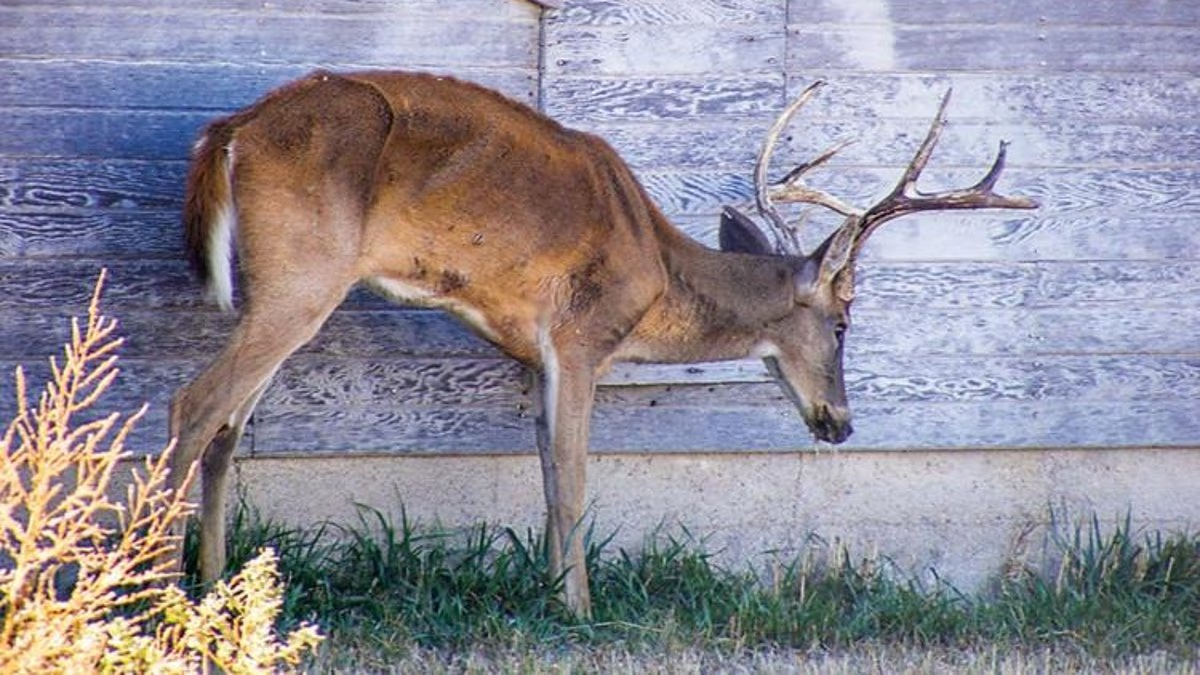
Often called “zombie deer disease,” CWD gradually destroys areas of the brain, causing infected animals to develop a sponge-like brain structure. Before dying, deer may drool, stumble and appear to stare blankly.
The disease is invariably fatal and can spread among deer, elk and other members of the deer family.
Although CWD has not been shown to spread from animals to people, the department urged residents not to eat meat from deer suspected of infection. Such meat may contain abnormally folded proteins known as prions, which scientists say could potentially pose a risk to humans.
No human case has ever been linked to CWD. However, prions can cause Creutzfeldt-Jakob disease (CJD), a rapidly progressive, dementia-like illness that is also fatal.

A deer showing symptoms of chronic wasting disease, a fatal condition that progressively damages the brain and can cause drooling, vacant staring and other abnormal behavior
Cooking or freezing does not destroy the infectious prions found in meat from a CWD-infected animal.
In early November, New York officials established a containment zone covering Conesus, Groveland, North Dansville, Sparta, Springwater and West Sparta.
The second infected deer was killed by a hunter in Sparta, inside the containment zone and south of where the first case was found.
Hunters who kill deer in the affected communities must submit the carcasses for CWD testing, officials said.
“The CDC recommends not consuming venison from any deer known to have CWD,” officials said.
“There is no evidence that CWD is linked to disease in humans or domestic livestock.”
Free testing is available for deer harvested in Ossian and Dansville in Livingston County and in Wayland, Steuben County. Deer taken in any community bordering the containment zone may also be tested at no cost.
The state is developing an online dashboard listing the number of deer tested and positive results by town. The site is expected to launch by early December. Officials also plan to provide local hunters with updates once deer hunting seasons conclude in early January.
Testing stations will operate from 8 a.m. to 8 p.m. between November 30 and December 13.
Head-collection bins will also be available for hunters who cannot reach a check station during its scheduled hours.
Results can take as long as two weeks. Hunters whose carcasses test positive will be notified directly.
Prions are proteins that have folded incorrectly. In animals with CWD, these abnormal proteins move through the central nervous system and accumulate in brain tissue and other organs.
There is currently no vaccine or treatment for the disease.

The map shows counties in the United States where chronic wasting disease has been detected in free-ranging deer and elk
CWD is highly contagious. When one animal in a herd tests positive, the wider group is generally treated as infected.
Scientists do not yet know precisely how the disease spreads, but transmission is believed to occur when animals consume food or water contaminated by infected feces or come into contact with carcasses.
Close contact may also play a role. Saliva, blood, urine and antler velvet shed during the annual antler cycle have all been identified as possible sources of transmission.
CWD has never been demonstrated to infect people, although some experts warn that the possibility warrants continued study.
A 2024 medical journal report described two hunters who died from CJD, another prion-related brain disease with a 100 percent fatality rate.
CJD, like CWD, is caused by misfolded prions and most often occurs sporadically. Researchers cautioned, however, that the two hunters may have been exposed by eating meat from infected deer.
“Although causation remains unproven, this cluster emphasizes the need for further investigation into the potential risks of consuming CWD-infected deer and its implications for public health,” the researchers wrote.
Studies indicate that CWD prions can bind to environmental materials, potentially changing their properties—including how infectious they are and whether they can affect additional animal species or humans.
According to the Centers for Disease Control and Prevention, CWD has been reported in animals across at least 35 states, four Canadian provinces and four other countries.
Warning signs in animals include severe weight loss, stumbling, drooling, lethargy, excessive thirst, lowered ears and an unusual lack of fear around people.
To limit the spread of CWD, New Yorkers who hunt deer, elk, moose or caribou outside the state should remove the bones before bringing the meat back to New York, officials said.
Hunters should also avoid deer urine lures and scents, which could contain infectious biological material, and should not feed wild deer.
Officials recommend disposing of carcasses in a landfill and reporting any deer that appears sick.


