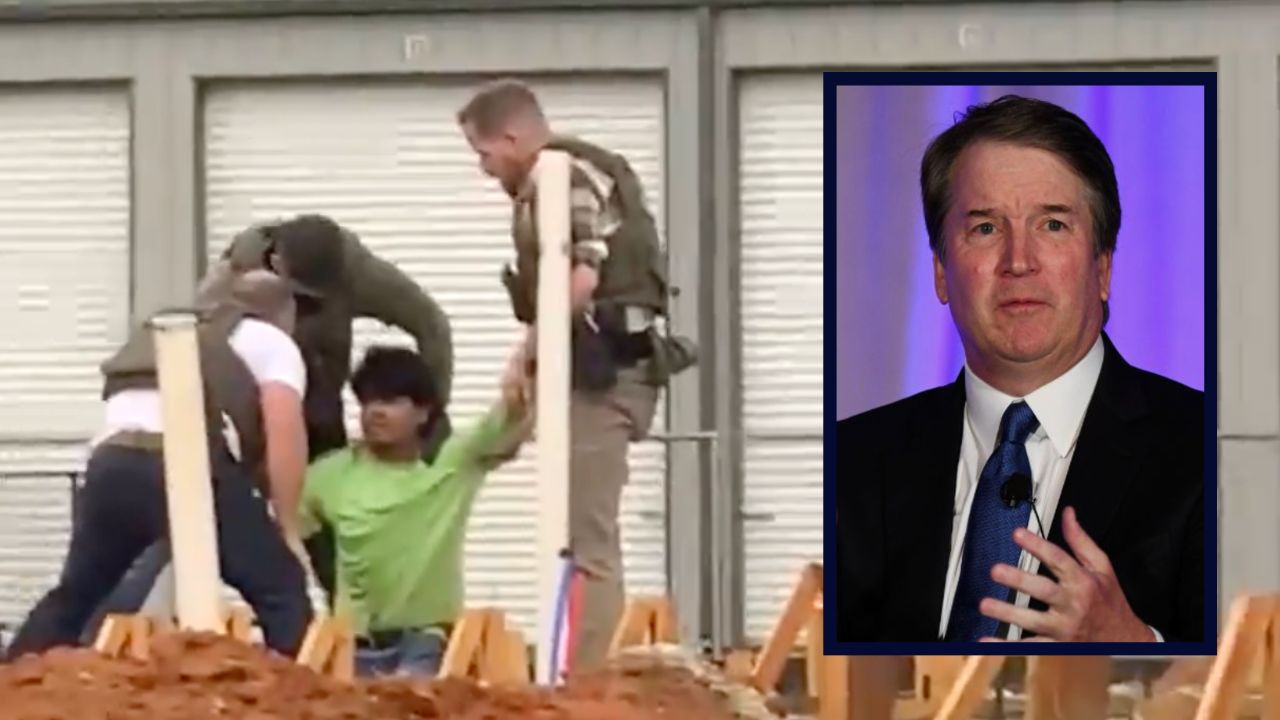

Main: Video recorded by another construction crew shows Leo Venegas being detained by immigration officers on May 21, 2025, as he says he is a U.S. citizen (Institute for Justice). Right inset: Justice Brett Kavanaugh speaks during a panel at the Eighth Circuit Court Judicial Conference on Thursday, July 31, 2025, in Kansas City, Missouri (AP Photo/Nick Ingram).
The chief judge of a federal court in Alabama said Monday that he was “not inclined” to accept the Trump administration’s “word for it” as he sided with a construction worker detained multiple times at job sites by immigration officers—even after he presented a REAL ID and repeatedly said, “I’m a citizen!”
The ruling arrives a little more than a year after Supreme Court Justice Brett Kavanaugh issued a shadow-docket stay in Noem v. Vasquez Perdomo. That decision allowed the administration to continue conducting roving immigration raids while minimizing concerns that the practice could lead to widespread abuse.
The government, Kavanaugh wrote, “sometimes makes brief investigative stops to check the immigration status of those who gather in locations where people are hired for day jobs; who work or appear to work in jobs such as construction, landscaping, agriculture, or car washes that often do not require paperwork and are therefore attractive to illegal immigrants; and who do not speak much if any English.”
Soon afterward, Drexel University School of Law Professor Anil Kalhan coined the phrase “Kavanaugh stop” for situations in which Department of Homeland Security agents assert “reasonable suspicion” and detain people based on factors such as perceived race or ethnicity, occupation, location, accent or limited English proficiency.
The phrase gained traction. Justice Sonia Sotomayor publicly criticized Kavanaugh—without naming him—as someone who “probably doesn’t really know any person who works by the hour.” Sotomayor apologized the following week for what she called “inappropriate” and “hurtful” comments.
Now, in an unexpected turn, the reasoning behind the “Kavanaugh stop” helped support the case of Leonardo Garcia Venegas, a 26-year-old Spanish-speaking construction worker from Baldwin County, Alabama. Venegas “has already been seized during two separate warrantless raids, on two different construction sites 20 miles apart, while doing his job,” despite possessing a REAL ID-compliant state identification card and being a U.S. citizen.
Chief U.S. District Judge Jeffrey Beaverstock, a Trump appointee presiding over the class-action lawsuit, noted that Kavanaugh had also written that “reasonable suspicion means only that immigration officers may briefly stop the individual and inquire about immigration status” and that “[i]f the person is a U.S. citizen or otherwise lawfully in the United States, that individual will be free to go after the brief encounter.”
That standard was not followed in Venegas’ case, Beaverstock concluded, because the agents refused to accept “a STAR ID that complies with the REAL ID Act” as sufficient proof.
“The record also reflects that Venegas was not promptly released following the production of his REAL ID to officers. Instead, the officers disregarded the veracity of his documentation and continued to detain him,” the judge wrote. “A policy that permits such action is likely to run afoul of the Fourth Amendment.”
Beaverstock also rejected the Department of Homeland Security’s explanation for a second stop on June 12, 2025. “The Court is simply not inclined to take the Government’s word for it,” he wrote. DHS acknowledged that it had no information about the detainer but nevertheless argued that agents had “reasonable suspicion” based on their training and experience.
The judge consequently issued a temporary stay blocking three DHS policies challenged in the lawsuit: a “Warrantless Entry Policy,” which would allow immigration officers to raid private construction sites without a warrant or consent; a “Preemptive Detention Policy,” allowing officers to detain employees without particularized suspicion that they were undocumented; and a “Continued Detention Policy,” permitting officers to keep holding workers after they produced evidence of citizenship or lawful presence.
On the continued-detention issue, Beaverstock said Kavanaugh’s concurrence “bolsters Plaintiff’s position with respect to this policy.”
“Again, the Government’s position that valid proof of citizenship such as a Real ID is not enough, undermines its position that it does not have a policy of continued detainer of individuals after a valid proof of citizenship has been produced,” the judge added in a footnote.
The Institute for Justice, which represents Venegas, released a statement from him after the ruling took immediate effect.
“For the first time in a long time, I will be able to go to work without worrying that I will be arrested for no reason,” Venegas said. “Americans cannot be stopped and held by law enforcement when they are doing nothing wrong.”
The post Chief judge says “Kavanaugh stop” opinion helps construction worker detained on the job with REAL ID, won’t take Trump administration’s “word for it” first appeared on Law & Crime.