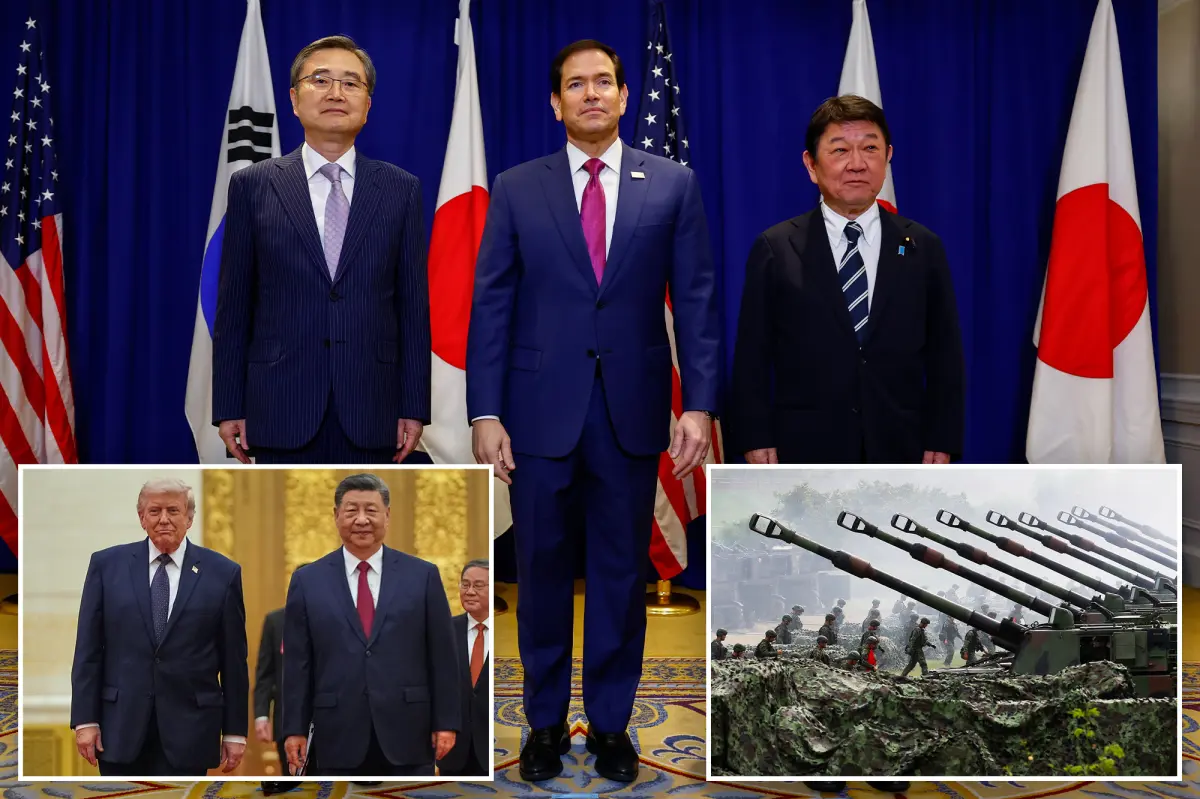
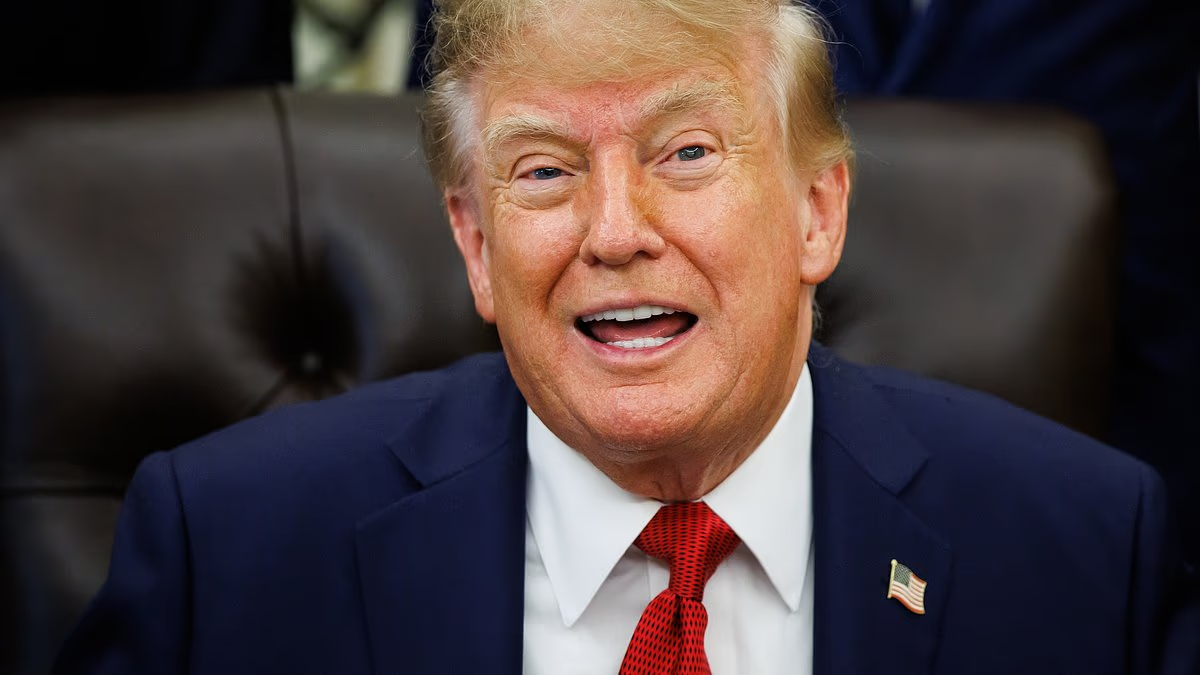
The United States on Monday reaffirmed its commitment to defending key Asian allies Japan and South Korea, while all three countries voiced support for Taiwan ahead of this week’s summit between US President Donald Trump and Chinese President Xi Jinping.
Analysts say Washington’s allies are concerned that Trump could offer Beijing concessions on Taiwan or trade in exchange for an economic breakthrough when he welcomes Xi to the White House in Washington on Thursday.
Officials said Japanese Prime Minister Sanae Takaichi and South Korean President Lee Jae Myung are both hoping to meet Trump during the United Nations General Assembly in New York, where the three leaders are scheduled to speak on Tuesday.
US Secretary of State Marco Rubio held talks in New York on Monday with South Korean Foreign Minister Cho Hyun and Japan’s Foreign Minister Toshimitsu Motegi.
In a joint statement, the three ministers pledged to stand firm, in an apparent reference to China, against “economic coercion and non-market policies and practices” as well as “arbitrary export restrictions that disrupt supply chains.”
They also welcomed the creation of a new trilateral consultation mechanism focused on economic security, part of wider efforts to reinforce supply chains and deepen cooperation on critical technologies.
‘IRONCLAD COMMITMENTS’
The statement said the United States had “reiterated its ironclad commitments to the defense of Japan and the ROK, backed by America’s unmatched military strength, including its nuclear capabilities, and reaffirmed its extended deterrence commitments to Japan and the ROK.” ROK is the abbreviation for the Republic of Korea, South Korea’s official name.
The ministers also underscored their commitment to strong security cooperation and stressed the importance of preserving peace and stability across the Taiwan Strait.
The statement further “expressed support for Taiwan’s meaningful participation in appropriate international organizations.”
Taiwan’s government welcomed the remarks.
In a statement, Taiwan’s foreign ministry said the renewed public backing from the three countries for peace and stability demonstrated that security across the strait had become a “strong consensus of the international community.”
On North Korea, the ministers “reaffirmed their resolute commitment to the complete denuclearization of the Democratic People’s Republic of Korea” and urged Pyongyang to return to dialogue.
Beyond concerns over Taiwan, the democratically governed island claimed by China, analysts said Japan and South Korea would closely examine any trade agreements emerging from the Trump-Xi summit, particularly their potential effect on the two allies’ competitiveness with China.
They warned that even a limited easing of trade barriers for Beijing could weaken the economic position of both countries.
Takaichi angered Beijing last year by saying Japan could be pulled into a conflict involving Taiwan. Meanwhile, Seoul and Washington have been working out details of South Korea’s $350 billion investment package in the United States under a trade agreement reached by the allies last year.
On Monday, a South Korean opposition lawmaker called for parliamentary scrutiny of the investment package, cautioning that negotiations on energy projects could expose South Korea to an outsized share of the financial risks.