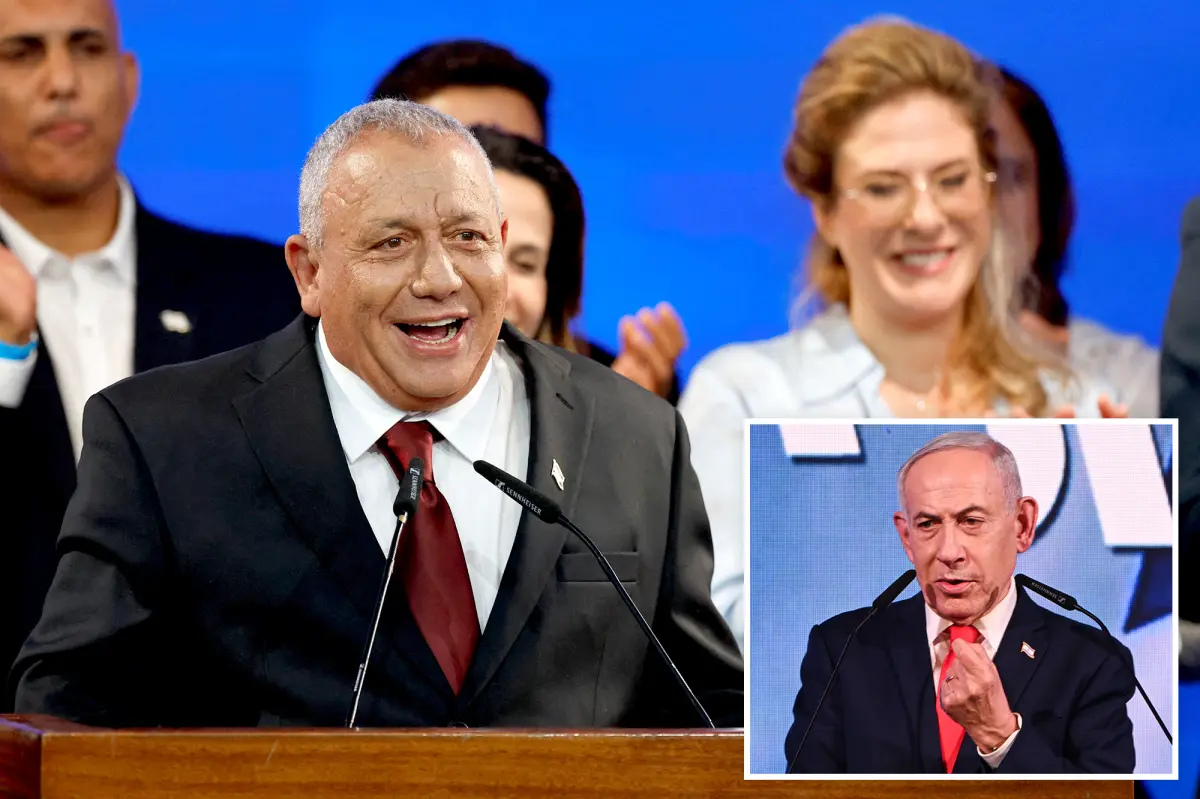

Israel’s president on Saturday tapped Gadi Eisenkot, Prime Minister Benjamin Netanyahu’s most formidable political rival, to attempt to form a government after an inconclusive election left neither leader with a clear route to power.
Netanyahu, Israel’s longest-serving prime minister, is seeking to remain in office after his religious-nationalist bloc lost its parliamentary majority in the October 27 vote. Even so, it remained the largest political force in the Knesset.
Eisenkot, a former military chief, has ruled out joining forces with Arab parties, whose backing could provide him with enough seats to command a majority. Arab leaders, angered by what they describe as racist policies pursued by Netanyahu and his far-right allies, nonetheless endorsed Eisenkot first, giving him the largest number of recommendations.
“President Herzog has invited Gadi Eisenkot to the President’s Residence, where he will be tasked with forming the government tomorrow,” a spokesperson for President Isaac Herzog said. Although the presidency is largely ceremonial, Herzog is responsible for selecting a candidate to build a governing coalition after elections.
In a post on X, Eisenkot said: “Now is the time to form a national emergency government. I will do everything I can to ensure we are worthy.”
Eisenkot faces uphill battle to form a government
Eisenkot’s nomination is expected to trigger weeks of difficult coalition negotiations. He has 28 days to assemble a government, with the possibility of receiving an additional 14-day extension.
His options include seeking Arab party support for a minority government, reaching an agreement with ultra-Orthodox parties that he and his allies have previously rejected, or attempting to establish a unity government with Netanyahu.
Political analysts regard all three scenarios as unlikely. If Eisenkot fails, another candidate may be given the opportunity to form a government. Should that effort also collapse, the Knesset can nominate a third candidate. The process has a deadline of roughly 100 days; if no candidate succeeds, Israel will hold another election.
DISCOVER MORE: Inside Charles and Anne Lindbergh’s Secretly Turbulent Marriage
Likud secured the largest number of seats for any individual party, winning 27 of the Knesset’s 120 seats. Netanyahu’s broader religious-nationalist alliance, however, captured only 53 seats, leaving it five short of the 61 needed for a majority.
Eisenkot’s Yashar party finished second with 21 seats. His coalition, made up of four Jewish-led parties ranging from the center-left to the right, won 48 seats altogether. Two parties representing Israel’s Arab minority claimed a combined 19 seats, an unprecedented result.
Eisenkot takes tough stance on settler violence
The 66-year-old Eisenkot, whose parents immigrated from Morocco, would become Israel’s first prime minister from the Mizrahi community, whose members trace their heritage to the Middle East and North Africa.
Known as reserved and reluctant to court the media, Eisenkot entered politics only in 2022. He briefly joined Netanyahu’s wartime cabinet after Hamas attacked Israel on October 7, 2023, but later returned to the opposition.
From the opposition benches, he repeatedly criticized Netanyahu’s leadership, including his handling of the military campaign in Gaza. Eisenkot has also pledged not to serve in a government led by Netanyahu.
His political reputation is closely tied to the personal losses his family has endured since 2023. One of his sons and two nephews were killed while fighting in Gaza.
During the election campaign, Eisenkot emphasized his national security credentials and pointed to his “Dahiyeh doctrine,” which calls for a disproportionate response to attacks. He applied the approach as a commander during Israel’s 2006 war against Iran-backed Hezbollah in Lebanon.
Eisenkot has condemned settler violence against Palestinians, which has increased sharply since 2023 and strained Israel’s relationships with Western countries. He also opposes Netanyahu’s far-right coalition partners, Itamar Ben-Gvir and Bezalel Smotrich, both of whom have faced sanctions from some Western governments over alleged incitement of violence against Palestinians.


