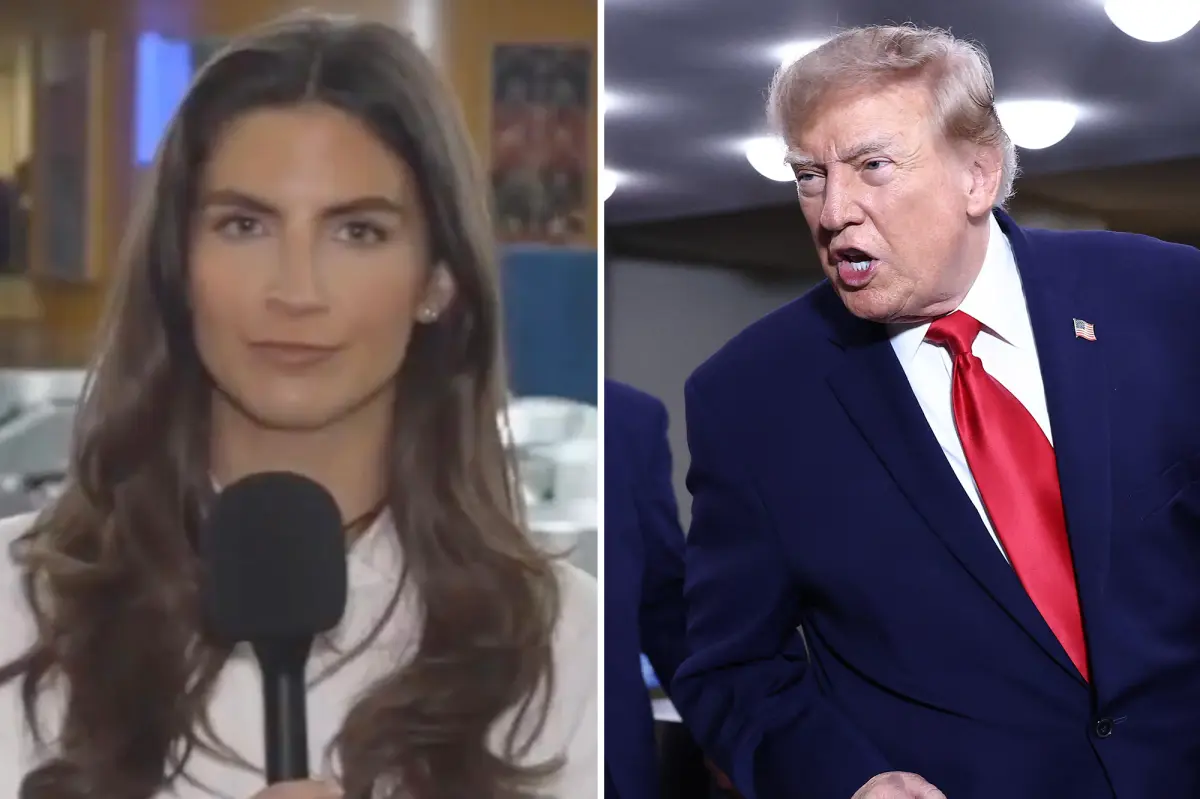
On a day of intense diplomacy at the United Nations, President Donald Trump opened his visit by telling a prominent American journalist, “You should not be here.”
“It’s an honor to be here,” Trump said Tuesday as he walked through the U.N. doors before addressing the General Assembly. There, he encountered CNN’s Kaitlan Collins, a frequent target of his criticism. “I’m surprised that CNN is here covering me,” he said. “You should not be here covering me. You said you weren’t going to cover me.”
Collins later explained on CNN that the network had never made such a pledge. Days earlier, the administration had barred CNN, MS NOW and Politico from the White House grounds and removed CNN from the media pool. However, the network was admitted to the United Nations as regularly credentialed press.
The exchange underscored how quickly the already bitter dispute between Trump and news organizations he dismisses as “fake news” has intensified.
The media ban became the focus of a joint lawsuit filed Monday by the three outlets, which asked a judge to declare the administration’s action unconstitutional. The White House was required to respond by Tuesday, while a hearing is set for Wednesday afternoon.
Trump says he has a right to ‘clean out fake news’
Later Tuesday, Trump stood by his comments and argued that unfavorable coverage posed a danger to the country.
Asked whether he would restore the outlets’ access if the court ruled against the White House, Trump replied, “Well, it probably will, because this is a judge who’s not a particularly fair judge.” He was referring to U.S. District Judge Timothy Kelly, whom Trump appointed in 2017. Kelly ordered a CNN reporter’s access restored in a similar case in 2018.
“So you never know,” Trump continued. “I think we have a right to clean out fake news.”
Trump’s remarks echoed statements he has made since announcing the ban Friday. He has complained about “purposely negative stories,” but has not identified specific reports, instead broadly citing what he calls “fake news” as the reason for the restrictions.
The ban and lawsuit represent the latest chapter in Trump’s long-running conflict with media organizations whose coverage he dislikes, particularly during his second term. The president has challenged outlets in court and pursued regulatory action, while also attacking individual journalists in person and on social media. His criticism of CNN’s Collins has at times become intensely personal, including most recently during a speech at the White House Correspondents’ Association dinner.
After her exchange with Trump, Collins said on air, “We never said we were not going to cover the president. We will do our best to cover him each and every day.”
Networks began the day without pool coverage
Tuesday’s White House press schedule also drew attention for what it left out: It did not include the U.S. network pool, breaking with the usual practice.
CNN had been assigned as the pool network for Trump’s trip to New York under a rotating schedule that distributes coverage of certain presidential events among the five major networks. The ban removed CNN from that role.
The other pool members agreed not to take CNN’s place and, in a show of solidarity, suspended all pool coverage until further notice. Other news organizations joined the response. The Associated Press, along with outlets including The Washington Post and The New York Times, chose not to publish photographs from presidential events Monday.
How long the media ban and the collective action by news organizations will last remains unclear.
Despite the restrictions, global audiences still saw plenty of Trump during his speeches and meetings Tuesday. UNTV, the United Nations’ official broadcast service, carried the events, while pool journalists covering other world leaders provided additional footage.
A sign posted in a White House workspace also expressed support for the affected outlets: “I stand with AP, CNN, MS NOW, Politico.”
For audiences, the long-term impact may be more serious, analyst says
One longtime television analyst predicted that limiting the nonstop coverage Trump values could ultimately hurt the president, potentially giving both sides a reason to end the standoff.
“This ban is not going to go on forever because he doesn’t want that to happen, anymore than anybody else,” said Robert Thompson, director of Syracuse University’s Bleier Center for Television and Popular Culture.
In the near term, however, Thompson said viewers are unlikely to experience a lasting effect. As he noted, audiences now have numerous ways to follow the news beyond traditional television network coverage.
“We are not going to be deprived of important civic information,” Thompson said, as might have happened years ago when outlets and options were fewer.
On the other hand, if viewers were interested in what Trump said as he inaugurated a helipad at the White House on Monday, they were out of luck: The sound of Trump’s whirring, waiting helicopter drowned out his remarks. TV network crews usually work to capture clearer audio.
On a deeper level, Thompson said, news consumers will be impacted in a more serious way. He called out Trump’s remarks labeling negative media coverage “dangerous” as troubling.
“These casual remarks, not even disguised, about what we always considered basic freedoms of the press … that, I think, is a lot more serious,” he said.