


A24
RATING: 8 / 10
A performer portraying a real person does not necessarily need to reproduce every physical detail or vocal mannerism. Jamie Foxx’s uncanny transformation into Ray Charles is one approach; Michael Fassbender’s turn as Steve Jobs is another. Fassbender neither looked nor sounded exactly like Jobs, but he conveyed the impression of the man as he exists in the public imagination. Robert Pattinson takes a similarly unconventional route with Chris Hansen in Lance Oppenheim’s Primetime. Pattinson has clearly worked hard on Hansen’s voice, yet the result feels deliberately strange. That may be because this is not a conventional biographical drama—or, strictly speaking, a biopic at all.
Primetime operates as both a bleak psychological thriller and a merciless dark comedy about the cultural meaning of Chris Hansen. Its focus is less the real man than the larger-than-life figure who has occupied the public consciousness for two decades, ever since NBC’s To Catch a Predator reached its peak. The movie is not a definitive account of the program, either. Viewers seeking a factual history of the show and its imitators may be better served by David Osit’s documentary Predators.
Instead, Primetime examines the legacy of To Catch a Predator and the way its influence continues to shape true-crime creators, amateur investigators and online personalities who pursue their own unofficial forms of justice. The result is a disturbing, often mordantly funny exploration of where journalism ends and entertainment begins—and how easily justice can become exploitation.
Primetime is an over-the-top dramatization
A24
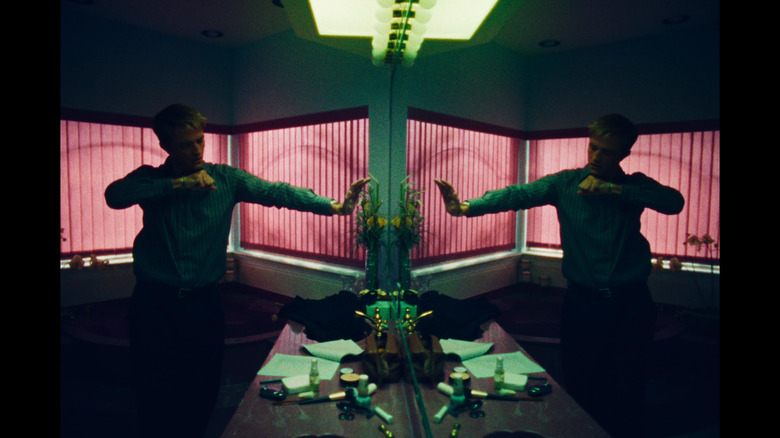
Chris Hansen, played by Robert Pattinson, is first introduced in front of a mirror, practicing dialogue taken from predator chat logs. In Pattinson’s performance, the grotesque innuendo and calculated grooming language are stretched into something theatrical, as if he is rehearsing a monologue designed to maximize public disgrace. He does not resemble a reporter preparing for a serious interview so much as an actor getting ready to go onstage. Yet when someone later asks whether the bracelet on his wrist is an acting talisman, Hansen reacts with wounded indignation and insists that there is no performance involved in what he does.
That contradiction fuels much of Primetime. The screenplay draws on the Esquire article that inspired it, but its Hansen is also the distorted, meme-like version that has taken shape in popular culture. The story unfolds as the network pushes To Catch a Predator into prime time to compete with ABC’s hit series Lost. What began as a news project intended to expose predators and promote online child safety must now become bigger, louder and more sensational. Behind the thin language of public service, Hansen and his colleagues are performers chasing the most shocking footage they can capture—and that appetite ultimately threatens to destroy them.
As the show’s host and public face, Hansen is recognized wherever he goes. He enjoys the celebrity, even as his private life falls apart and his strained family circumstances begin to jeopardize the production. Oppenheim and Pattinson have described the performance as a collision between Tom Cruise in Jerry Maguire and Dracula, but Hansen also recalls a darker variation on another Pattinson character: Batman. His everyday persona has the desperate charm of Bruce Wayne’s public mask, while the figure who emerges on camera is closer to a predatory vampire feeding on the spectacle of vigilante justice. At one memorable point, Pattinson’s voice even edges into his familiar Batman register.
If Hansen is the film’s Batman, then Decoy Dan, played by Skyler Gisondo, serves as his Robin. An aspiring actor, Dan accepts a role as an on-camera decoy and soon finds himself subjected to repeated psychological distress, unwanted exposure and other forms of trauma. Merritt Wever’s Andie, Hansen’s consistently sharp producer, functions as an Alfred figure—quietly keeping the entire operation alive despite receiving little recognition. The comparisons are intentionally overextended, and both supporting characters are substantially fictionalized, but they capture the heightened, morally warped universe that Primetime creates.
Oppenheim brings us back to 2006

A24
After directing the Max documentary Ren Faire, Lance Oppenheim makes an impressive move into narrative filmmaking. Reuniting with cinematographer David Bolen, he recreates the early 2000s through a blend of period-accurate technology and deliberately subjective filmmaking. The movie shifts among the era’s various video formats, while dramatic staging, saturated colors and carefully composed images push the story into a more emotional and manipulative reality. Some of the film’s strongest passages move between the control room, where the program is assembled, and the heightened experience of watching the confrontations unfold on screen.
Hansen argues that the public once gathered to stone evil people in town squares, and that television has inherited the same role. He appears to believe that his work is both righteous and necessary, but he handles the television screen like a guillotine. The people on the receiving end are not literally executed; Hansen suggests that what he does to them may be even more damaging. His certainty gives the film an especially unsettling portrait of a man who sees humiliation as a form of heroism.
Primetime clearly wants audiences to recognize their own participation in this appetite for televised punishment. The irony is that the film is also irresistibly entertaining, even as it dissects Hansen, his program and the viewers who made it a phenomenon. The laughter it provokes feels less accidental than confrontational. Oppenheim’s connection to Nathan Fielder—who is collaborating with him on the upcoming Elizabeth Holmes project You Can See Everything—makes sense, given the film’s uneasy blend of sincerity, absurdity and social experimentation. The tone suggests what might happen if Fielder directed a collision between Dan Gilroy’s Nightcrawler and Billy Wilder’s Ace in the Hole.
Still, the film’s critique is softened by the sheer pleasure it takes in its pulpy thrills and pitch-black humor. The audience is implicated in the sensationalism surrounding Hansen, but the filmmakers themselves seem to be enjoying the provocation just as much. That tension—between condemnation and entertainment—is precisely what makes Primetime so difficult, and so compelling, to look away from.
Primetime opens in theaters on September 25.


