
Albo’s no-show
Anthony Albanese has finally found a sporting event he was willing to miss. The Prime Minister did not attend Saturday’s AFL grand final, explaining that he had only returned from overseas that morning. The match, however, was played in the afternoon.
For a politician rarely reluctant to embrace cameras, sporting crowds or corporate hospitality, the timing was strikingly convenient.
That is particularly true given that his taxpayer-funded Commonwealth aircraft has a bedroom and ensuite, offering Albanese plenty of time to freshen up before seeing his favourite pop star — and watching the footy.
Kylie Minogue was scheduled to provide the pre-game entertainment. That, arguably, was the real explanation for Albanese’s absence.
She was, after all, the same Kylie Minogue he brought into a controversial podcast discussion about which woman he would like to ‘shag’. An internationally successful Australian became the subject of remarks that appeared to reduce a remarkable career to an adolescent sexual joke.
The same podcast also featured Albanese discussing the melons presented to him by Japan’s first female prime minister, accompanied by hand gestures mimicking breasts.
The irony is difficult to miss: the overseas trip that gave Albanese a reason to skip the AFL grand final also involved him accepting an award recognising him as a good ‘global citizen’.

In July, Prime Minister Anthony Albanese said he would ‘shag’ Kylie Minogue during an interview on the Bush Deep podcast

The controversy helps explain why he stayed away from the AFL grand final. Kylie Minogue is pictured performing before Saturday afternoon’s Fremantle-Brisbane match

Albanese returned to Australia on Saturday after attending the United Nations General Assembly in New York, where he accepted an award recognising him as a good ‘global citizen’
It is worth imagining the television coverage his attendance could have generated.
If Albanese had applauded Minogue enthusiastically, footage of his reaction would almost certainly have revived the podcast comments. If he had attended the match but stayed away during her performance, perhaps watching from behind the frosted glass of a corporate box while eating canapés, reporters could have asked why he appeared to snub the pre-game show.
By missing the event altogether, he avoided both lines of questioning.
An education for the Opposition
The Opposition has recently outlined plans to change the way Australian children are educated. It wants greater emphasis on history, but before the Coalition focuses on teaching the nation’s past, it may need to confront aspects of its own record in government.
Shadow education spokesman Julian Leeser has promised to rewrite the national curriculum, strengthen classroom discipline, reduce screen time and place more emphasis on the foundations of Western culture.
Some of those proposals have clear appeal. But before the debate becomes another argument over flags and national identity, the Coalition faces a more fundamental question: what did it do while it was in office?
The Liberal-National Coalition held federal government for almost nine years between 2013 and 2022. Before that period, and after the Rudd-Gillard governments’ six years in office, John Howard was prime minister for nearly 12 years.

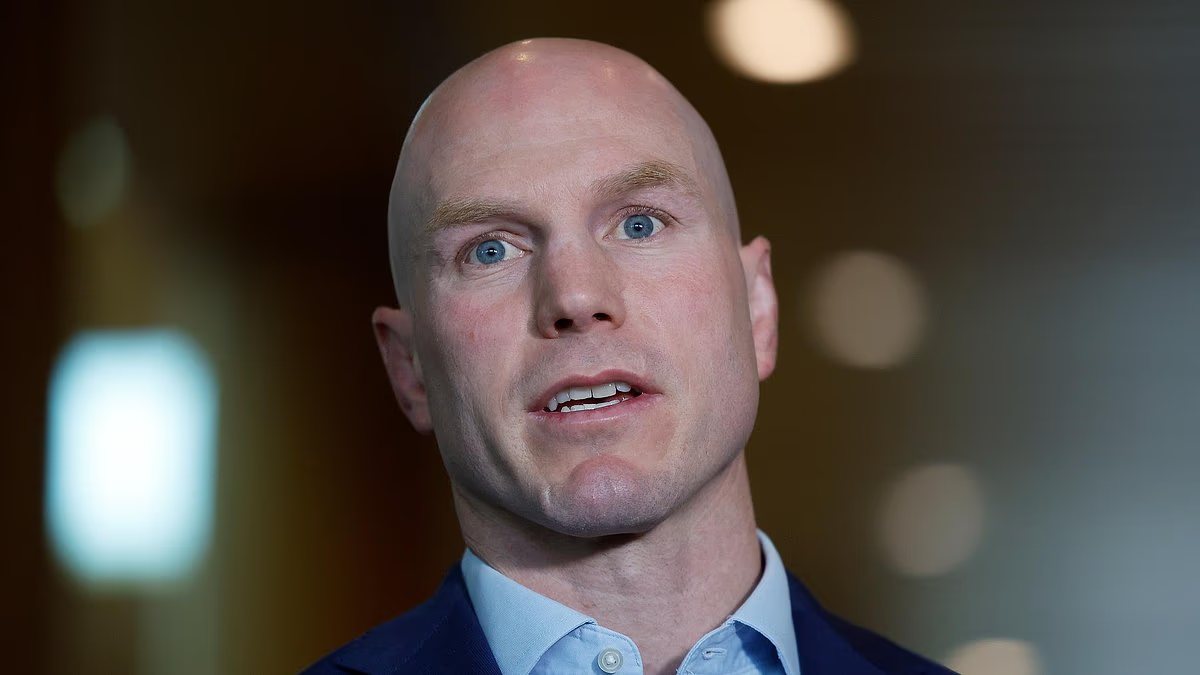
Shadow education spokesman Julian Leeser is promising to rewrite the national curriculum, strengthen classroom discipline, reduce screen time and put greater emphasis on the foundations of Western culture
I am no mathematical savant, but roughly 20 years in government during the 26 years before Albanese’s election represents a substantial opportunity to shape Australia’s education system. If the system is now failing, the Coalition must also ask whether it squandered that opportunity.
The Liberals and Nationals have hardly been powerless outsiders over the past quarter-century. They have held significant influence over Australia’s direction — which is also why their current struggles against One Nation are so politically significant.
They’ve had many chances.
Yet listen to the latest diagnosis of what’s wrong within our schools, and you could imagine the Coalition had spent its time peering helplessly through the school gates.
Leeser describes declining academic performance, disengaged boys, disrupted classrooms and teacher shortages, despite ever-increasing expenditure. These are serious concerns to be sure. But describing them as longstanding failures makes the Coalition’s own record the real issue here.
Children who began primary school when Tony Abbott became PM in 2013 were in secondary school by the time Scott Morrison lost office in 2022. For much of their education, the federal government belonged to the party now offering to rescue them from the poor results.
IN CASE YOU MISSED IT: Jeffrey Archer and Wife Mary Open Up About Their Marriage
Ironic, isn’t it? It gets richer when you realise Leeser spent much of his pre-parliamentary career advising the federal Liberal Party on policy – first as an adviser within the Howard government, before heading up the Liberal Party’s official think tank, The Menzies Research Centre. During that time he produced precisely zero policy proposals on how to improve teaching within our schools.
I don’t object to a political party developing better policies. Opposition is supposed to be a period of reflection and renewal. What I object to is renewal without the reflection: the implication that identifying an enduring problem somehow absolves you of responsibility for having presided over it in the first place.
To be fair to Leeser, that’s far from entirely on him personally. But it’s certainly a Coalition failure given their time in office this millennium versus Labor.
As education minister, Christopher Pyne commissioned a national curriculum review in 2014. Arguments about balance, educational basics and Australia’s cultural inheritance were already familiar then. This isn’t new territory for the Coalition.
More awkwardly, education ministers endorsed version nine of the Australian Curriculum on April 1, 2022. Morrison was still prime minister at the time. His government approved the revised framework the Coalition is now railing against just weeks before losing the election.
Was it inadequate? Were the reforms badly implemented? Or has the diagnosis changed, and if so, why?
Any of those answers would be more useful than another promise to just start again.
There is an obvious qualification here too. State and territory governments run public schools, and the Commonwealth can’t simply dictate everything that happens in a classroom. National curriculum changes require negotiations between the Commonwealth and the states.
But federalism is a condition of governing Australia, not an excuse that expires when a party enters opposition. Leeser knows that, because as head of the MRC he did produce research on fixing the federation.
The constitutional arrangements haven’t suddenly become more accommodating because the Liberals desperately need another policy announcement. Which is why the Liberal government Malcolm Turnbull led shouldn’t have junked the tax and federation white papers.
That was our moment to reform sectors like education, but it was lost, on the Coalition’s watch.
Nor should scrutiny of the Coalition’s woeful record be used as an excuse to dismiss the substance of Leeser’s proposals out of hand.
Teachers deserve support in maintaining orderly classrooms. Students can’t learn effectively amid persistent disruptions. Making it easier for capable graduates and experienced professionals to enter teaching is worth examining, provided competence is maintained, of course.
So is whether schools are using screens because they improve learning or because technology has become a substitute for thinking about teaching.
There is also a legitimate debate about curriculum overload. Removing Indigenous history, sustainability and engagement with Asia as cross-curriculum priorities isn’t necessarily the same as removing those subjects from education. Leeser explicitly proposes retaining Indigenous history in dedicated topics.
That distinction deserves an honest hearing. Students should learn about Indigenous Australia, the British inheritance and the country’s multicultural development. Arguing about how to organise that teaching is not, of itself, an assault on any of these areas.
Other elements of what the Coalition want to do warrant more scepticism. A flag doesn’t teach a child to read. Veterans may make excellent teachers, but military service is no substitute for teaching ability, and classroom management requires more than an appreciation of delivering discipline.
Which brings us back to the missing explanation as to why we should believe that the Coalition can deliver now what it so comprehensively failed to deliver previously.
With Pauline Hanson challenging the established parties, the Liberals are trying to convince disillusioned voters that they have rediscovered their convictions. National pride, Western culture and discipline all fit rather neatly into that effort.
But there is a reason voters currently prefer an insurgent party to an established one promising to do, next time, what it should have done last time. The established party has a record against which its assurances can be tested, and it’s not a good one.
Labor shouldn’t mistake this for vindication either, by the way. Its own ministers must answer for educational outcomes and the effectiveness of their reforms. The Coalition’s failures don’t make the existing system satisfactory.
After all, Labor has already been in power for four and a half years since Albo was first elected. Enough time to start fixing the mess in Australian education that it inherited.
Instead, it just keeps getting worse.