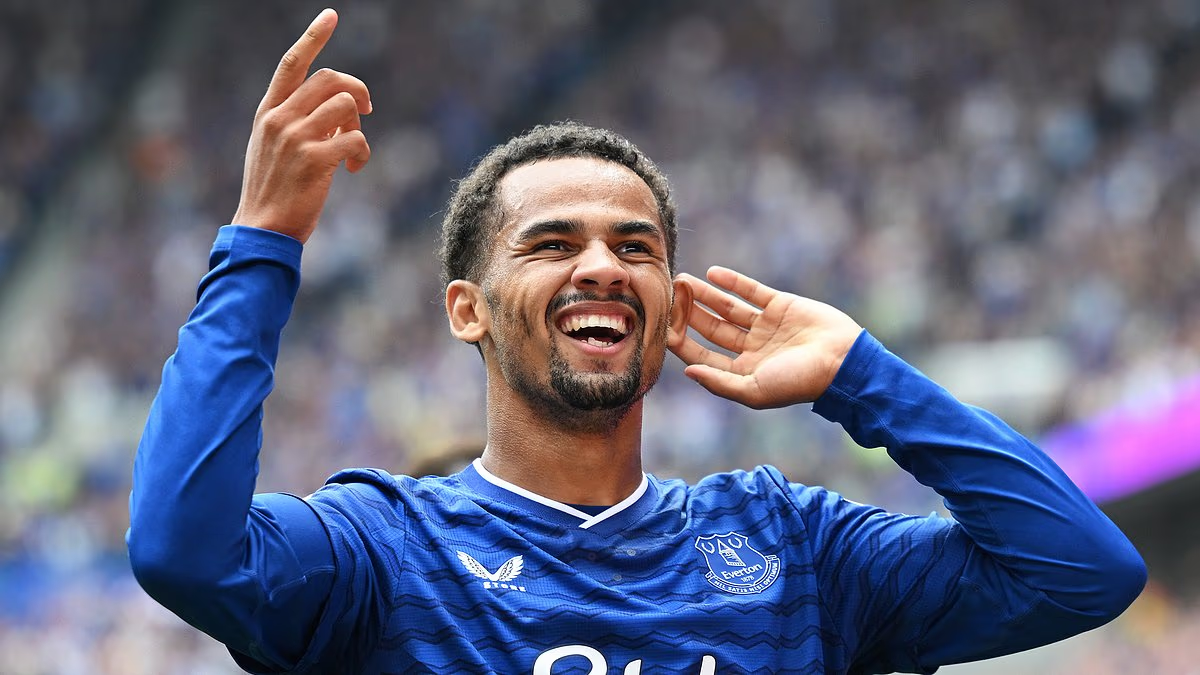

After missing out on Cody Gakpo and settling the bill for Tottenham’s Italian transfer summit, Roberto De Zerbi quickly turned his attention to a new target: Iliman Ndiaye.
The Tottenham manager was keen to stress that, ‘for once’, he was not the one demanding a late burst of recruitment to finish assembling his squad before the transfer deadline.
According to De Zerbi, Spurs’ owners and chief executive Vinai Venkatesham were eager to continue strengthening the team, while sporting director Johan Lange had arrived at the meeting with several ‘ideas to make solutions’.
During the discussion over spaghetti, Everton winger Ndiaye emerged as a realistic option. His next move was expected to become one of the major deadline-day storylines, although Manchester City are now poised to sign him after Liverpool reconsidered their willingness to sell Gakpo.
Ndiaye, 26, is entering his prime. He has already demonstrated his ability in the Premier League and, despite representing Senegal internationally after being born in France, could potentially qualify for one of the eight homegrown places in a 25-man squad.
His natural ability is beyond dispute. Ndiaye possesses outstanding technique, close control and an unusual dribbling style that he credits to childhood exercises created by his father and carried out to music.

Iliman Ndiaye is blessed with extraordinary natural ability, combining outstanding technique with a distinctive dribbling style he developed through childhood exercises devised by his father.

Tottenham had been moving towards a deal for the Everton winger, but Ndiaye has now chosen Manchester City and the Etihad Stadium over a move to north London.
‘His shoulders move from side to side, almost like he is dancing,’ recalled Jack Lester, who was Sheffield United’s head of player development and is now part of the Brentford coaching staff. ‘He can glide beyond defenders and beat them with his upper-body movement. Those are qualities you cannot teach.’
His character has also rarely been questioned. Lester described him as ‘a lovely lad, always smiling’ and a popular figure, while praising his bravery, physical strength and determination. ‘He is strong on the ball and difficult to play against,’ he added.
The main uncertainty is whether Ndiaye can consistently impose himself on matches while maintaining the tactical discipline demanded by top Premier League sides. Since breaking into Sheffield United’s team at 21, when he was still raw and had received relatively little coaching, he has worked hard to develop that side of his game.
His two seasons at Everton have helped turn him into a more complete Premier League player. A switch to Tottenham would have presented another step up, bringing stronger competition for a starting place, the pressure of a major transfer and the challenge of helping revive the club while proving he belongs among the elite.
De Zerbi regularly speaks of having a particular understanding of creative players, including wide forwards and No 10s, because he played in those roles himself. However, he also demands end product. Effort and energy alone are not enough without goals and assists.
When Savio arrived from Manchester City, the Spurs manager challenged him to improve his scoring return and aim for 10 to 12 goals a season, a figure De Zerbi considers typical of the world’s leading wingers.
Ndiaye has reached double figures in a top-flight season only once. In his first campaign with Everton, he scored 11 times in 37 appearances in all competitions, including nine Premier League goals. His total fell to six last season. During one season at Marseille, he managed four goals in 46 games before joining Everton for £17million after De Zerbi arrived at the French club in 2024.
Tottenham viewed Ndiaye mainly as a left-sided attacker who could move straight into their starting XI, a level of certainty he is unlikely to receive at Manchester City given the competition from players such as Jeremy Doku.
His versatility allows him to operate on either flank or behind the striker, but Spurs would have wanted him primarily on the left. Son Heung-min remains a difficult player to replace, while Mathys Tel has yet to consistently deliver. Savio can also play either side but is more comfortable on the right, alongside Mohammed Kudus and Dejan Kulusevski. Wilson Odobert, a left-sided option, and Xavi Simons, who has looked most effective for Spurs as a No 10, are both recovering from serious knee injuries and are not expected back until next year.
Although the transfer now appears unlikely, Ndiaye’s arrival would have allowed De Zerbi to build an entirely new attacking trio, with Ndiaye and Savio flanking Omar Marmoush. None of those players were at Tottenham when the season began with a disappointing 3-0 defeat by Brentford.

Ndiaye scored four goals in 46 appearances during his season at Marseille before joining Everton for £17million after De Zerbi took charge at the Stade Velodrome in 2024.

Omar Marmoush started ahead of Dominic Solanke as Tottenham’s centre forward against Newcastle on Saturday, but tactical flexibility will be crucial as Spurs continue searching for their best attacking formula.

New £85m signing Savio is comfortable on either flank but would prefer to play on the right – as would Mohammed Kudus and Dejan Kulusevski
Although Marmoush got the nod at centre forward ahead of Dominic Solanke against Newcastle on Saturday, flexibility will matter as Spurs trial-and-error their way to the best formula. All coaches value those who can operate in more than one position. Since taking control in April, De Zerbi has been committed to a 4-2-3-1 shape.
Ndiaye, Kudus and James Maddison might expect to challenge to start at No 10 but so far this season Spurs have reinforced midfield with Conor Gallagher or Mateus Fernandes in that role. Until they are stronger at the back and settled into a rhythm, it would be a surprise to see De Zerbi trade this ball-winning power for greater creativity.
For one thing, the play-making No 10 has become increasingly rare in the Premier League. More often they have come to be valued more for changing a game from the bench or starting when the opposition can be relied upon to sit deep and surrender possession.
See Eberechi Eze’s limited opportunities at Arsenal or Florian Wirtz’s struggles at Liverpool. See Rayan Cherki fight for a starting place at Manchester City. Those who regularly include a playmaker might do it as part of a front three not a front four. See Cole Palmer at Chelsea. Bruno Fernandes has been Manchester United’s best player for years but the best place to play him in their changing systems has often been a contentious issue.
Spurs will face a similar puzzle when Maddison, Kudus and Kulusevski are ready to start, but De Zerbi won’t care about that. He will just long for a day when he has all the options at his disposal and can find the best combinations.