
I’ve spent nearly a quarter of my life pregnant.
Across six consecutive pregnancies in eight years, I became a mother of two and served as a surrogate three times.
Every pregnancy has brought its own mix of joy and difficulty, but surrogacy carries a unique kind of anxiety. You’re not simply carrying a baby; you’re carrying someone’s hopes of expanding their family.
I first began exploring surrogacy soon after my daughter Aria was born in 2019.
At the time, I was 30 and living in San Diego, California. My grandmother suggested egg donation, but that wasn’t right for me. Because my first pregnancy had been so positive, I started considering other ways to help women who struggled to conceive.
Surrogacy offered a way to support my own family financially while helping another family achieve its dream of having a child.
The nerves surrounding my first surrogacy were intensified during my second journey in 2021, when I learned that Chrissy Teigen and John Legend had chosen me to help them welcome another child—less than a year after the couple lost Baby Jack at 20 weeks of pregnancy.
Following their loss, Chrissy and John began searching for a surrogate. After viewing my profile, they decided they wanted to meet me.

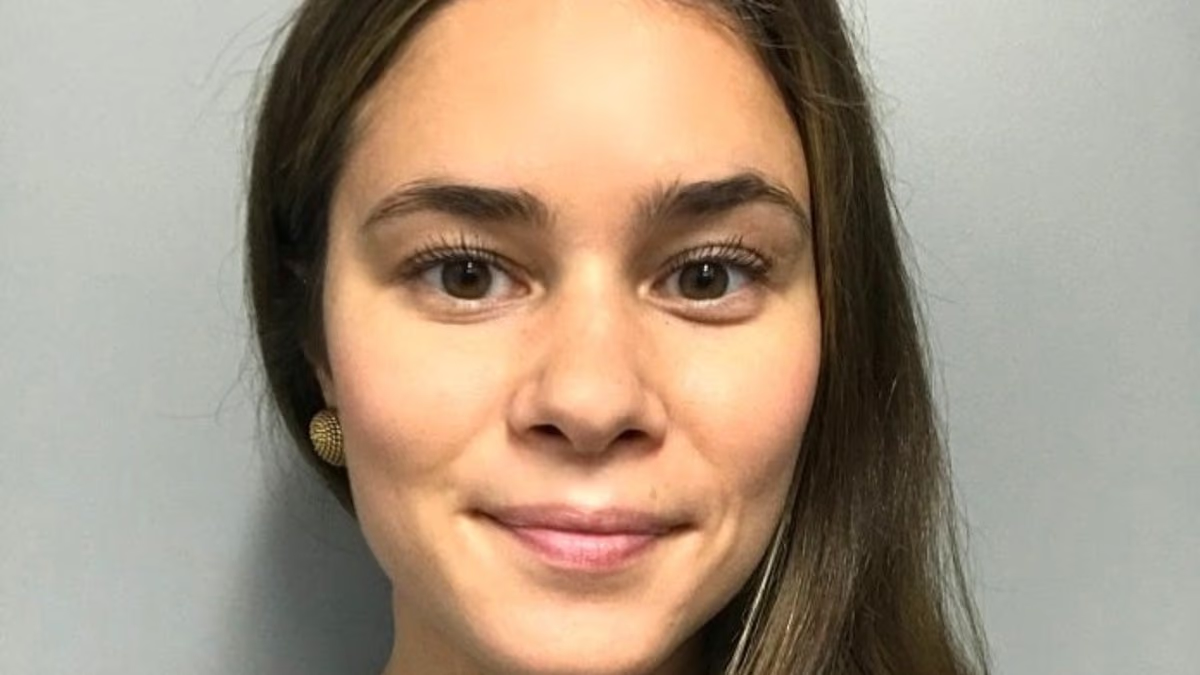
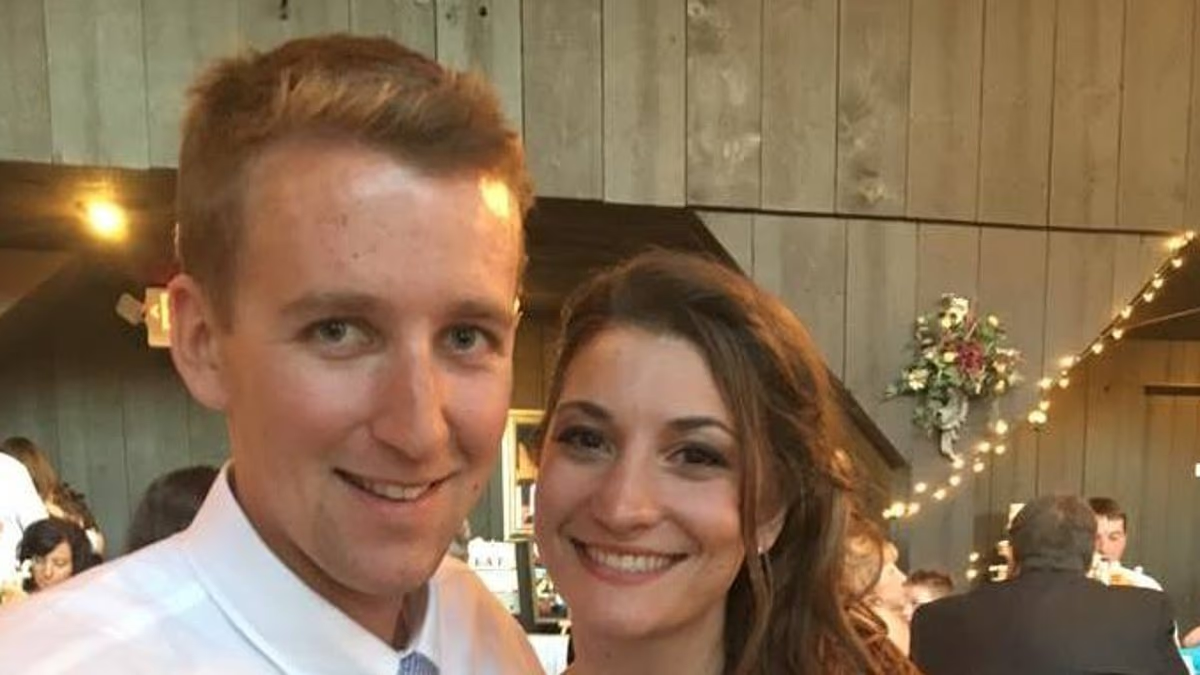
Alexandra Ryan experienced six consecutive pregnancies over eight years, becoming a mother of two and a three-time surrogate—once for Chrissy Teigen and John Legend

Alexandra’s first pregnancy with her daughter Aria, pictured here, was so straightforward that she began exploring surrogacy to help other families have children
I was excited, nervous and hopeful when I met Chrissy and John. Although I felt starstruck, I knew I had to look beyond their fame as a Sports Illustrated model and a Grammy-winning singer. They were, above all, two people hoping to have a baby after enduring a very public loss.
Once we agreed to proceed, I felt thrilled and confident that I could give them something meaningful. The journey ultimately proved both humbling and challenging.
Chrissy, John and I matched only a few months after I had delivered my first surrogate baby. That earlier experience, carrying a baby girl for two fathers in Seattle, Washington, had been unexpectedly easy.
At first, I assumed qualifying as a surrogate would be relatively simple. My first pregnancy and delivery had been free of complications, and I thought that would be enough. But when I began researching agencies, I discovered a long list of medical, financial and environmental requirements.
An ideal candidate must have carried a baby to term without complications, meet an income threshold and fall within a specified body mass index range. Agencies also assess a surrogate’s family and home to ensure she has both psychological and physical support from the people and environment around her.
After extensive online research, I applied to a well-regarded surrogacy agency in California.
My application was approved quickly, and I soon attended an in-person consultation. The agency reviewed my background, medical history and preferences regarding the family I hoped to carry for. Matching is deeply personal and depends on everyone feeling comfortable with one another.
Age, surprisingly, is not as decisive as many people might expect.
I started my surrogacy journey at 30, making me relatively older than many candidates. I was 32 when I matched with Chrissy and John. Although pregnancy can become more challenging with age, it is less of a concern for gestational carriers because they do not contribute their own genetic material. I was surprised to learn that some agencies accept surrogates into their early 40s.
The agency confirmed my information by reviewing my medical records, evaluating my home and conducting background checks on both me and my then-fiancé.
Once cleared, the agency shared my profile with intended parents looking for a gestational carrier. Higher-profile couples, like Chrissy and John, use third-party matching services that search for a specific surrogate across different agencies, and that’s how they found me.
After a medical screening confirmed that I’d be physically capable of carrying a pregnancy, I moved onto the legal portion of the process – the step that takes the longest.
Although each surrogacy contract is individualized, they generally address many of the same details. They specify the number of attempts for an embryo transfer and payment details, including insurance coverage, reimbursements for medical fees and stipends for maternity clothes and prenatal massages. Payments are generally paid out in monthly installments after a fetal heartbeat is confirmed.
Once the contracts were signed, I began taking in vitro fertilization medications and prepping my body for the embryo transfer.
With Chrissy and John, I had my first embryo transfer in November 2021. Despite multiple positive pregnancy tests, my first ultrasound revealed that there was no baby growing in the gestational sac. Because the pregnancy was not progressing, I would have to miscarry.

Chrissy and John began the search for a surrogate after losing Baby Jack 20 weeks into Chrissy’s pregnancy

Alexandra began her surrogacy journey at 30, matching with Chrissy and John when she was 32. Meeting Chrissy and John for the first time, she was excited, nervous and hopeful
Miscarriages are already horrible and traumatic on their own. Miscarrying someone else’s child – no matter who they are – is a whole other level of sadness and anxiety. It was a lot of pressure, and I was battling my own body, frustrated that it was not doing what it was supposed to do. I wanted so badly to give John and Chrissy a healthy baby and yet, for reasons out of my control, things weren’t going the way we had anticipated.
Getting my body ready to undergo a second embryo transfer was also a much longer process than I could ever have anticipated. I had to undergo approximately seven procedures – including hysteroscopies, polyp removals and scar tissue treatment – before I was finally cleared for another transfer.
I was worried John and Chrissy would find another surrogate who could deliver their baby without any hiccups. Why wouldn’t they? Knowing who they were, I figured they could essentially pick anybody.
But they were so patient with me: loving, caring and gentle. They never tried to rush me or make it feel like I was at fault. I felt supported and given the space I needed to process what had happened. It made everything that much easier.
Luckily, in October 2022, the second embryo transfer worked.
And there was more news to celebrate. Earlier that year, Chrissy also found out that she was pregnant.
The babies – the one Chrissy was carrying and the one I was carrying – would only be six months apart.
She and John had waited until she was three months along before they shared the news with me. It was incredibly considerate given everything we had already experienced.
Chrissy and I were only pregnant together for a short period of time, but I loved it. It was such a unique and special part of the journey to know we were both carrying babies who would grow up together.
Throughout my pregnancy, I commuted to doctor’s appointments in Los Angeles from my home in San Diego. Chrissy and John couldn’t always accompany me given their busy schedules, but I took videos after every ultrasound to make sure they felt as involved as possible.
Before the baby was born, I relocated to LA to be in closer proximity to their hospital and doctor. On June 19, 2023, I went into labor.
I initially wanted Chrissy to help deliver the baby, but some unexpected complications prevented that from happening. Still, she and John got to be in the room when I gave birth. I’ll never forget watching them meet Wren Alexander Stephens, who they named after me, for the first time.

Chrissy and John were in the room with Alexandra when she delivered their baby

The couple named the baby Wren Alexander Stephens – his middle name in honor of his surrogate, Alexandra
For me, seeing my intended parents look into the eyes of their newborn is the most fulfilling part of surrogacy. It’s the reason I’ve gone through the journey three times. It’s what makes it all worth it.
A lot of people don’t understand that surrogacy is a commitment. It’s a lot of countless doctor’s appointments and IVF appointments, it’s embryo transfers and potential pregnancy loss, it’s recovery, and then more transfers – all while being a mom and a partner and working full time. Surrogacy is so much more than simply being pregnant for nine months, though this part isn’t insignificant. It can take years from the time you match with the intended parents and the time you deliver the baby. There is so much that happens before anyone ever sees a positive pregnancy test.
The journey with Chrissy and John took two years.
But it was worth every minute.
Chrissy and John always treated me as part of their family. Even though I’ve since moved to Texas and no longer live locally, I love being able to watch Wren grow and live his beautiful life through the updates and photos his parents send me. There’s something special in knowing that I got to play a small part in helping create the family and life he has today.
As told to Katherine Fung