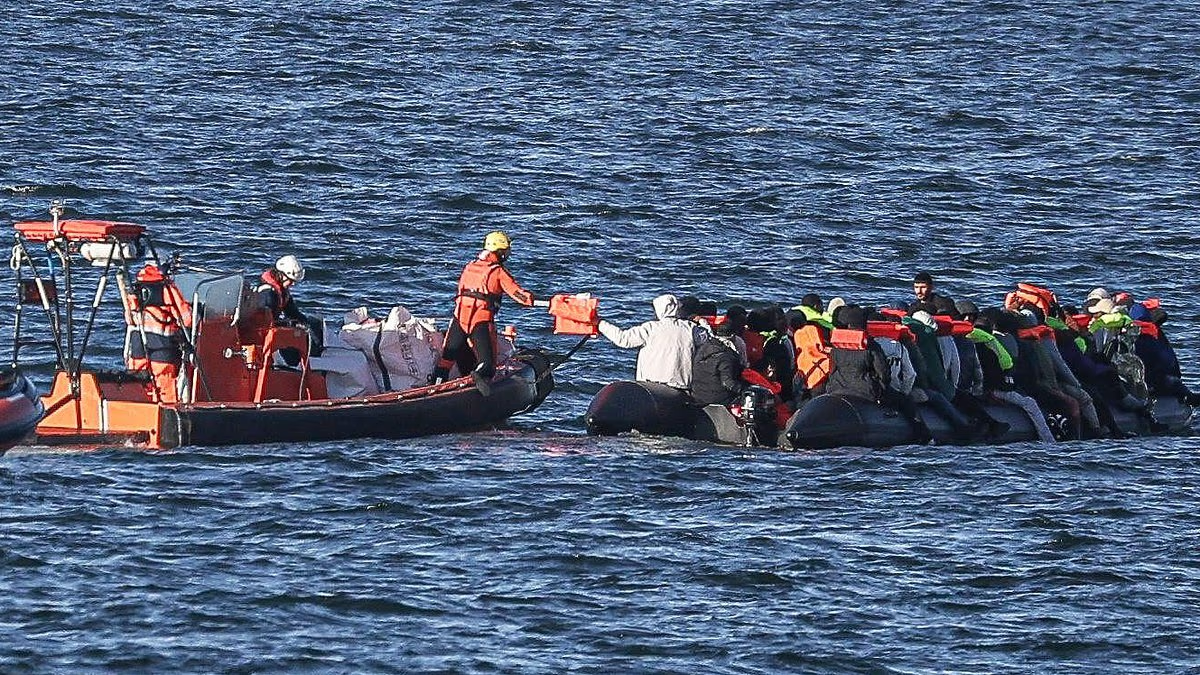

A photograph appears to show French maritime crews assisting a migrant boat before it embarked on an arduous journey from Normandy to England last week.
Members of the French sea-rescue service SNSM, the country’s equivalent of the RNLI, are seen providing lifejackets while remaining on standby in case anyone fell into the water.
The exclusive image captures the boat near the shoreline before it began the crossing, described as possibly the longest migrant Channel journey from France to England on record.
The journey began last Monday morning, when around 50 people ran onto the beach and boarded a boat allegedly operated by people smugglers at Port-en-Bessin, in central Normandy.
Acting with the approval of France’s Ministry of the Sea and local coastguard authorities, SNSM volunteers surrounded the boat and provided assistance. They reportedly remained alongside it for 38 miles.
The vessel followed the coastline to the resort of Varaville, where additional migrants were waiting to board at what authorities believe may have been a pre-arranged stopping point.
While French maritime authorities continued to monitor the operation, 15 more people attempted or managed to climb aboard after wading into the sea without being stopped.
A local mayor offered accommodation in a community hall to the more than 60 migrants then on board, but the boat was permitted to continue its journey.

The photograph appears to show French crews assisting a migrant boat before it began a 36-hour journey from the Normandy coast to England last week.

Migrants are seen receiving lifejackets from SNSM volunteers, France’s equivalent of the RNLI, while rescue crews remain nearby.

People watch the boat at Port-en-Bessin in central Normandy. Up to 50 people ran onto the beach and boarded the vessel last Monday morning.
“The hospitality was refused by the migrants because they wanted to go only to England and leave France,” police said later.
The crowded boat was then allowed to resume its passage. Still accompanied by sea-rescue crews, it headed towards the French Navy patrol vessel Abeille Liberté, which shadowed the boat on its route to England before withdrawing once the migrants reached British waters, 12 miles from the south coast.
UK Border Force personnel then transferred the migrants to one of its own vessels and initially set course for Gosport, near Portsmouth, on the Hampshire coast. The vessel changed direction after anti-migration protesters threatened to demonstrate at the port.
The Border Force cutter instead diverted east and docked at Dover Harbour on Tuesday evening, bringing the entire journey to 36 hours.
The reported French assistance came just four days after a press conference on the Normandy coast, where local officials claimed they were intensifying efforts to stop a fresh rise in migrant Channel crossings from the region.
The event, held in the coastal hamlet of Senneville-sur-Fécamp, took place in a dry ravine that migrants had recently used to reach the beach and waiting boats.
Officials said British funding from the £662 million, three-year Sandhurst treaty—renewed last April—would pay for additional gendarmes to patrol the beaches, as well as drones and other surveillance technology intended to combat unauthorised migrant crossings.
READ MORE: Democratic Duo Sparks Speculation Over 2028 Presidential Ticket
France has recently indicated that it wants the Sandhurst funding, which is due to run until 2029, increased to £1 billion.

Migrants and Red Cross workers are pictured at a shelter in the Port of Le Havre last Monday.

Coastal ravines, like the one at Senneville-sur-Fécamp (pictured) ‘are an ideal spot for smugglers,’ explained Isabelle Bonamy, head of the Border Police for the Normandy area

A table and chairs are seen at a migrant camp in the Port of Cherbourg, along with an Afghanistan flag
Sébastien Huyghe, the chairman of a French parliamentary commission into Channel agreements, said that if the small boats crisis continued, France could demand an increase of 40 per cent.
He maintained Britain bore a significant responsibility for the current free-for-all because it was so attractive to migrants (who are given benefits and housing, with few deported).
According to French research a third of migrants who illegally enter the EU are heading for England.
Coastal ravines, like the one at Senneville-sur-Fécamp, ‘are an ideal spot for smugglers’, explained Isabelle Bonamy, head of the Border Police for the Normandy area last week. She said there are 40 of the routes along the coast.
‘We aren’t dealing with the sandy beaches of the French north that stretch as far as the eye can seen. Monitoring these ravines is very complicated.’
Smuggling gangs guide the migrants to the ravine paths posing as hikers or by private taxi. The vast majority are sub-Saharan African, particularly Sudanese, while the gangs organising the launches are Syrian Kurds.
General Éric Delain, commander of the Normandy gendarmerie region, explained: ‘A few months ago we discovered an engine and a deflated inflatable boat in a private garden.
‘It was an unoccupied holiday home; this shows that unscrupulous smugglers do not hesitate to stash equipment on private property to facilitate departures later on.’
Our News Outlet last week found a new tall fence around the railway station at Abbeville, an inland Normandy town nine miles from the coast and thought to be the migrants’ gateway to Normandy.
It was erected by the local council a fortnight ago to stop migrants camping at the back of the station after coming in on trains from Paris, Calais and Dunkirk to await rides, by bus, taxi or vans, to the Normandy beaches via the ravine paths.
‘They come every week,’ said a married couple who live in a neat house by the station. ‘We see them all the time. Look at the rubbish they leave in the hedgerows before they go to the beaches.’
But whatever the French posturing, the question is whether Paris is really keeping its side of a very expensive bargain with the British to ‘stop the boats’.
Our telling picture taken on the Normandy coast on Monday suggests the opposite is the reality.