
I first realised just how extensive my hair loss had become while spending a summer evening on the beach with my family.
We were on Denmark’s west coast, watching a spectacular sunset spill across the ocean. As you would expect, we took a group selfie, holding the camera high with the horizon behind us. But when I looked at the picture, I barely noticed our happy faces. My attention went straight to the top of my head, where my scalp was glaringly visible.
Hair loss is often described as one of men’s biggest fears. The beach photograph was taken in 2016, when I was only 23, yet I looked at least a decade older.
As a teenager, I played guitar in a band and wore my hair down to my shoulders. I never imagined that I might not always have a full head of hair. My father was thinning on top, but he was in his 60s—several decades older than I was.
It is a common misconception that your hair-loss future can be predicted from DNA alone. Genetics certainly play a part, but having parents with thick, healthy hair does not guarantee that you will avoid thinning.
By the age of 20, I was the first person in my friendship group to notice my hair getting thinner. I felt deeply embarrassed. Surely I was far too young for this? The change undermined my confidence and self-image, and hair loss soon began to dominate my thoughts.
When I began university in Copenhagen at 20, the problem was already advanced. My hairline was visibly receding and the crown was becoming increasingly thin. I struggled to find a hairstyle that looked right. My friends and I joked that hair loss would eventually catch up with all of us, but beneath the humour I sensed their pity and concern. I inevitably looked older than they did.

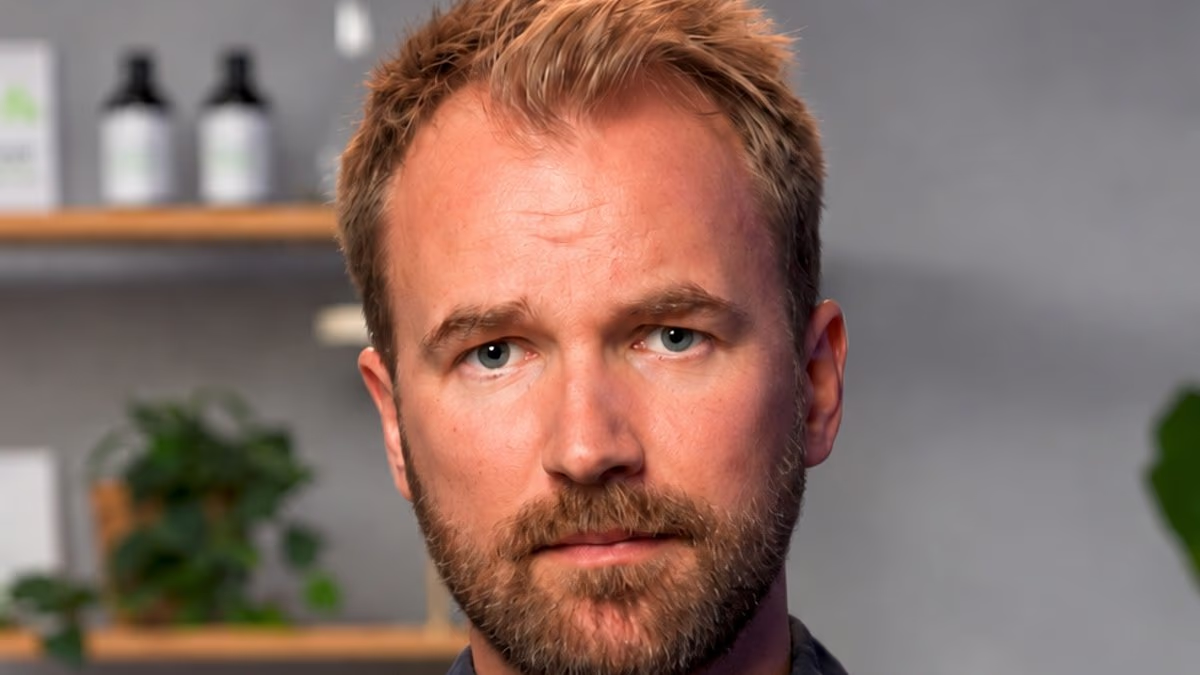
Losing his hair was one of Niels Konradi’s biggest fears, and the experience shattered his confidence and self-image

Taking control of his appearance proved to be a complete game-changer
I became intensely self-conscious. I would laugh along when people asked, ‘Are you sure about your age?’ or joked that it was ‘time to go to Turkey?’, a reference to the many hair-transplant clinics there. But the comments still hurt.
My wife, who was my girlfriend at the time, is a model, and I often attended fashion shows with her. I would invariably wear a hat to conceal my thinning hair.
I began noticing that people looked at my hairline rather than meeting my eyes when they spoke to me. My insecurity intensified. Then I saw the beach photograph and knew I had to take action.
But what could I do? Although friends teased me about it, I could not afford a transplant on a student budget, and I did not want to take medication. Treatments such as minoxidil and finasteride carry potential side effects, which concerned me—particularly the risks associated with finasteride, including depression and erectile dysfunction.
By then, I was almost bald on top. I tried trimming the remaining hair very short to create a more even appearance, but I disliked the result and knew other people noticed how uncomfortable I felt about it.
In recent years, there has been greater discussion of female hair loss and its emotional consequences, while people often assume men will simply accept it. For me, coping with hair loss was extremely difficult.
My girlfriend was incredibly supportive. We had met when we were 16, so she had also known me with long, thick hair. She reassured me that she loved me just as much without it. She even said the buzz cut gave me a sexy, bad-boy look, although I certainly did not feel sexy.
With no obvious ‘cure’ in sight, I decided to regain control in the only way I could: I shaved off the rest of my hair and went completely bald.
At first, the decision felt liberating. I was choosing what happened to my appearance rather than allowing hair loss to dictate it. What I had not anticipated was the reaction from other people.
I am almost 6ft 6in tall and fairly broad, and the new look dramatically altered people’s first impressions of me. Some friends and relatives barely recognised me, while I could sense that strangers found me intimidating.
I was working for a financial consulting firm by then, and I realised that many people considered me frightening. That troubled me greatly because, in reality, I am a very warm person.
I was even given coaching at work on how to deal with it, and told that the last thing I should do in a negotiation was raise my voice since people would panic because I looked so menacing.
Then I was refused entry to a nightclub where my sister was holding her birthday party. The bouncer, assuming I was some sort of thug, told me I couldn’t come in as they didn’t want any trouble.
It was all very disheartening. Not only did I feel self-conscious about my lack of hair, but I was having to check my personality all the time to counteract other people’s impressions.
Being a very outgoing person, it was stressful and exhausting to be on my guard like that.
EXPLORE MORE: Racing Prodigy, 24, Recounts the Crash That Killed His Dad
By then I didn’t feel quite so alone, however – more and more of my male friends began having the same hair-thinning issue. And it wasn’t just men.
My mother was in her mid-50s and going through menopause, and she lost pretty much all her healthy, thick hair in a very short amount of time.
It had a big impact on her. She’s a very open-minded and social person, but all of a sudden she found she didn’t really want to leave the house and started wearing all sorts of hats and wigs.
When she went to the doctor about it, she was told ‘hair loss is normal at your age’, which didn’t make her feel any better. She spent lots of money on different supplements, but none of them worked.
So many people suffer the same debilitating condition. You might argue that there are plenty of worse things to worry about than hair loss, but medical surveys show it has a serious impact on people’s mental health.
One study showed that 78 per cent of women suffering from thinning experience persistent feelings of shame, acute anxiety or depression, while a survey of men under 35 with male pattern hair loss found that 41 per cent would rather lose their sight than go bald.

Niels and his wife on their wedding day… she was glad I had my hair back for the photos
I carried on researching and looking into alternative options to help me regain control (and my hair).
And then in 2017, a friend introduced me to a team of scientists and researchers who were developing a plant-based solution to hair loss using biotechnology.
I was sceptical at first but as I delved further, I realised they weren’t using your average natural ingredients.
These were advanced, high-performance, lab-developed ingredients with clinical evidence behind them, such as Capilia Longa, a potent form of turmeric that helps reset disrupted hair-growth cycles.
I told them I wanted to help and we worked to create a product that we believed could help people.
I was my own guinea pig. I started using the serum we developed daily and after five or six months, was able to book myself in for a haircut – my first in five years.
I left my day job and co-founded Scandinavian Biolabs, which we launched in 2020. That product – our Bio-Pilixin Activation Serum (£49 for 100ml, boots.com) – became our hero product. It’s powered by stem-cell technology: you apply it to the scalp via a pipette and gently massage it in.
Being in command of what my hair looks like was a complete game-changer for me. That’s why I’m here every day, trying to improve life for women like my mum and men like me. I saw hair growth, increased density and my hair regained its strength where the follicles were still ‘alive’.
On that note, it’s important to say that this is not a magic potion – it won’t work in every case and, in fact, as you can see in my own hair, the areas in which the follicles are dead are still bald.
Most hair loss begins when follicles get stuck in shortened growth phases, producing weaker, thinner hair before eventually shutting down. If you don’t treat them, they eventually reach a point of no return.
But these days I’m content with the hair I have – it’s hard to overstate the impact that thicker, fuller hair has had on my confidence.
And though my wife never minded about my hair issues, she was glad I had hair again in our wedding photos.
My mum also started using the products and has never stopped; she now enjoys her beautiful, thick, healthy hair again. These days it’s grey but we haven’t created any solutions for that yet!
Our brand is now sold in 100 countries – this year we launched into more than 300 Boots stores in the UK – and I’m very proud of our success.
Every day, however, we still hear from people who don’t want to leave the house because they’re embarrassed about their hair. These are the people I always wanted to help. Believe me, hair loss can wreck your life – but you can take back control.
As told to Edwina Ings-Chambers
Scandinavian Biolabs products are available to buy at Boots stores nationwide and online at boots.com, Scandinavianbiolabs.co.uk, @scandinavianbiolabsco