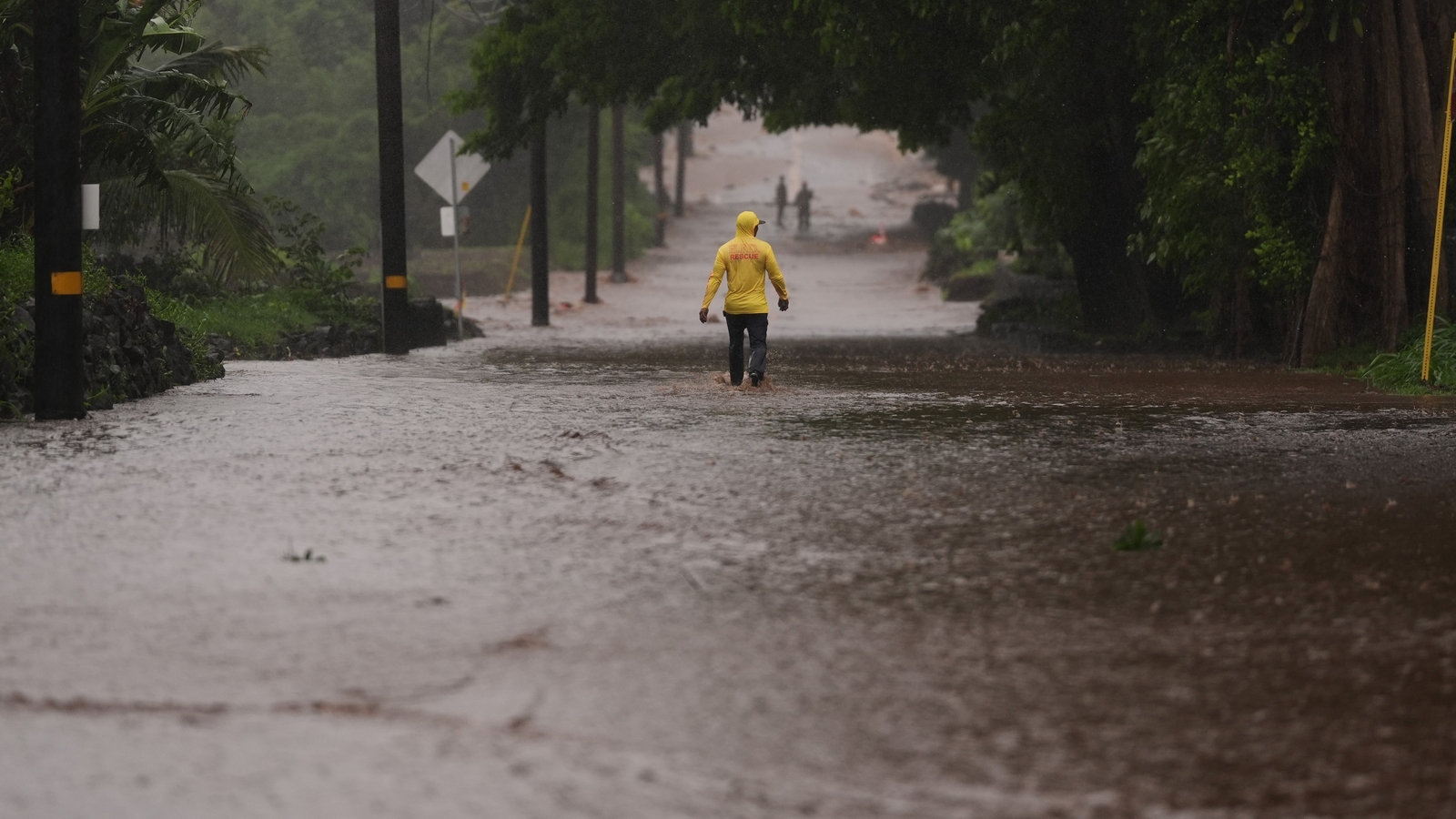

Residents across Mexico’s Baja California Sur sealed up their homes Monday as crews moved soil and debris to reinforce flood barriers ahead of Hurricane Polo. The powerful storm threatened the peninsula with destructive winds, flooding and mudslides. Far across the Pacific, Hurricane Nolo was pulling away from Hawaii but could still deliver torrential rain to parts of the state.
In the fishing town of Puerto San Carlos, home to roughly 5,700 people, residents worried that high tides and pounding surf could overwhelm protective barriers and push seawater into the community. Some families planned to evacuate to shelters in Ciudad Constitución, about 37 miles (60 kilometers) away, while authorities moved dozens of other residents to safety elsewhere in the state.
“Civil Protection told those of us here in San Carlos to evacuate because this is a high-risk area. With the current tides, the expected waves and the wind, the earthen barriers they built (to prevent flooding) could give way,” said Rocío Sánchez, a local fisherwoman.
RELATED: Hurricane Polo off Mexico’s coast ranks among the strongest storms ever, strengthened by El Niño
Hurricane Polo races toward Baja California
Polo was classified as a Category 3 hurricane Monday morning, carrying maximum sustained winds of 115 mph (185 kph), according to the U.S. National Hurricane Center in Miami. Forecasters warned that the storm would sweep across Baja California Sur with intense rainfall before reaching Mexico’s mainland, raising the risk of deadly flooding and mudslides. Heavy rain and flooding could also affect parts of the U.S. Southwest later in the week.
The hurricane center said Polo was expected to approach major hurricane strength as it reached Baja California Sur Monday, then remain a hurricane when it made landfall on mainland Mexico late Monday night or early Tuesday.
By Monday morning, large waves were already pounding the shoreline and sending water into coastal areas. Laura Velázquez, Mexico’s national civil protection coordinator, said Polo was expected to come ashore later that afternoon.
During a morning briefing, Velázquez urged people to avoid unnecessary travel and move to shelters if their homes could not withstand the storm. Authorities planned to halt transportation near the projected landfall zone and close ports throughout the affected region.
Meanwhile, Nolo was positioned far southwest of Hawaii and moving away from the Big Island as the weekend ended. Even so, wind and high-surf advisories remained in place for parts of the island through Monday morning. Nolo’s maximum sustained winds had strengthened to nearly 155 mph (249 kph).
The Pacific hurricane season remains unusually active
Tropical activity across the Pacific has exceeded average levels during the peak of hurricane season, said Bob Oravec, a lead forecaster with the National Weather Service. He noted that stronger storm activity is common during El Niño years, when the Pacific typically produces more tropical storms and hurricanes.
YOU MIGHT ALSO LIKE: Trump Floats Turning White House Press Room Into Indoor Pool
As Polo approached Mexico, the Mexican navy said it had positioned personnel and emergency supplies in the Pacific ports of Guaymas and Mazatlán. Three vessels were also deployed to deliver aid to coastal communities that could become cut off by flooding or damaged roads.
San Juanico, a small fishing settlement on Baja’s Pacific coast, was among the communities in Polo’s forecast path. The town has had dependable electricity for only a few years and still faces regular outages. Residents also feared washed-out roads could prevent access to medical care.
ALSO SEE: Is a nor’easter a hurricane? The key differences between the storms
“Our people are concerned about this event,” said Gloriely Robles Meza, who manages a small hotel in San Juanico. “We haven’t faced such a worrying situation in many years.”
Robles Meza said soldiers arrived Sunday to prepare an emergency shelter and help the community respond if conditions deteriorated.
Tropical Storm Rachel also developed Sunday well offshore from Mexico’s southwestern coast. The National Hurricane Center said Rachel had maximum sustained winds of 50 mph (82 kph) and was located about 230 miles (370 kilometers) south-southwest of Acapulco. No coastal watches or warnings had been issued.
Flooding and mudslides remain possible in Hawaii
Forecasters warned that Nolo’s outer rain bands could trigger life-threatening floods and mudslides. Parts of the Big Island could receive as much as 20 inches (50 centimeters) of rain, while heavy downpours were also expected across Hawaii’s other islands.
More than 120 National Guard members were called up, joining approximately 400 personnel mobilized statewide after the governor issued an emergency proclamation. President Donald Trump recently approved an emergency declaration, allowing the Federal Emergency Management Agency to coordinate relief efforts and provide financial assistance.
Hawaii communities were already dealing with the aftermath of Hurricane Lala, whose powerful winds and heavy rain swept roughly 100 homes from their foundations on the Big Island.
Copyright © 2026 by The Associated Press. All Rights Reserved.