
Matt Newberry remains a relatively private figure in football. Search his name online and there is little beyond his professional title, while Liverpool’s official website does not currently list him among the club’s public profiles.
Behind that low-profile presence, however, Newberry and his colleagues are playing a significant part in shaping Liverpool’s long-term future.
Since 2024, Newberry has worked as Liverpool’s director of global talent. In that position, he oversees an international youth recruitment strategy designed to bring some of the most promising young players in world football into the club’s system.
The Reds have been particularly active in 2026, recruiting Mor Talla Ndiaye from Senegalese side Amitie FC, Ifeanyi Ndukwe from Austria Vienna, Samuel Martinez from Colombia’s Atletico Nacional, Lucca Brughmans from Genk and Djylian N’Guessan from Saint-Etienne.
Liverpool have also brought in Hungary international Armin Pecsi, who has earned one senior cap and shares an agency with vice-captain Dominik Szoboszlai. Club insiders describe the approach as an ambitious attempt to secure the best emerging talent before their reputations become fully established.
Within Liverpool, Brughmans is viewed as potentially the finest young goalkeeper in the world. Ndukwe is held in similarly high regard at centre-back, with his ability already attracting attention during pre-season before he joined La Liga club Levante on loan.

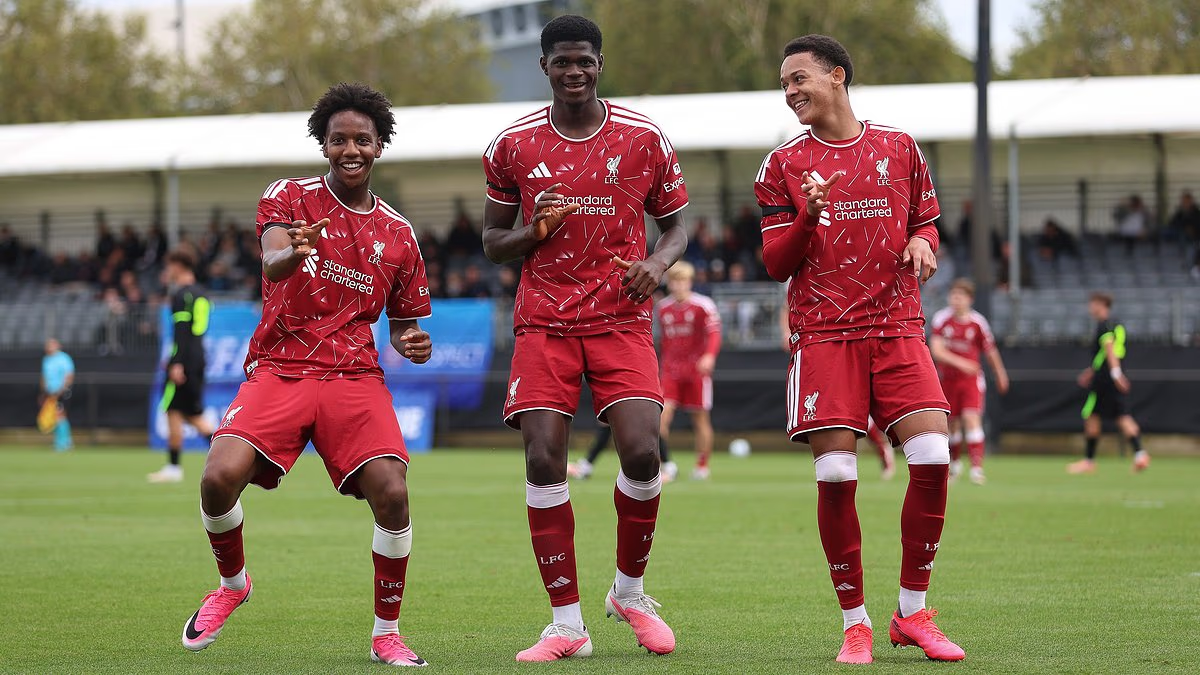
Defender Mor Talla Ndiaye (centre) is among the wave of highly rated youngsters Liverpool have recruited in 2026

Though he keeps a low profile online, Matt Newberry and his team are central to Liverpool’s plans for the future
Liverpool do not expect every one of those signings to establish themselves at Anfield. The club’s strategy is based on the belief that if even two or three reach the first team, the global talent operation will have delivered. Those who fall short may still generate significant value through future transfers.
The work carried out by Newberry’s department involves far more than identifying talented teenagers.
Many of the players on Liverpool’s list are already known to the leading clubs in Europe and beyond. A major part of the global talent team’s role is therefore building strong relationships with clubs worldwide and convincing young footballers that Liverpool offers the right route for their development.
Newberry recently travelled to Colombia to work with Martinez, who is expected to join Liverpool’s academy next season — or once he turns 18. Brexit regulations prevent British clubs from signing overseas players before they reach adulthood.
Brughmans had previously visited Real Madrid and appeared destined to follow his hero, Thibaut Courtois, by joining the Spanish giants. Liverpool’s recruitment team ultimately persuaded him that Merseyside offered the strongest pathway for his career.
The move was completed at remarkable speed. Liverpool submitted their offer to Genk on the Sunday morning before transfer deadline day, and by Monday morning Brughmans was flying to Merseyside.
But who is the man leading Liverpool’s increasingly ambitious global recruitment operation?
Newberry, who was born in County Down, Northern Ireland, began his football career as an academy scout at Birmingham City before progressing into youth recruitment. He joined Liverpool nearly 15 years ago and has since held a series of positions focused on scouting and developing young players.
During his time as a scout, Newberry is credited with first identifying Ryan Gravenberch while watching him play for Ajax Under-16s at the age of 13. Liverpool eventually signed the midfielder, who went on to win the Premier League Young Player of the Year award during the club’s 2024-25 title-winning campaign.

Liverpool moved quickly to sign young goalkeeper Lucca Brughmans after he had been linked with Real Madrid

Liverpool insiders consider Ifeanyi Ndukwe (left), currently on loan at Levante, one of the world’s most promising young defenders
Newberry also helped bring fellow Northern Irishman Conor Bradley to Liverpool. When Bradley was with Dungannon Swifts, two members of the club’s staff visited the local side to assess its facilities. Bradley stayed connected to Dungannon while travelling regularly to Merseyside for training, and Liverpool continue to support coaches from the club by bringing them over to attend matches.
James McConnell, who played for Liverpool’s first team last week, had a similar story. The Newcastle fan was signed from Sunderland at 14 and placed in a school just down the road from some family friends who housed him.
Newberry also spent a year working as pathways manager, essentially sorting out loans for youngsters – making sure the new club is the right one, their playing style fits and that the player’s personal needs and development are looked after.
Liverpool were one of the first adopters of this role and Julian Ward, who is to take over from Richard Hughes as sporting director, previously occupied the position. Ward’s successor was David Woodfine, now assistant sporting director and a key cog in the operation.
One of the reasons the club has turned to foreign talent is Brexit and rules that prohibit British clubs signing Europeans before the age of 18. This might sound like a contradiction, but British talent now costs a premium.
Academy director Alex Inglethorpe said earlier this year: ‘The market is more competitive now around the age of 16 than it’s ever been. There’s no question that since Brexit, the landscape has changed and it’s driven up the price of young English talent.’
There is something of an arms race developing in the youth game. Teenagers (and sometimes pre-teens) are being offered flash cars, big houses, promises of first-team debuts within certain time frames, eye-watering bonuses to get around salary caps, and all sorts.
Liverpool poached Rio Ngumoha from Chelsea two years ago and the Blues tried to retaliate by targeting several youngsters in Liverpool’s academy. Ngumoha could have earned more at Stamford Bridge but was instead sold on the pathway at Anfield.
He is now a fully-fledged member of the first team and in line for a bumper new contract soon. Last term, he was paid a nominal salary – for a footballer, anyway! – but remunerated with healthy bonuses and performance-related add-ons.

Rio Ngumoha, 18, is already a fully-fledged member of the first team and in line for a bumper new contract soon

Rival clubs were willing to pay 16-year-old winger Joshua Abe nearly £50,000 a week to sign for them
Some clubs were willing to pay 16-year-old winger Joshua Abe nearly £50,000 a week to sign for them, with Chelsea, Arsenal, Manchester City and Real Madrid all keen. It shows the success of Liverpool’s youth policy is about more than finances.
Several academy stars have already played for the first team this season, with boss Andoni Iraola in regular contact with youth staffers. Captain Virgil van Dijk is also a regular at youth games and not just because his young son Jacey has trained at the club.
Newberry’s team is not designed to cut across any domestic scouting operations or loan pathways. They work closely with the other departments and Gary Probert, brought in from Ipswich as loan manager, has won many fans inside the club.
Everyone is keen to stress that all recruitment at Liverpool is a team game and no individual should take all the credit. Recently departed head of academy recruitment Chris Dowling, who was influential in bringing Ngumoha to the club, was also a key player.
Think of Newberry’s team then, as an extension of the sporting director with a particular focus on the emerging talents in the game. Remember, the club have recently invested £20million in the redevelopment of the academy and its facilities, with a full-size indoor pitch under a dome.
Part of their remit has also been to extend Liverpool’s tentacles into less traditional markets. Before the signing of Martinez, for example, the Reds had not previously done much shopping for South American youngsters. Before Ndiaye, the African market was largely untapped.
The president of Gambian side BST Galaxy was invited to the AXA Training Centre to meet club staff and two players were given trials at Liverpool. Again, this drive is as much about nurturing relationships as it is finding the players in the first place.
The Reds employ many regional scouts, such as Dassler Marques and Gonzalo Siegrist in South America. In February, they recruited former Mechelen left back Laurens Paulussen to focus on Belgium and the Netherlands.
Jasper Vallmark has covered Scandinavia for a year, Tika Musonda moved from Spurs to be a global talent scout. These are just some examples of their global operation, but they still have plenty of domestic employees – such as former winger Stewart Downing.
That is why they are keen to spread their wings, but the arrivals of current first-teamers Ngumoha and Trey Nyoni from fellow English clubs show the global drive is not coming at the expense of domestic recruitment.

Liverpool still have plenty of employees scouting the domestic market – such as former winger Stewart Downing
Another player Liverpool have watched is striker Michael Mulholland from Northern Irish side Crusaders. The Belfast-born forward supposedly once scored 256 in a single season. He already has several caps for the Northern Ireland youth team and an adidas deal.
In two other moves first revealed in Confidential, Liverpool also signed Zach Trinder from Wolves, rated as one of the best young goalkeepers in the country, and defender Dara Jikiemi from Celtic.
Any of those could be the next cab off the rank for Liverpool, whose reach stretches further than ever before. Newberry and Co are just as crucial to shaping the future as anyone at Anfield – and they are confident some of their recruits will strike gold.