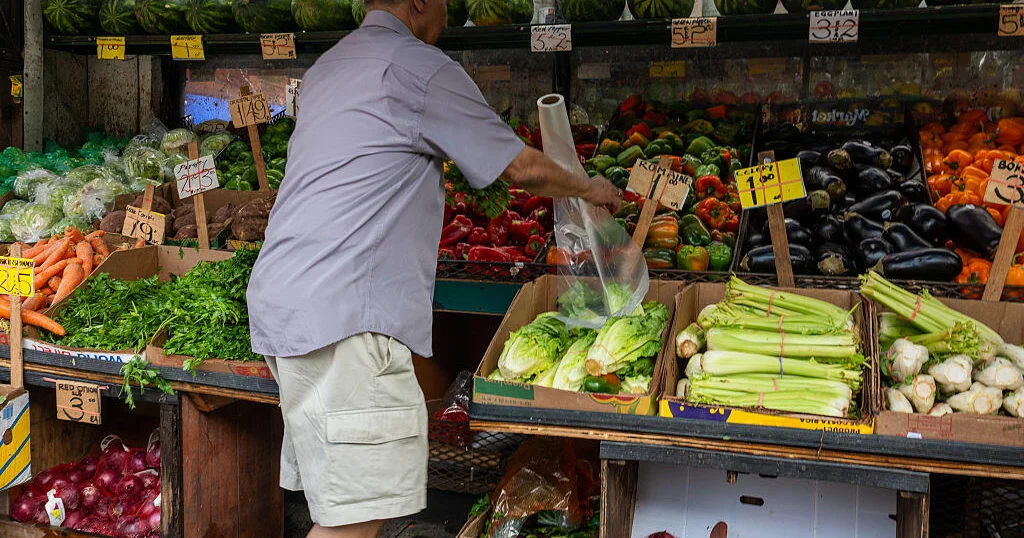
The approach to the midterm elections is becoming a food fight — in the most literal sense.
This summer brought a major foodborne illness outbreak that sickened scores of people, along with the recall of tens of thousands of pounds of imported meat. Together, those events have pushed food safety into the national spotlight and turned it into a political issue.
Late-night talk show hosts joked about symptoms that included explosive diarrhea. As a precaution, chain restaurants such as Chipotle and Taco Bell yanked lettuce, jalapeños, and other suspected products from menus. Some food safety scientists blamed the outbreaks on federal cuts to public health.
The developments have left consumers wondering whether it is safe to order a salad or a burger.
Democrats have come out on the offensive, saying voters worried about the safety of the U.S. food supply should oust Republicans in the midterm elections. The Trump administration has countered by accusing Democrats of scaremongering over food safety to score political points.
The political dispute reflects the psychological impact of large-scale foodborne outbreaks. Voters have long focused on household concerns such as grocery prices, but a wave of recalls has added another worry: whether the food they buy is safe to eat. Political leaders are taking notice.
A cyclospora outbreak linked to lettuce produced nearly 20,000 laboratory-confirmed cases between May and August, compared with 1,180 cases during the same period in 2025, according to the Centers for Disease Control and Prevention. It was the largest recorded outbreak of the parasite.
“One of the reasons food safety is in the news this year, and people have been rightfully concerned, is the combination of high-profile restaurant names and the absolute colossal number of illnesses,” said Teresa Murray, consumer watchdog director for the U.S. Public Interest Research Group, or PIRG. Referring to the recent cyclosporiasis outbreak, she added: “It’s thousands of people. It makes it more real.”
Data shows that roughly 200 food recalls have been announced so far in 2026. That is broadly in line with the number recorded at this point last year, according to PIRG data.
Following the numbers
Most registered voters have little or no confidence in government oversight of food safety, with Democrats considerably more likely than Republicans to question the protections in place, a July Quinnipiac University survey found. Separately, 94% of U.S. adults said they were concerned about the frequency of food recalls in a poll conducted by GS1 US, a data standards organization.
Consumer confidence in the safety of the U.S. food system has also fallen. About 30% of consumers strongly agreed in August that the system produces food that is safe to eat, down from 40% in November 2025, according to survey data released in September by the University of Illinois and Purdue University.
Democrats have seized on the moment to renew their criticism of President Trump’s budget cuts and policy priorities.
The Democratic National Committee recently posted a list of recalled food items on social media while calling Health and Human Services Secretary Robert F. Kennedy Jr. a “complete disaster” who must resign.
“Trump is dismantling our government — and it’s harming people,” Sen. Elizabeth Warren (D-Mass.) posted Sept. 2 on the social platform X, adding: “Slashed food safety agencies → cyclospora outbreak.” Just weeks earlier, she had written to Kennedy demanding answers for what she described as the administration’s “failed response” and its connection to political contributions.
Rep. Gabe Amo (D-R.I.) posted Sept. 5 on X: “I’m calling on Trump to stop gutting the FDA & restore its inspectors. We deserve safe food.”
The campaign for Rep. Judy Chu (D-Calif.) posted Sept. 5 on X: “Trump is cutting our food safety funding and workforce, and we have seen far too many food recalls this summer.”
Even so, the raw number of recalls does not tell the entire story.
Although recalls are not significantly higher this year than they were in 2025, they have increased over a longer period. The Food and Drug Administration and the U.S. Department of Agriculture recorded 320 food recalls in 2025, compared with 296 in 2024, PIRG reported.
The overall number of recalls rose 21% between 2021 and 2025, according to an analysis by Trace One, which provides regulatory guidance software. Much of that growth came from an increase in Class I recalls — the highest-priority category because the products could cause serious illness or death.
Recall totals, however, can be deceptive. Federal agencies do not announce every recall, particularly when products are no longer available on the market. The data can also count the same contamination event multiple times when an affected ingredient is used in processed foods or other products.
Epidemiologists say the number of people who become ill is a more meaningful measure. By that standard, this summer’s multistate cyclospora outbreak was extraordinary, affecting residents in 21 states.
For bacterial food contamination — including E. coli, listeria and salmonella — the broader trend suggests that outbreaks are sickening fewer people. Some food safety officials view that as encouraging, even though the CDC estimates that 48 million people in the United States experience foodborne illness each year.
“That’s an indication we’re finding more outbreaks and finding more when they are smaller and limiting the extent to which they can get bigger,” said Craig Hedberg, a public health professor at the University of Minnesota and a leader in food safety surveillance.
Still, the widespread perception that the food supply has become more dangerous has been enough to fuel a bitter political fight.
ALSO READ: How Phone Cameras Can Expose Affairs Without Millions Realising It
The FDA recently asserted on X that recalls for fiscal year 2026 are among the lowest levels recorded in over a decade, stating, “Don’t believe the fake news.” It included a chart that showed recalls dropping to 1,836 in fiscal 2026 from almost 4,000 in fiscal year 2013.
On the same day, HHS senior adviser Calley Means doubled down on the claim, posting on X that Kennedy is doing so well that Democratic operatives are slamming the FDA for doing its job by conducting food recalls.
“It makes sense that these craven, disingenuous attacks are all these influencers have,” he wrote.
Some food safety experts, however, have challenged the figures, pointing out that the agency’s recall totals cover a broad mix of products. The count also includes drugs and medical devices, according to an analysis of the posted data by Susan Mayne, who led the FDA’s Center for Food Safety and Applied Nutrition from 2015 through 2023. Food safety leaders say it is misleading to suggest that food recalls have declined when the underlying data also includes recalls unrelated to food.
“This HHS assertion appears to be based on incorrect data,” Mayne said on LinkedIn, a job-oriented social networking site.
It’s about more than recalls
Food safety has occasionally taken center stage in politics. In 1993, for example, an E. coli outbreak traced to Jack in the Box fast-food outlets pressured newly inaugurated President Bill Clinton to make it an agenda item at his first Cabinet meeting. His administration wound up adopting a new approach focused on preventing foodborne illness and credited with drastically reducing E. coli infections.
Concern about food safety has especially taken hold now, public health leaders say, because the administration is portraying itself as a safety crusader while cutting staffing and funding for federal agencies responsible for surveillance and inspection.
“There’s a level of hypocrisy from the administration when they promise to make our food safer and then eviscerate the agencies and programs that detect and prevent outbreaks,” said Sarah Sorscher, regulatory affairs director at the Center for Science in the Public Interest.
The FDA continues to have the staff required for outbreak investigations, and no FDA investigators were affected by staffing changes or reductions in force, HHS spokesperson Grace Davis Jamison said in an email.
The CDC lab supporting foodborne outbreak investigations also was not impacted by reductions in force, she said, and the agency maintains a dedicated team investigating foodborne outbreaks and working closely with state and local health departments.
“The Trump Administration has mounted a robust response to each outbreak, working closely with health departments in all 50 states and leading the public health response by promptly identifying known sources and providing Americans with the information they need to protect themselves,” she said.
The administration’s initiatives risk weakening food safety protections. Mr. Trump in late August said he would take action to make it easier for small livestock operations to slaughter and process their own meat, raising concerns among food safety leaders that the change could allow inadequately inspected beef to enter the food system.
Mr. Trump also announced the U.S. would import more beef from Argentina and Brazil, despite concerns about inspections and safety. The European Union has implemented a ban on Brazilian beef imports because of noncompliance with food safety and antibiotic use.
The administration withdrew a proposed Biden-era rule that would have stopped the sale of raw turkey and chicken containing high levels of salmonella. And it said it would delay compliance with a rule requiring grocery stores and companies to trace food in their supply chains, allowing for quick removal in cases of contamination. Implementation, originally set for Jan. 20 of this year, would instead occur in July 2028.
The actions came after hearing concerns from stakeholders about the time needed to comply, Davis Jamison said.
Some food safety leaders say the administration should do more to prevent foodborne illnesses, saying that failing to direct more resources into preventing problems makes it harder for Kennedy’s campaign to encourage people to eat more fresh foods.
In fact, almost half of consumers changed their habits regarding which groceries they bought and 40% modified purchases at restaurants in the past month due to foodborne illness concerns, according to the survey by the University of Illinois and Purdue University. Concerns about foodborne illness exposure via fresh vegetables increased in August compared with feedback from the previous two years.
“If you want people to eat real food, fresh fruits and vegetables, they have to be safe,” said Sandra Eskin, chief executive at Stop Foodborne Illness, a nonprofit public health organization. “Instead, we have had farmers plowing under fields because people aren’t buying lettuce.”
KFF Health News is a national newsroom that produces in-depth journalism about health issues and is one of the core operating programs at KFF — the independent source for health policy research, polling, and journalism.


