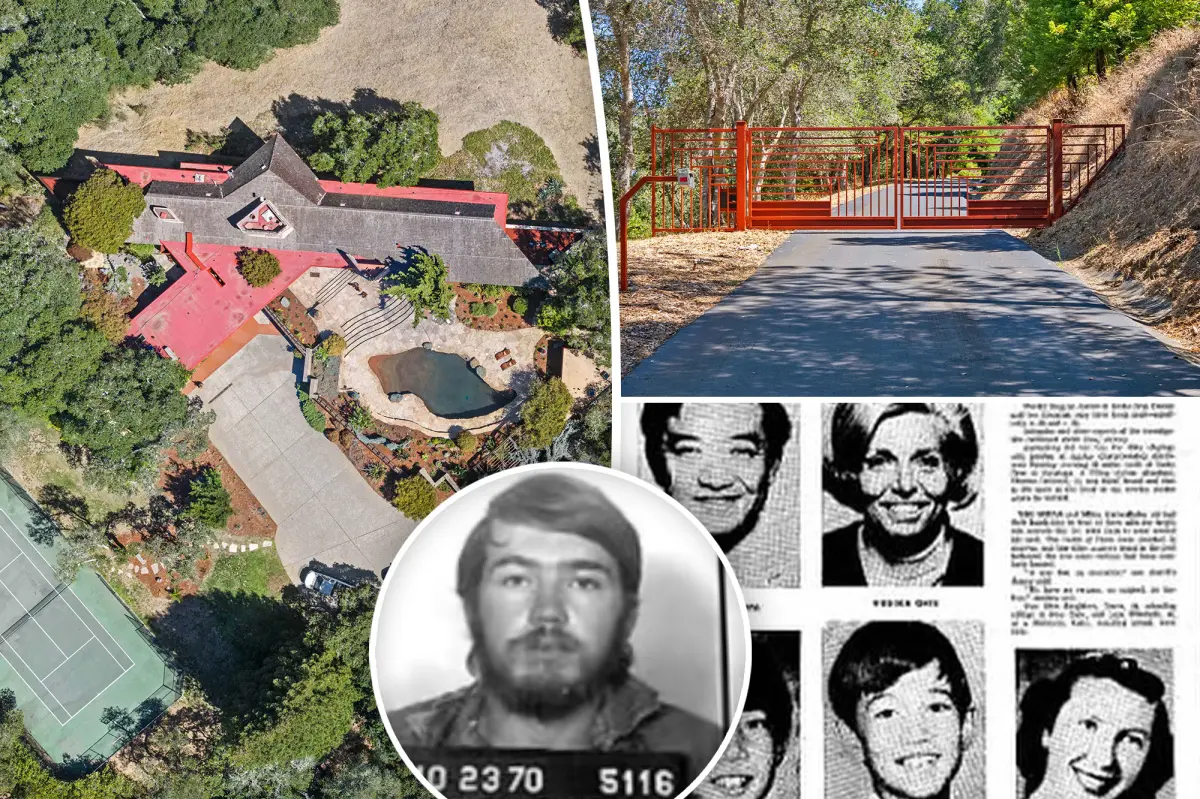

Perched on a private ridge in the affluent Soquel Hills, with sweeping views of Monterey Bay and the Santa Cruz countryside, this Northern California residence is an exceptionally well-preserved example of organic mid-century modern architecture. It also carries a deeply disturbing past.
Completed in 1965, the home at 999 North Rodeo Gulch Road was designed by Aaron Green, the protégé whom celebrated American architect Frank Lloyd Wright regarded almost as a son.
The property is now listed for $4.6 million following a recent price reduction. It is also remembered as the scene of one of modern California’s most notorious mass murders.
Five years after the house was built, on the night of Oct. 19, 1970, 24-year-old local man John Linley Frazier entered the home of respected eye surgeon Dr. Victor Ohta. The crime came just a year after the Charles Manson murders in Southern California.
Frazier was a paranoid, Bible-obsessed hippie who called himself “the Killer Prophet.” He believed God had appointed him to punish people who “misuses the natural environment.”
Court records say Frazier bound Dr. Ohta, his wife, Virginia, their two young sons — 12-year-old Derek and 11-year-old Taggart — and Ohta’s secretary, Dorothy Cadwallader, using silk scarves and ties.
He then led the victims into the backyard and shot them in the back and head near the swimming pool or into the pool itself, where their bodies were later found.
After the killings, Frazier started several fires inside the house and left a rambling typewritten message on the windshield of Dr. Ohta’s Rolls-Royce. According to TIME, the note claimed that “World War III” had begun and warned that anyone who damaged the natural environment would “suffer the penalty of death by the People of the Free Universe.”
Firefighters responding to the blaze discovered all five bodies floating in the pool. The property had suffered extensive damage from the fires Frazier intentionally set.
He was captured four days later while sleeping in a nearby shack. Frazier was subsequently convicted on five counts of first-degree murder and sentenced to death.
The house was carefully restored in the early 1970s after the fire. Its architecture and craftsmanship remain remarkably intact.
From its indoor-outdoor design and hillside limestone masonry to its redwood-framed glass walls, the home reflects the organic principles associated with Wright’s work. A soaring living room, polished concrete floors, five spacious bedrooms, four bathrooms, custom built-ins, deep roof overhangs, terraces, gardens and panoramic views all remain part of the estate.
Green translated his mentor’s philosophy of organic architecture into virtually every detail of the property.
The single-story residence encompasses 4,166 square feet on nearly 10 secluded acres. Its dramatic living room rises 25 feet and features one of Santa Cruz County’s largest private residential fireplaces.
An additional outdoor fireplace further connects the structure to its natural setting. More than 5,000 square feet of stone terraces surround the pool house and traditional sauna.
The grounds also include a tennis court, a Japanese garden with a koi pond and waterfall, two large redwood decks, a bamboo-lined walking path, a bocce court and a secluded hilltop great lawn.
The lagoon-shaped swimming pool, however, remains in place.
Frazier’s death sentence was later commuted to life in prison. In 2009, he died by suicide after hanging himself in his prison cell.
For the next owner, the choice comes down to whether the property’s tragic history can be reconciled with its $4.6 million asking price — or whether the appeal of owning one of California’s finest and most architecturally significant mid-century homes outweighs it. Either way, the decision will require both considerable resources and a certain degree of resolve.