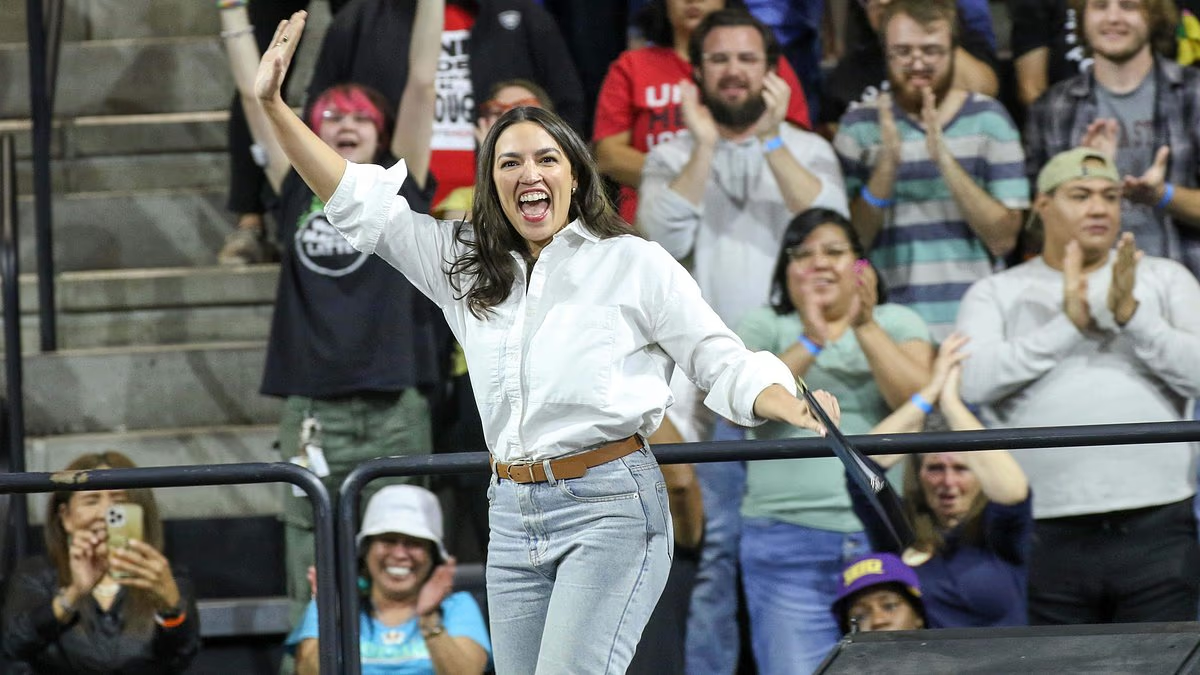

Alexandria Ocasio-Cortez has been largely missing from the campaign trail, and several candidates in competitive states now appear reluctant to have the progressive Democrat campaign on their behalf.
The unusual distance comes as Democrats work to defend and capture closely contested House and Senate seats this fall, while speculation continues to grow about Ocasio-Cortez’s potential presidential ambitions in 2028.
In an interview with The New York Times last week, Ocasio-Cortez strongly suggested that she is considering a presidential run in 2028.
Yet her limited presence in battleground states could complicate those ambitions. A national campaign would require Ocasio-Cortez to expand her appeal beyond her established progressive base.
She would also need to win over voters in key swing states, where her progressive record and policy positions are likely to face closer examination from more moderate and undecided voters.
Some candidates who welcomed her support during the Democratic primaries have adopted a more cautious strategy now that they are facing Republican opponents in the general election.
In Montana, progressive House candidate Sam Forstag appeared with Ocasio-Cortez at a rally in May, before securing the Democratic nomination.
But when Axios asked whether Ocasio-Cortez would campaign with him during the general election, Forstag said he did not expect to have many political figures from outside Montana campaigning alongside him.

Progressive House candidate Sam Forstag rallied with Alexandria Ocasio-Cortez in Montana in May before winning his primary. His campaign has since removed her endorsement from its website.

Ocasio-Cortez campaigned with controversial Michigan candidate Abdul El-Sayed in July.

Ocasio-Cortez has endorsed at least 10 candidates during the midterm campaign, including Angie Nixon, Ed Markey and Abdul El-Sayed.
Forstag’s campaign has also taken Ocasio-Cortez’s endorsement off its website.
According to party officials who spoke with Axios, other Democrats running in competitive races have directly asked Ocasio-Cortez’s team not to get involved.
One senior Democratic strategist called Ocasio-Cortez a “lightning rod” and said polling for her was weak.
The change in strategy underscores the challenge facing Democrats who embraced Ocasio-Cortez during their primary campaigns.
Her national profile can bring media attention, fundraising and enthusiasm from progressive voters. But once candidates move into general-election contests, some appear concerned that Republicans could make her record and public image central to their attacks.
That strategy is already playing out in New York’s 17th Congressional District.
Democratic candidate Cait Conley has said she does not plan to campaign with Ocasio-Cortez.
Even so, Republican Representative Mike Lawler, who is seeking reelection against Conley in a closely watched race, has tried to link the two Democrats.

Ocasio-Cortez campaigned alongside Florida state Representative and US Senate candidate Angie Nixon, part of a broader progressive effort ahead of the midterm elections.

Ocasio-Cortez’s national profile may generate attention, fundraising, and enthusiasm among progressive voters, but once candidates enter general-election contests, some appear concerned that Republicans could use her record and reputation against them

Former Vice President Kamala Harris hit the campaign trail for the first time this election season last week, joining Michigan Democratic US Senate candidate Abdul El-Sayed
The Republican super PAC Congressional Leadership Fund has also run an advertisement calling Conley ‘AOC’s choice for Congress.’
Ocasio-Cortez dismissed the attacks, arguing Republicans have been trying to use her against Democrats since she first entered Congress in 2018.
The picture is far from universal.
Michigan Senate nominee Abdul El-Sayed heavily featured Ocasio-Cortez during his Democratic primary campaign.
His allies spent nearly $1 million on television advertisements featuring her, according to AdImpact.
Since winning the nomination, however, El-Sayed has largely stopped featuring her in advertising while facing Republican attacks over his progressive record.
His campaign says it would still welcome Ocasio-Cortez back to Michigan.
Ocasio-Cortez has thrown her support behind at least 10 candidates during the midterm campaign, endorsing a roster that includes Angie Nixon, Ed Markey, Abdul El-Sayed, Chris Rabb, Analilia Mejia, Justin Pearson, Randy Villegas, Adam Hamawy, Sam Forstag and Junaid Ahmed.
She’s also campaigned for Florida Senate nominee Angie Nixon and supported Virginia House candidate Tom Perriello through fundraising.
And this week she campaigned with Representative Josh Riley in Ithaca.
Riley’s race, however, has become less competitive, with the national Republican House super PAC pulling $4.8 million in advertising reservations from the district.
CNN reported in June that Ocasio-Cortez’s aides were preparing a fall schedule designed to test her appeal beyond her progressive base.
So far, that broader campaign test has been limited.
Even former Vice President Kamala Harris has received invitations from some battleground campaigns.
Harris joined El-Sayed last week in Michigan, which was the first time she was seen on the campaign trail.
She’s set to campaign in Nevada with Democratic gubernatorial candidate Aaron Ford, before heading to Georgia, where she’ll join Senator Jon Ossoff and speak at a Democratic fundraiser in Fulton County on October 3.
Harris is leading the early Democratic field for 2028, according to the latest Echelon Insights poll, conducted September 17–21.
Harris registered 24 percent among Democratic voters, followed by California Governor Gavin Newsom at 14 percent and Pete Buttigieg at 10 percent.
Ocasio-Cortez and Georgia Senator Jon Ossoff each received 8 percent, while Arizona Senator Mark Kelly stood at 7 percent.