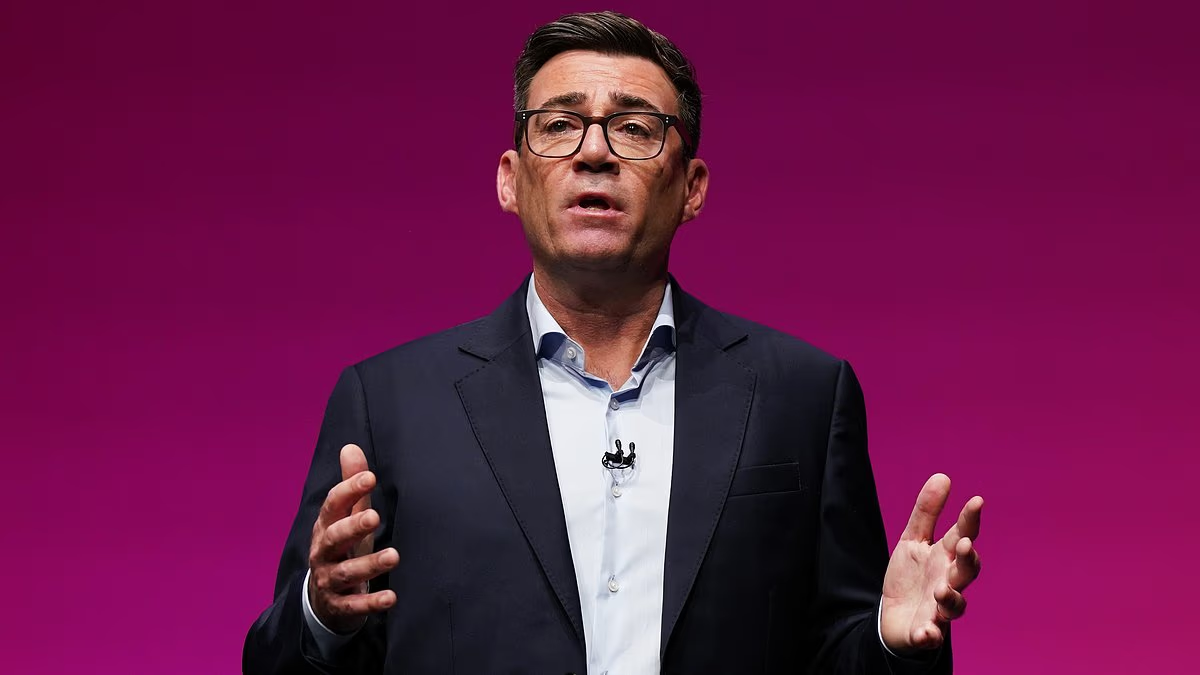
Andy Burnham has set out plans to abolish Britain’s first-past-the-post voting system for Westminster elections.
Delivering his first Labour conference speech as Prime Minister, Mr Burnham promised to usher in a “new politics” through sweeping electoral reform.
He confirmed that Labour would fight the next general election, expected in 2029, on a manifesto pledge to change the system used to elect UK governments.
The Prime Minister, a longstanding supporter of proportional representation, said reform would ensure that “everyone’s vote counts and everyone’s voice is heard”.
Mr Burnham also announced a new “national commission” on electoral reform and invited opposition parties to contribute to its work.
Replacing first-past-the-post with proportional representation could give smaller parties, including the Greens, a route into a future Westminster government.
The proposal is likely to revive warnings about a “coalition of chaos” made up of a range of Left-wing or nationalist parties taking control of Britain.
However, in his conference address, the Prime Minister argued that the existing first-past-the-post system was responsible for the country’s recent succession of premiers.

Andy Burnham has announced plans to scrap Britain’s first-past-the-post voting system for Westminster elections
Mr Burnham said Britain should not be governed by a “divisive” administration elected with “30 per cent of the vote or less”.
Only 10 weeks after his brutal ousting of Keir Starmer from Downing Street, Mr Burnham told Labour members that the country’s political system needed to change.
“Westminster prizes point-scoring over problem-solving. And that is why so many things go unfixed for so long,” he said.
“If we want to change Britain, we need to change ourselves. I will work as hard as I can to get as much cross-party support for our plan for Britain as I can.
“If we can secure that, it will project a message of confidence and stability to the markets and the world about Britain’s future direction.”
READ MORE: 315,000-Year-Old Human Brought to Life in Reconstruction
The Prime Minister has so far declined to call a snap general election to seek his own mandate from voters.
That is despite previously calling on the Conservatives to do the same when they changed leaders while in government.
But in his first Labour conference speech as Prime Minister, he demanded a “new politics” and accepted calls from Labour MPs for a national commission on electoral reform.
“We can’t succeed in the eyes of the world if we continue with the levels of political turbulence we have seen in recent times,” he added.
“It is always in my mind that I’m the seventh PM in 10 years. It is why I want to underpin our plan for Britain with a new politics.
“We will all have failed in our public duties if we carry on as we are and open the door of No 10 to a divisive government on 30 per cent of the vote or less.”
‘Conference, in past years you have voted twice to support electoral reform.
‘I hear you, I agree with you and today I am announcing a new national commission on electoral reform.
‘I invite all political parties to be a part of its work.
‘We will contest the next election with a manifesto commitment to change the electoral system so everyone’s vote counts and everyone’s voice is heard.’
Labour’s party conference voted to support moving towards a proportional representation voting system in 2022.
But the party’s 2024 manifesto instead focused its electoral and constitutional changes on extending voting to 16 and 17-year-olds and House of Lords reform.
Mr Burnham has previously spoken of how his late father Roy – who died earlier this month after suffering with Alzheimer’s – was unaware that his son had swung behind one of his political passions, a change in the voting system to proportional representation.
‘I don’t think he’s ever realised, because of his condition, that I’ve come round to PR, which is one of his missions – to get me to accept that,’ the PM told The Times in July.