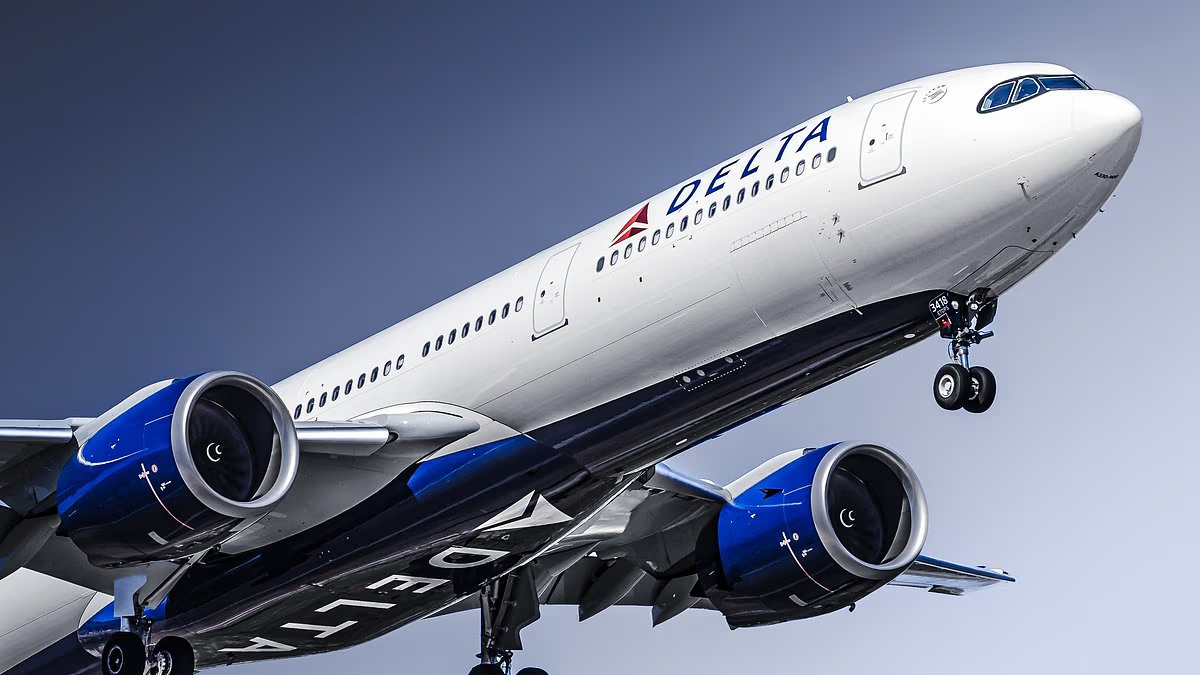

Delta’s decision to select Amazon’s satellite internet for in-flight Wi-Fi rather than Elon Musk’s Starlink has sparked an unusually heated exchange.
Delta CEO Ed Bastian reportedly told employees at company events that Delta did not want to partner with Musk, according to posts on X.com by trusted aviation insider JonNYC.
According to a report, Delta CEO Ed Bastian said while discussing the airline’s decision: “We do not want to be with Elon Musk. Trust me.”
At another event, Bastian allegedly made an even stronger statement, saying: “If you know his reputation, it’s all true what they say about him.”
JonNYC, who reported the remarks, stressed that he could not confirm whether the quotes were accurate. The comments have not been independently verified.
Delta has not responded to Our News Outlet’s request for comment.
The reported comments come just days after Musk warned in his own post on X.com that Delta ‘will lose a lot of customers’ because it has chosen not to install Starlink on its aircraft.
Musk’s response followed reports that United Airlines had already installed Starlink on more than 600 aircraft, while Delta had no planes equipped with the service and no plans to adopt it.

Delta CEO Ed Bastian is alleged to have told employees at company events that the airline did not want to partner with Musk because of his “reputation”

Elon Musk warned that Delta “will lose a lot of customers” after the airline chose not to install Starlink on its aircraft
Industry trackers estimated that Starlink had been installed on more than 600 of United’s 1,668 aircraft—about 36 percent of its fleet—as of September 28. United’s Starlink rollout continues to expand.
United has said it remains on schedule to equip its entire fleet with Starlink by the end of 2027. The service will be offered free to MileagePlus members.
Delta announced in March that it would take a different route, selecting Amazon Leo satellite internet for its aircraft. The initial installation is due to begin on 500 planes in 2028.
As a result, Delta’s next-generation satellite Wi-Fi rollout is not expected to begin until several years after United launched its Starlink program.
United is not the only major carrier embracing Starlink. American Airlines said in May that it would install the service on more than 500 narrowbody aircraft, with work scheduled to start in the first quarter of 2027.
Delta’s choice is notable because the airline had previously tested Starlink, according to JonNYC’s report.
Musk has also claimed that the companies disagreed over Delta’s Wi-Fi portal. He said the airline wanted passengers to access Starlink through Delta’s own system instead of connecting directly to the satellite network.
“Starlink wifi must just work effortlessly every time, as though you were at home,” Musk wrote in May. He accused Delta of wanting to make the service “painful, difficult and expensive” for passengers.

Delta announced in March that it would instead bring Amazon Leo satellite internet to its planes, beginning with an initial installation on 500 aircraft in 2028
Delta has publicly given a different reason for choosing Amazon over Starlink.
The airline has highlighted its established relationship with Amazon, having used Amazon Web Services since 2020. Nearly 600 Delta applications have been moved to Amazon’s cloud platform.
When the onboard Wi-Fi agreement was announced, Bastian said Amazon Leo offered what he described as the “fastest and most cost-effective technology available.”
Amazon says its Leo system will offer fast, low-delay internet on planes, with download speeds of up to 1Gbps.
Meanwhile, Delta says the Amazon partnership will also help it improve and expand the entertainment available to passengers.
Delta already offers free wifi to SkyMiles members, provided by T-Mobile, with the service now available on more than 1,200 aircraft. The airline uses connectivity from providers including Viasat and Hughes, depending on the aircraft.
The airline therefore argues that Amazon Leo is not about finally bringing internet to its planes, but about upgrading an existing service with greater speed, reliability and capacity.
On Reddit, some aviation and satellite-communications users questioned whether Delta’s decision was necessarily as straightforward as it now appears.


Starlink already has deals with a growing list of airlines, while United is rapidly expanding its fleet coverage and American is preparing to begin its own rollout next year
One commenter who said they work in satellite communications noted that, when Delta was originally making its decision, Starlink had not yet been certified for air mobility and there were ‘genuine technical doubts’ about whether it could deliver what was being promised.
Another suggested Delta may simply have secured a favorable early deal with Amazon, while others argued that its existing Viasat service could bridge the gap until Leo is ready.
But there was also plenty of criticism, with one commenter calling the choice a ‘huge miscalculation’ and arguing that Delta may underestimate how much passengers value fast, free WiFi.
Another Reddit user offered a rather different perspective, saying they had recently flown with Starlink and found it a ‘game changer.’
The contrasting reactions highlight the uncertainty surrounding Delta’s gamble, particularly because Amazon Leo has yet to prove itself at commercial scale.
Starlink already has deals with a growing list of airlines, while United is rapidly expanding its fleet coverage and American is preparing to begin its own rollout next year.
Whether passengers actually change their booking habits because of the difference remains to be seen, but Musk has made his prediction clear: Delta ‘will lose a lot of customers.’