
Frank Abagnale built his reputation by deceiving almost everyone around him. Now, the former con artist says artificial intelligence has handed modern scammers tools far more powerful than anything available during his criminal past.
The ex-con man whose life story became the basis for Steven Spielberg’s film Catch Me If You Can warns that AI is transforming fraud by making it quicker, less expensive and increasingly difficult to identify. Criminals can now produce realistic identities, voices and written communications on a vast scale.
Abagnale issued the warning this week while addressing the Mortgage Bankers Association’s Compliance and Risk Management Conference in Washington, DC.
Now 78, Abagnale has spent decades advising banks, companies and government agencies on fraud prevention. In his view, the threat has moved well beyond the forged documents and fraudulent checks that once defined many financial crimes.
His own safeguards are straightforward: he freezes his credit, writes only a small number of checks and keeps the number of applications on his phone to a minimum.
However, he says those measures are no longer enough on their own. Individuals and organizations must also question whether the person contacting them by phone, email or video call is genuinely who they claim to be.
His advice can be summed up in one rule: never rely solely on what you see or hear—confirm the information through an independent source.
That warning carries greater weight as artificial intelligence enables fraudsters to replicate real people through highly persuasive audio, photographs and video.

After once making a living by deceiving others, Frank Abagnale now says artificial intelligence has equipped today’s fraudsters with capabilities he could once only have imagined
AI also allows criminals to reach far more victims, generating and distributing enormous volumes of tailored-looking messages for very little money.
Abagnale, who spent years evading the FBI, told conference attendees that personal details exposed in earlier data breaches may remain valuable to criminals long after the original hack. When paired with modern AI systems, that stolen information can become even more useful.
The danger, he said, is increasingly centered not only on attacking computer networks but on deceiving the people who operate them.
A dramatic example occurred in Hong Kong in 2024, when an employee at engineering firm Arup transferred approximately $25.6 million after taking part in a video conference populated by AI-generated versions of senior company officials.
The worker had initially questioned a message seeking a confidential payment. The fabricated video meeting, however, appeared to confirm that the request was genuine.
The incident demonstrated how traditional social-engineering tactics can be strengthened by AI, giving criminals a way to neutralize a victim’s initial suspicions.
MORE STORY: LA Councilwoman Raman Slams Trump’s English-Only Child Care Plan
The real-estate industry is also facing growing exposure. Property deals involve substantial sums and depend heavily on confirming the identities of buyers, sellers and other participants.
The American Land Title Association reported this month that 59 percent of surveyed title companies had encountered at least one attempted seller-impersonation scam in 2025. That figure was up from 28 percent in the organization’s 2024 survey.
In these schemes, criminals pose as legitimate property owners and try to sell homes or land they do not own.

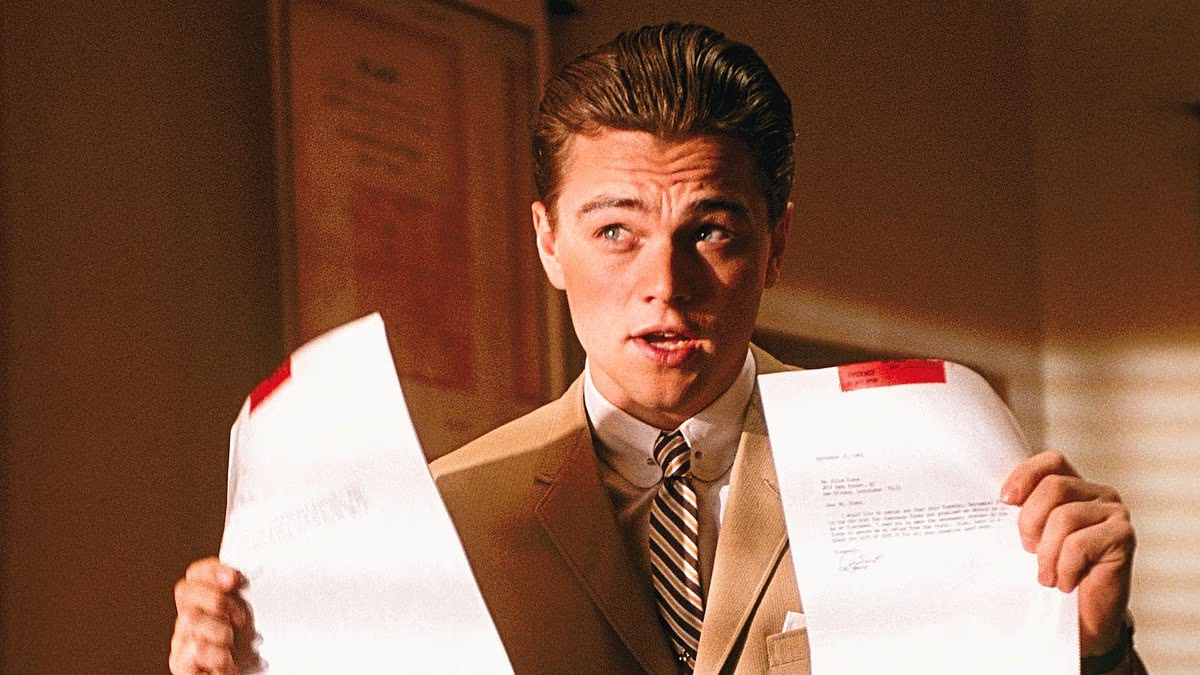
Leonardo DiCaprio portrayed Frank Abagnale in the 2002 film Catch Me If You Can

Abagnale warns that AI is enabling criminals to produce realistic fake identities, voices and messages faster, more cheaply and on a far larger scale
The latest ALTA research, based on responses from 245 title professionals across 40 states, Washington, DC, and the US Virgin Islands, also found that 45 percent of firms had seen an attempt during the month before the survey.
Deepfake images and voices are already part of the fraudsters’ toolkit, with 58 percent of respondents describing their use as at least somewhat common.
And the potential losses are substantial: Among firms that had experienced seller-impersonation attempts, one in four reported a paid claim connected to the fraud, while half of those disclosing average claim costs reported losses above $100,000.
The warning comes as the mortgage industry itself is increasingly experimenting with AI, although adoption remains relatively early.
A separate survey released this week by the Mortgage Bankers Association, the American Association of Residential Mortgage Regulators and Boston Consulting Group found that nearly 60 percent of respondents regarded regulatory and compliance uncertainty as their biggest obstacle to greater AI adoption.
The survey also found that nearly all participating mortgage firms had at least one or two AI applications in production, but that most uses were concentrated on productivity and support rather than core mortgage processes.
For consumers, the lesson from Abagnale and the mortgage industry is that seeing something convincing is no longer necessarily enough to prove it is genuine.
A familiar voice on the phone, a realistic-looking video or an email containing personal information could all potentially be part of a carefully constructed scam.
That means people should independently verify requests involving money or sensitive information rather than relying solely on the contact details or communication channel provided by the person making the request.
For property transactions in particular, industry experts recommend using multiple layers of verification, including independent identity checks, secure authentication and direct contact through trusted channels.