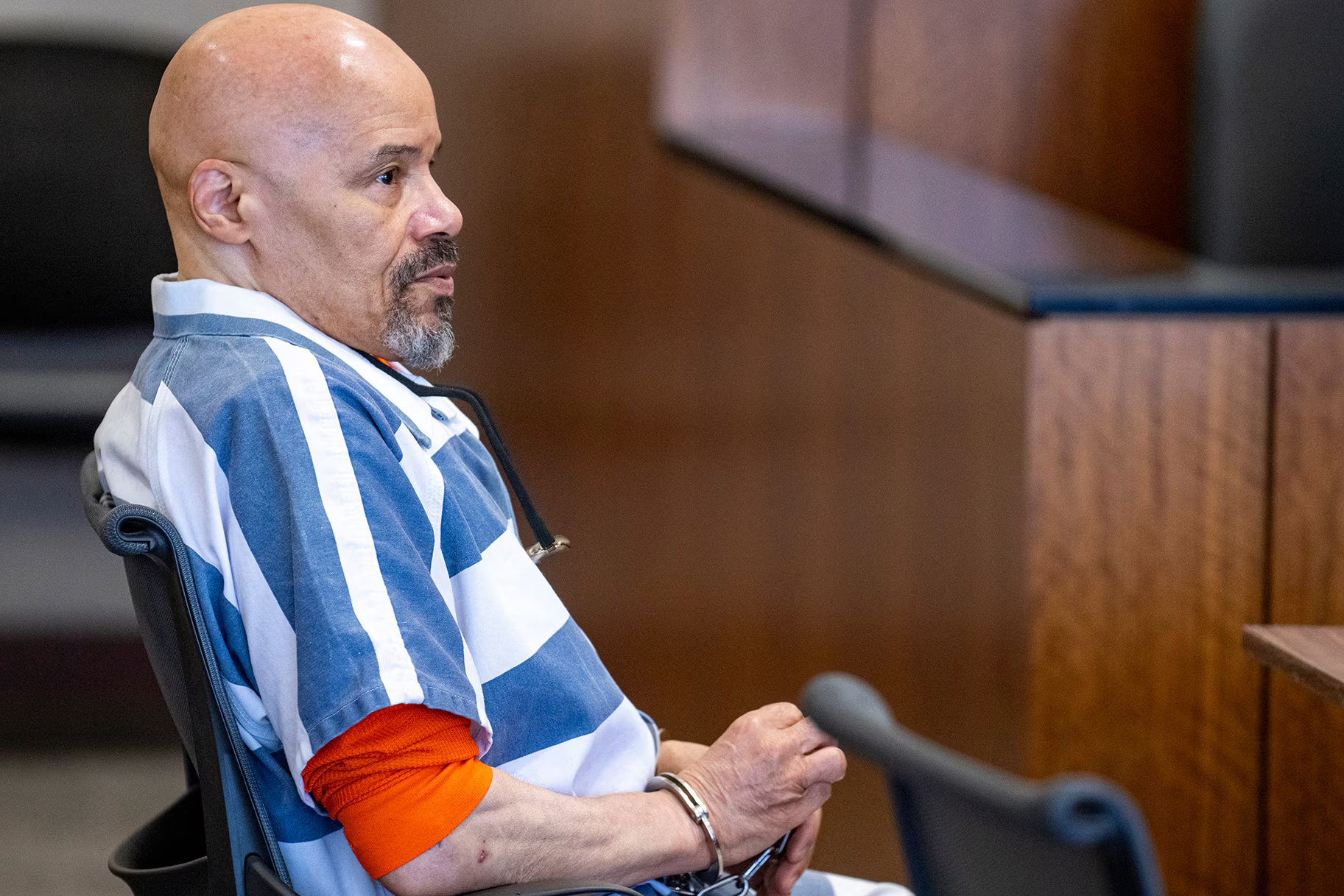

A man who spent more than four decades on death row has been released on bail after prosecutors said newly analyzed DNA evidence does not connect him to key items from the crime scene.
Douglas Stewart Carter, 71, left the Utah County Jail on Sept. 28 after serving 41 years for the 1985 killing of Eva Olesen, whose nephew was Provo’s police chief at the time. His attorney said Carter spent most of those years on death row.
Utah County Attorney Jeffrey Gray wrote in a September court filing that DNA recovered from the handle of the knife used to kill Olesen, along with blood found on a doorknob, does not match Carter, according to the Associated Press.
Carter is now free on bail and subject to GPS monitoring as he awaits a July 2027 trial. The death penalty will not be an option in the retrial. He plans to live near the family that adopted his son as an infant.
Defense lawyer Neal Hamilton is asking prosecutors to dismiss the case entirely and launch an investigation into what he describes as Carter’s wrongful conviction.
“Doug is taking the future one moment at a time,” Hamilton told . “Long-term planning is not something he has allowed himself to indulge in.”
Hamilton added, “The state of Utah didn’t just steal 41 years of his life. They stole his hopes and dreams. Doug’s first night of freedom was a lot to process. He is moving slowly, trying to savor what he can without overwhelming himself.”
What Happened to Eva Olesen?
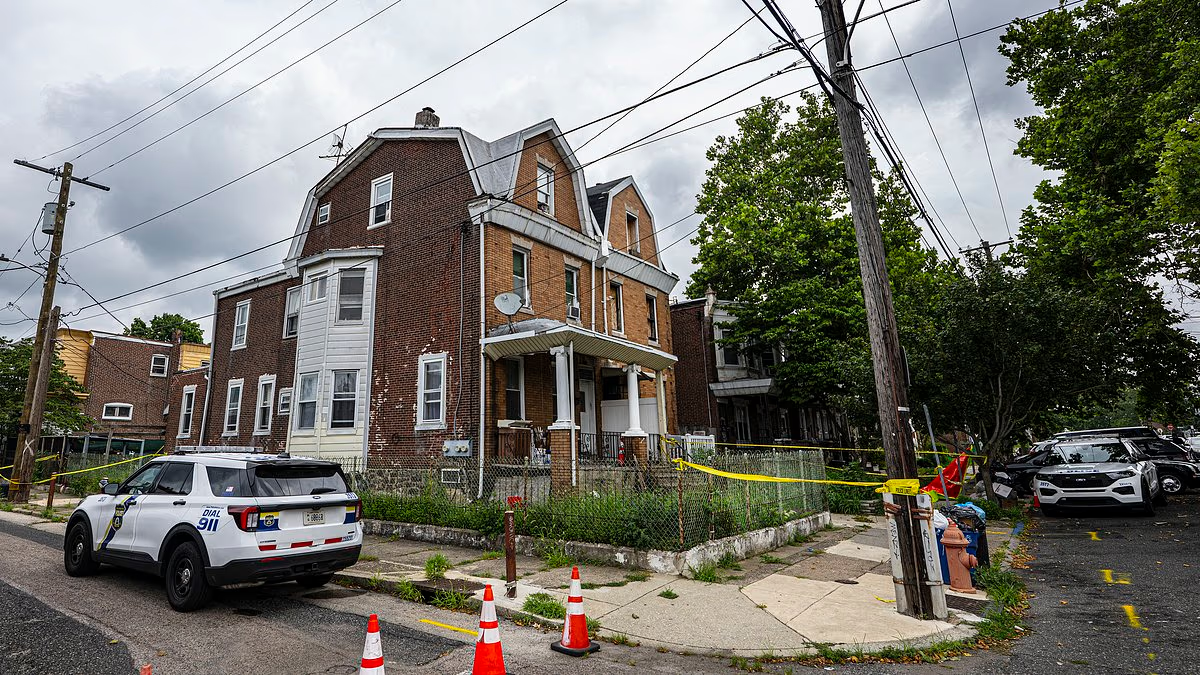
On Feb. 27, 1985, Olesen’s husband discovered her body inside their Provo home. She was naked from the waist down and had her hands bound behind her, according to a 1995 Utah Supreme Court opinion.
The 57-year-old teacher had been stabbed 10 times and shot at close range. The firearm was never found, while investigators determined the knife came from Olesen’s kitchen, the court opinion said.
Carter came under suspicion after police questioned him about an unrelated offense. Investigators then “received information that Carter’s wife, Anne, on learning of the homicide, had told someone that she rushed home to see if her husband was involved,” according to the court opinion.
Carter denied killing Olesen but eventually signed a confession, which he later said had been coerced. Police also pointed to inconsistencies between Carter’s account and his wife’s statement. Two witnesses claimed Carter had “bragged” about the killing, the court opinion noted.
Although there was no physical evidence tying him to the crime—hair recovered at the scene did not belong to a Black person, and blood on Carter’s clothing was not Olesen’s—he was convicted and sentenced to death. Carter maintained his not-guilty plea.
The case remained largely dormant for decades. In 2022, a judge ordered a new trial, according to the Associated Press.
RELATED: Trump Says RAF Fairford Suspects Were ‘Looking to Do Big Damage’
The Utah Supreme Court upheld that decision in 2025, citing “numerous constitutional violations,” the AP reported. The witnesses later accused authorities of coaching them into falsely linking Carter to the murder.
“The defense maintains that physical evidence and eyewitness accounts pointed to a white male as the perpetrator,” Hamilton said in a Sept. 28 press release, “while Carter, a young Black man, was prosecuted for the crime.”
The latest DNA development came in July, when the state crime lab produced a “suspect DNA profile” from evidence connected to the killing, according to The Salt Lake Tribune. DNA testing was not available when the crime occurred in 1985.
“No DNA testing was done before June of 2026,” Hamilton told Oxygen. “The items were submitted for testing in October of 2025, but DNA profiles were not identified from the evidence until June of 2026.”
Still, Gray cautioned that the results “do not necessarily exonerate Carter of the murder,” according to the Associated Press.
For the moment, Hamilton told Oxygen, Carter’s family is “smothering” him with love and attention as he adjusts to life outside prison.
“Doug has a lot of healing to do,” Neal said. “He is slowly starting that process. It would be immensely helpful to that healing process if he didn’t have to continue worrying about being wrongfully convicted, again.”
Olesen’s family said they “will not comment on the guilt or innocence of any individual” in a statement released by the Utah County Attorney’s Office and published by ABC News and other outlets.
“The latest developments have raised difficult questions,” the statement read, “and once again left our family without the sense of resolution we had hoped for after so many years.”
Olesen’s daughter-in-law Theresa Olesen said her family has “serious concerns” about Carter’s freedom.
“By golly we were hoping for a concrete match,” she told CNN during Carter’s Sept. 28 bond hearing. “It doesn’t mean he wasn’t there.
“There are other factors and hopefully the investigation will continue,” she told the outlet. “We just want justice for Eva. And if he had any part of it, we want that to be known.”