
As we sweep around blind bends and overtake almost every vehicle in sight, my taxi driver, Hugo, insists he has never felt safer. With his foot firmly planted on the accelerator, I resist the urge to comment. But our conversation is not really about the nerve-racking journey from the airport. It is about the dramatic transformation of his home country, El Salvador.
Only a decade ago, the small Central American nation was branded the murder capital of the world, recording roughly one killing every hour.
Gangs held much of the country’s six million people in fear, demanding extortion payments and turning to kidnapping, torture and murder when they were resisted.
Violence shaped much of Hugo’s life. Before becoming an Uber driver, the 32-year-old drove a bus and was compelled to hand over a third of his £75 weekly income to gang members as renta — protection money. “If you didn’t pay? Well, they killed you,” he says.
Today, he says, the picture is very different. President Nayib Bukele, who has described himself as the “world’s coolest dictator”, deployed emergency powers to detain suspected gang members. Around 91,000 people have been arrested in total in a country of just six million.
With so many gang members behind bars, Salvadorans can at last begin to put decades of military dictatorship, civil war and gang violence behind them. The latest arrivals are tourists — and they are coming in growing numbers.

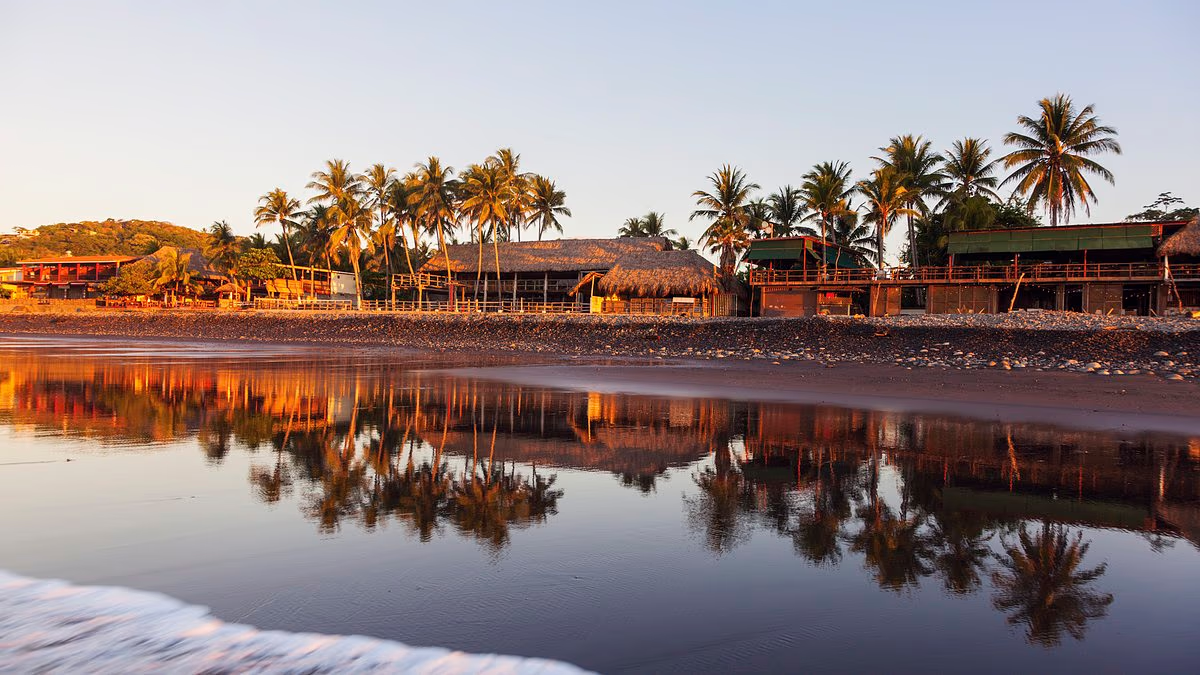
El Salvador’s stunning coastline was once overshadowed by gang violence and murder, but the country now looks strikingly different

Jim Norton explores El Tunco, one of El Salvador’s most popular resorts
The United Nations World Tourism Organisation ranks El Salvador as the world’s third fastest-growing holiday destination.
The appeal becomes clear within minutes. Around 30 minutes west of the airport — or less if Hugo is driving — the road begins to trace a spectacular 190-mile stretch of Pacific coastline. Volcanic cliffs descend towards rugged surf towns, palm-fringed roads and dramatic black-sand beaches.
I am heading for El Tunco, the country’s best-known resort. Once a destination mainly for determined backpackers and surfers, it remains home to inexpensive hostels and casual eateries serving cheap pupusas and fried plantain — thick corn tortillas accompanied by slices of fried banana.
Yet a new, more affluent wave of visitors is changing the resort. Luxury villas on the beachfront and stylish coffee shops are gradually appearing alongside the hostels and local diners.
We pass through an armed checkpoint after being waved on, and I arrive at my accommodation, the Balance Surf & Yoga Retreat.
The owner, Adrian, greets me. Tall and long-haired, the American surfer has the relaxed manner of someone who fits perfectly into the retreat’s bohemian surroundings.

With budget hostels, inexpensive food and a famous surf scene, El Tunco remains a backpacker favourite

Surfing is one of El Tunco’s biggest attractions, prompting Jim to stay at the Balance Surf & Yoga Retreat
The retreat feels like a pocket of calm. I find little reason to leave, spending long stretches in a hammock beneath mango and walnut trees, eating tacos, drinking cacao smoothies and cooling down in the plunge pool.
Over a beer, Adrian explains that he discovered the property by chance during a 2004 road trip to Costa Rica with his best friend, Matty.
DON’T MISS: Ole Miss Vape Store Clerks Jailed on Federal Drug Charges
The pair were 19 when police stopped them at gunpoint in the middle of the night. They were warned not to continue towards Honduras, their next destination, because of civil unrest there.
The following morning, the enthusiastic surfers woke to find themselves looking out over flawless waves — with nobody else in the water.
Elsewhere, El Salvador was buckling under the rise of notorious gangs, such as MS-13 and Barrio 18, that had filled the power vacuum after a brutal 12-year civil war. But the tiny town of El Tunco was seen as ‘neutral’.
They ended up staying a month – surfing every day and spearfishing – and vowed to return. Two decades on and it is no longer the same sleepy village, instead earning itself a reputation as El Salvador’s party capital for Salvadorians at weekends.

Once a quiet, sleepy destination, El Tunco has become a party hotspot
Indeed, my first two nights are spent in a haze of mezcal and margaritas, dancing to reggaeton in beachside bars.
I can’t decide if it’s reassuring or disconcerting to see a line of stony-faced armed soldiers keeping watch.
Weekdays in the town are a quieter affair. It gives me a chance to focus on the real reason I, like many, have travelled here – El Salvador’s world-class waves.
American surfers first started seeking out the consistent swells in the 1960s. Now, President Bukele is looking to supercharge this, pouring a billion pounds into revamping the coastline as ‘Surf City’.
I head out for a lesson with Balance’s finest surf coach Brayan, 24, who has impressive English. On one side of the bay is El Sunzal, a perfect, mellow 600ft longboard wave.
But given my level, I’m taken instead to La Bocana, a more powerful, faster – and unfortunately shallower – break over sharp rocks.

Surf lessons are very much on the cards, and Jim heads out to catch some waves

El Tunco beach is beautiful, and the locals are happy here
I appear to have oversold my surfing abilities, and return nursing cut feet and grazed knees. But I’m happy – it’s hard not to be in El Tunco under cloudless skies and 30C (86F) heat in January.
And it’s fair to say the locals are, too. Everyone has a terrifying story of the El Salvador of old. Take street seller Eddy, 50, who tells me how he was just eight years old when he watched his mother set upon by five men and stabbed to death.
As the sun sets on my final evening, a fiery glow casts silhouettes across a busy beach. It’s already a raucous atmosphere.
Not long ago the nation was too scared to set foot outside after dark. Now it’s just getting started.