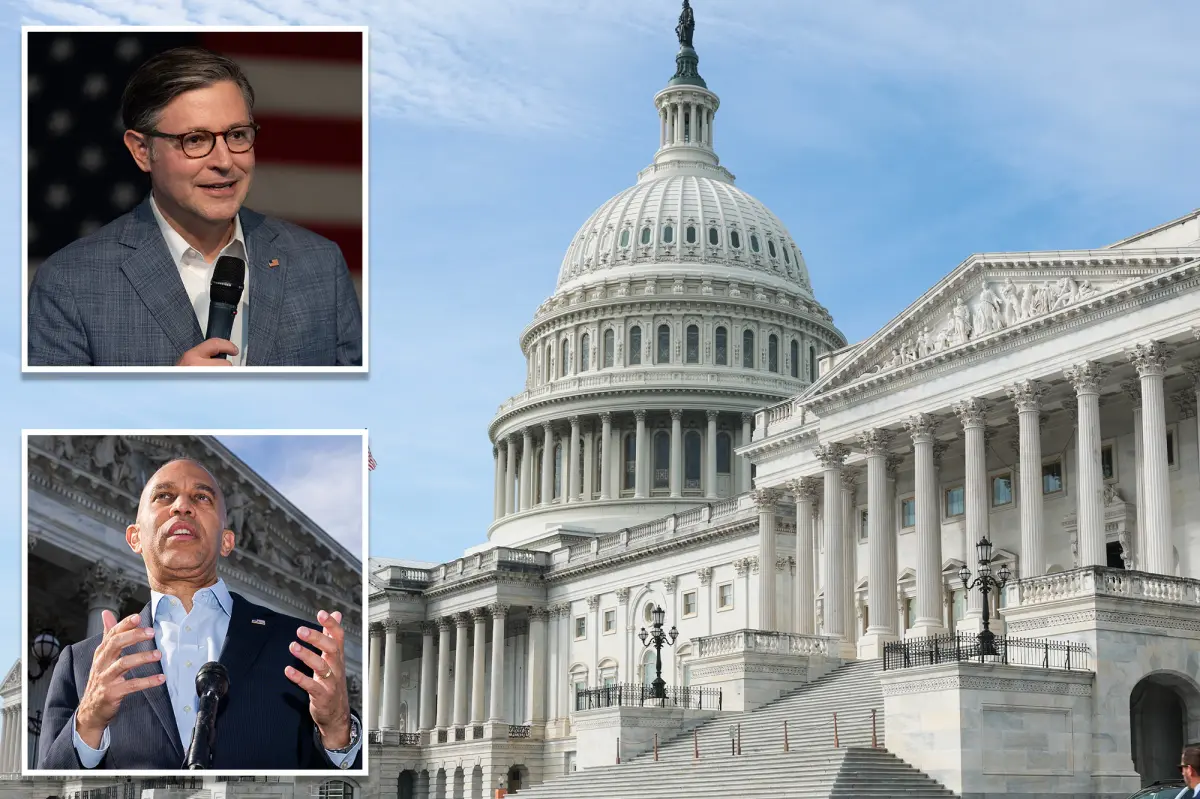

WASHINGTON — With roughly a month remaining before the midterm elections, House Democrats are widening their offensive map as polling increasingly points to a possible Democratic takeover of the chamber after four years in the minority.
The Democratic Congressional Campaign Committee has added several Republican-held districts to its list of targets, including seats represented by Reps. Jack Bergman of Michigan, Derek Schmidt of Kansas, Brad Knott of North Carolina, Jeff Van Drew of New Jersey, Stephanie Bice of Oklahoma, Michael Baumgartner of Washington and Ben Cline of Virginia. The committee is also eyeing the open seat in Texas’ 9th Congressional District.
The Cook Political Report currently classifies each of those contests as either “likely Republican” or “solid Republican,” underscoring the breadth of the Democrats’ expanding strategy.
The DCCC now lists 66 House districts as competitive, twice as many as it identified as “in play” before the 2024 House elections.
“Democrats are continuing to expand the midterm map into deep red territory as Republicans run scared,” DCCC Chair Rep. Suzan DelBene, D-Wash., said in a statement.
DISCOVER MORE: NC Gov. Roy Cooper Sent $100M in Hurricane Aid to Low-Income Housing
DelBene argued that Democrats are positioned to capture the House majority in November, saying voters are frustrated by what she called Republicans’ unfulfilled promises while her party is emphasizing lower costs, anti-corruption efforts and support for working families.
Historically, the president’s party has lost House seats in nearly every midterm election since 1938, with 1998 and 2002 standing as the only exceptions.
Republican leaders, however, maintain that they can still preserve their House majority. They point to previous election cycles in which polling failed to fully capture the strength of GOP support.
Republicans also hold a substantial fundraising advantage. The National Republican Congressional Committee reported $89 million in cash on hand, compared with $76 million for the Democratic Congressional Campaign Committee, according to the latest Federal Election Commission filings.
The financial gap is even wider at the national party level. The Republican National Committee had $125 million available, while the Democratic National Committee reported $16.9 million in cash and $17.6 million in debt.
Even with that Republican financial edge, Democrats lead by 8.3 percentage points in the generic congressional ballot, based on the latest RealClearPolitics polling average.