

Tennessee’s failed effort Wednesday to execute 30-year death row prisoner Christa Pike by lethal injection has cast new doubt on the state’s use of capital punishment—and could ultimately prompt officials to abandon executions altogether, according to the former Knoxville police chief who supervised her arrest in the 1995 killing of 19-year-old Colleen Slemmer.
“I’ll be surprised if there are any executions in Tennessee in the near term, if again, ever,” Phil Keith, who headed the Knoxville Police Department from 1988 to 2004, told News Outlet.
Pike drew national attention in the lead-up to her scheduled Sept. 30 execution after filing a last-minute appeal, seeking clemency and asking for alternative execution methods and an all-female execution team. But when officials failed in their attempts to administer the lethal injection, the botched execution became the central focus.

An undated portrait photograph of Colleen Slemmer provided by her mother. (May Martinez/Special to the News Sentinel)
That attention, Keith said, overshadowed the story of Slemmer, the woman Pike was convicted of killing.
“Why don’t we talk about Colleen’s potential future, about her life, you know, do a deep dive on her family, talk about what she was trying to do?” Keith said in an interview with News Outlet on Thursday.
Pike and Slemmer met at the Job Corps Center, a vocational program for young people from challenging backgrounds, Keith said. While Pike displayed behavior he associated with a developing criminal career, Slemmer was a teenager who avoided trouble and was working to build a better future.

Christa Gail Pike is seen during her trial for the murder of Colleen A. Slemmer March 18, 1996, in Knox County Criminal Court. (USA TODAY Network via Reuters Connect)
“She was a bright young woman,” Keith said. “She had interest in computers. She was applying herself there. She was clearly an innocent party in this, she was not involved in any of the violence that went on at Job Corps.”
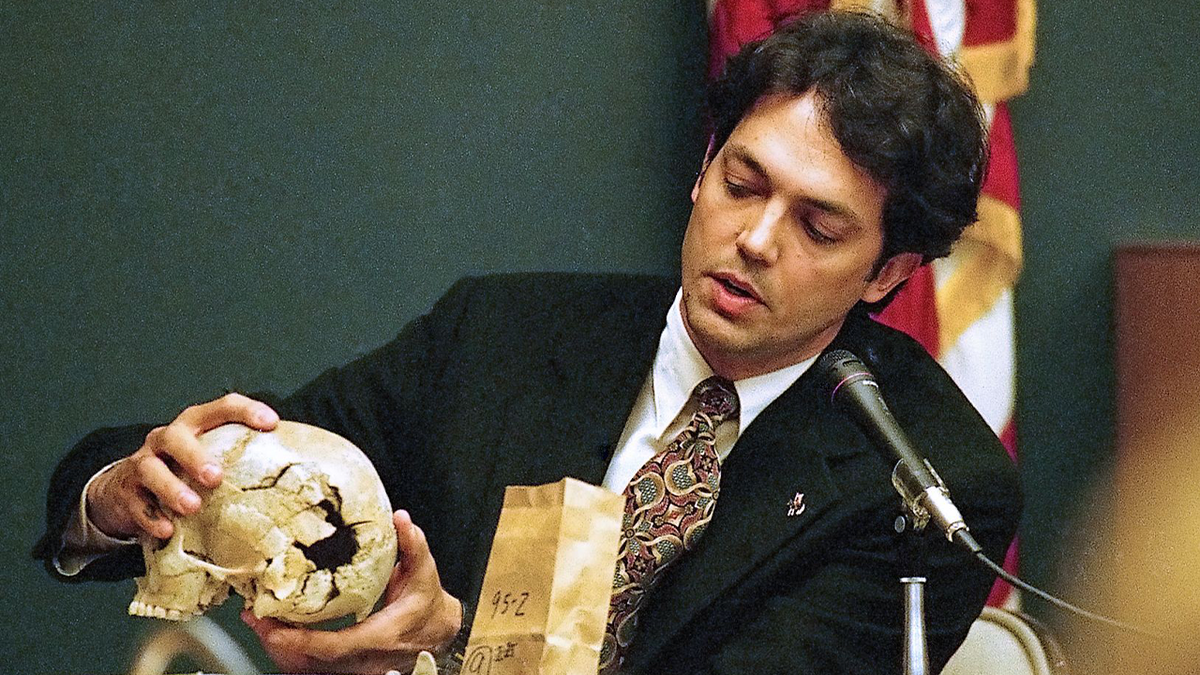
University of Tennessee forensic anthropologist Dr. Murray Marks testifies about the wounds to Colleen A. Slemmer’s skull during Christa Gail Pike’s murder trial in Knox County Criminal Court on March 25, 1996. (USA TODAY Network via Reuters Connect)
Keith described Slemmer as shy and committed to her education.
“She was just a child that was trying to, that had been through a troubled early life and was trying to get her life on track,” the former chief said. “Her mom was, was clearly a big supporter of her, but there were some limitations there.”
Slemmer’s mother, May Martinez, did not respond Thursday to News Outlet’s requests for comment.
Pike and two others—her boyfriend, Tadaryl Shipp, and friend Shadolla Peterson—lured Slemmer to a park, where they beat, cut and tortured her for as long as an hour.

Christa Gail Pike was scheduled to be executed on September 30, 2026. (Tennessee Department of Correction via AP)
“Pike was the catalyst,” Keith said. “She was the one that was planning out all the events, the luring, all that sort of thing.”
Keith said Pike showed “no remorse” during police questioning. At trial, a psychiatrist later testified that the attack included what he described as “satanic elements.”
Pike also kept a fragment of Slemmer’s shattered skull as a trophy and displayed it to classmates before her arrest, Keith said. Shipp prevented Slemmer from escaping and restrained her; he later carved pentagrams into her chest and face.
“She represents pure evil,” Keith said of Pike.