
People who practice Islam could outnumber Christians worldwide by 2035, making Islam the world’s largest religion, according to a new Pew Research Center study.
The report points to higher fertility rates and younger populations among Muslims as the primary reasons for the shift. Muslim populations are expanding more rapidly than those of other major faith groups.
“Around the world, we find that Muslims tend to have more children than non-Muslims, [and] they tend to be younger as a result of having more children in the past,” Pew senior demographer Conrad Hackett told News Outlet.
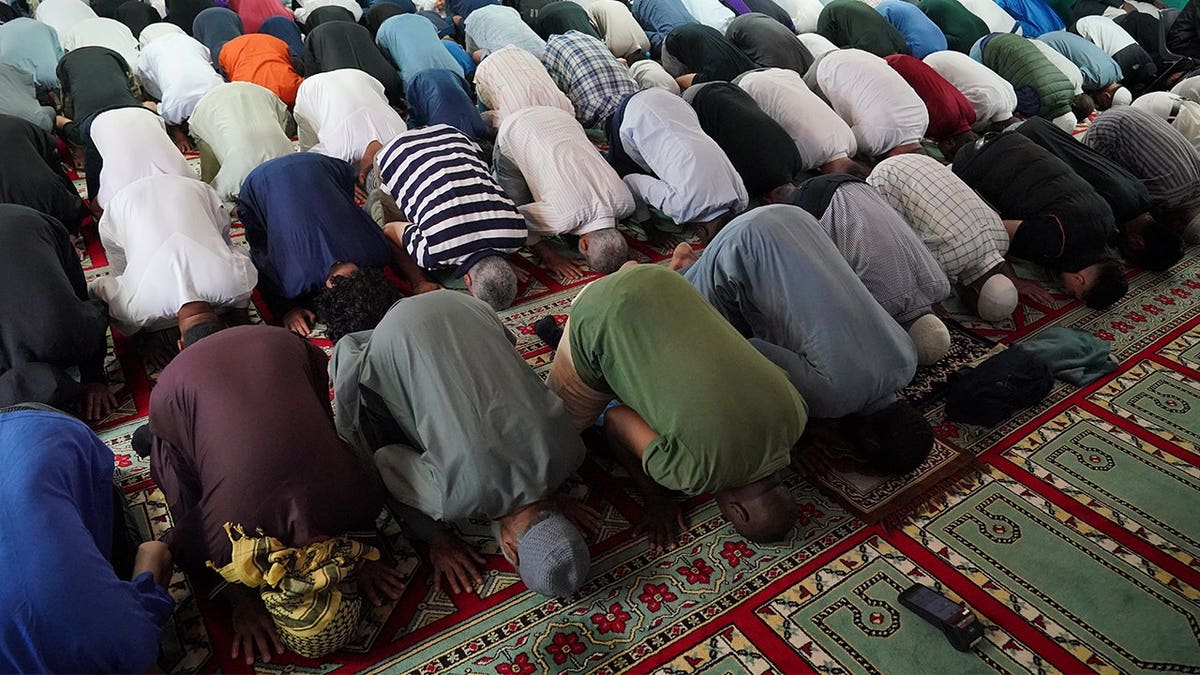
Muslims attend Friday prayers at a mosque. (Jonathan Brady/PA Images via Getty Images)
Muslims have the highest fertility rate among the groups examined, at 3.1 children per woman, followed by Christians at 2.5, the study found. From 2020 to 2025, Muslim women had 252 million babies—more than women in any other religious group and above the 208 million births recorded among Christian mothers.
The United States could also experience a significant religious transformation if current trends persist. Christians now represent approximately 62% to 64% of U.S. adults, but that figure is projected to drop below 50% by 2065.
By 2070, Christians are expected to comprise less than half of the U.S. population, while religiously unaffiliated Americans—often called “nones”—could account for about 41%.
“The Muslim population in the U. S. is growing faster than the Christian population, but Christians vastly outnumber Muslims in the U. S., and that’s not going to change,” Hackett said.
The U.S. Muslim population is projected to reach nearly 4% by 2070. That would make Muslims the country’s third-largest religious group, behind Christians and the religiously unaffiliated, and ahead of the Jewish population.
The geographic center of major religions is changing globally as well. By 2070, Pakistan is expected to have the world’s largest Muslim population, followed by India, Nigeria and Indonesia, which currently ranks first.
MUST READ: Veteran NYPD School Safety Agent Strangled by Ex-Con Boyfriend

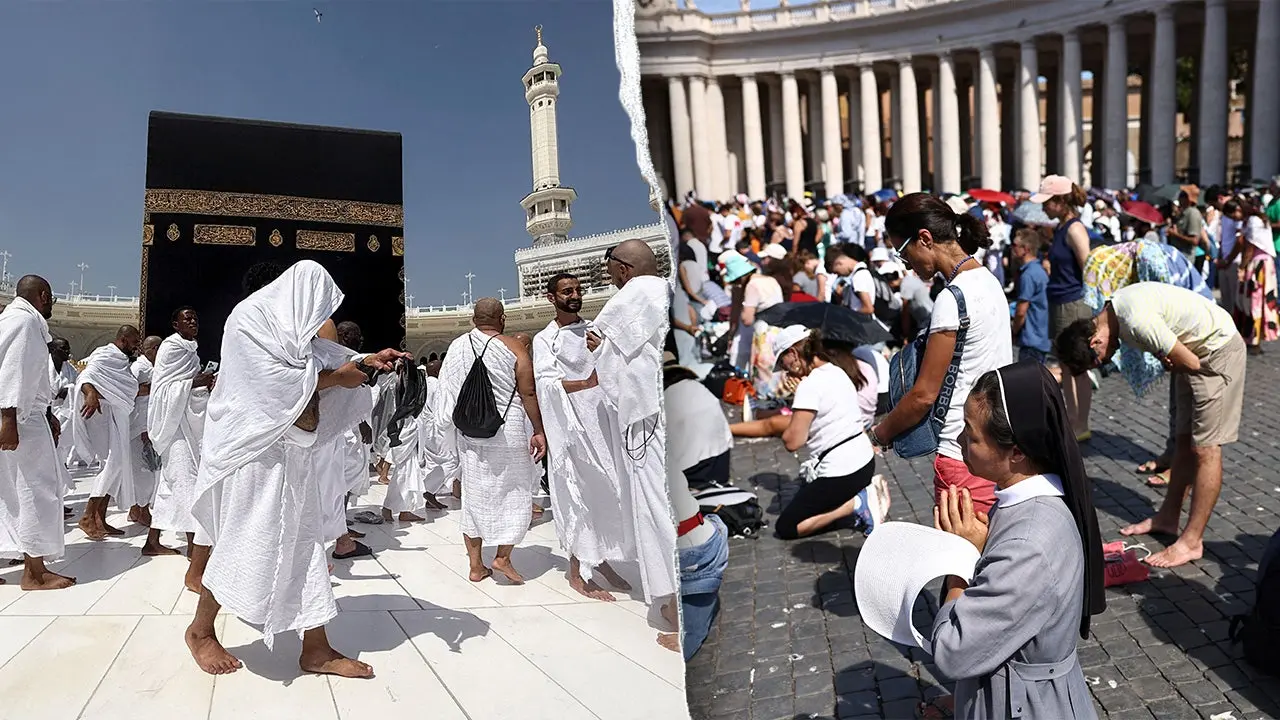
Muslims pray in Mecca, one of Islam’s holiest sites in Saudi Arabia, while Christians pray inside Vatican City. A Pew Research report released Wednesday said Muslims could outnumber Christians worldwide by 2035. (Reuters)
Christianity is also moving southward. By 2070, more than half of the world’s Christians are expected to live in sub-Saharan Africa. The Democratic Republic of the Congo is projected to overtake the United States as the country with the largest Christian population.
Hackett noted that most of the world’s Christians lived in Europe a century ago. Europe now has slow population growth and is expected to contract in the coming decades, while Africa’s population continues to expand rapidly.
“Europe’s population has been growing slowly, and Africa’s population has been growing very quickly,” Hackett said. “In the coming decades, Europe’s population is expected to shrink, [while] Africa’s population is going to expand a lot.”
Other religious populations are changing, too. The global Jewish population is expected to become more concentrated in Israel, where 62% of the world’s Jews are projected to live by 2070, compared with 46% in 2020.
Pew projects that the global Muslim population will surpass 3.6 billion by 2070, compared with slightly less than 3 billion Christians.
Muslims and Christians are the only major religious groups expected to keep pace with overall global population growth. The world’s population is projected to rise 29% between 2020 and 2070, while the Christian population is expected to increase 30% and the Muslim population 80%.
Outside organized religion, the number of people with no religious affiliation—including atheists and agnostics—continues to increase in many countries.
China is home to a substantial share of the world’s religiously unaffiliated population, but its population decline is expected to offset growth elsewhere, Hackett said. Excluding China, the global population of “nones” is projected to grow by more than 180 million by 2070.
Religiously unaffiliated people already make up a majority of the population in 10 countries, including the Czech Republic, Japan, the Netherlands, New Zealand, Uruguay and Vietnam.


