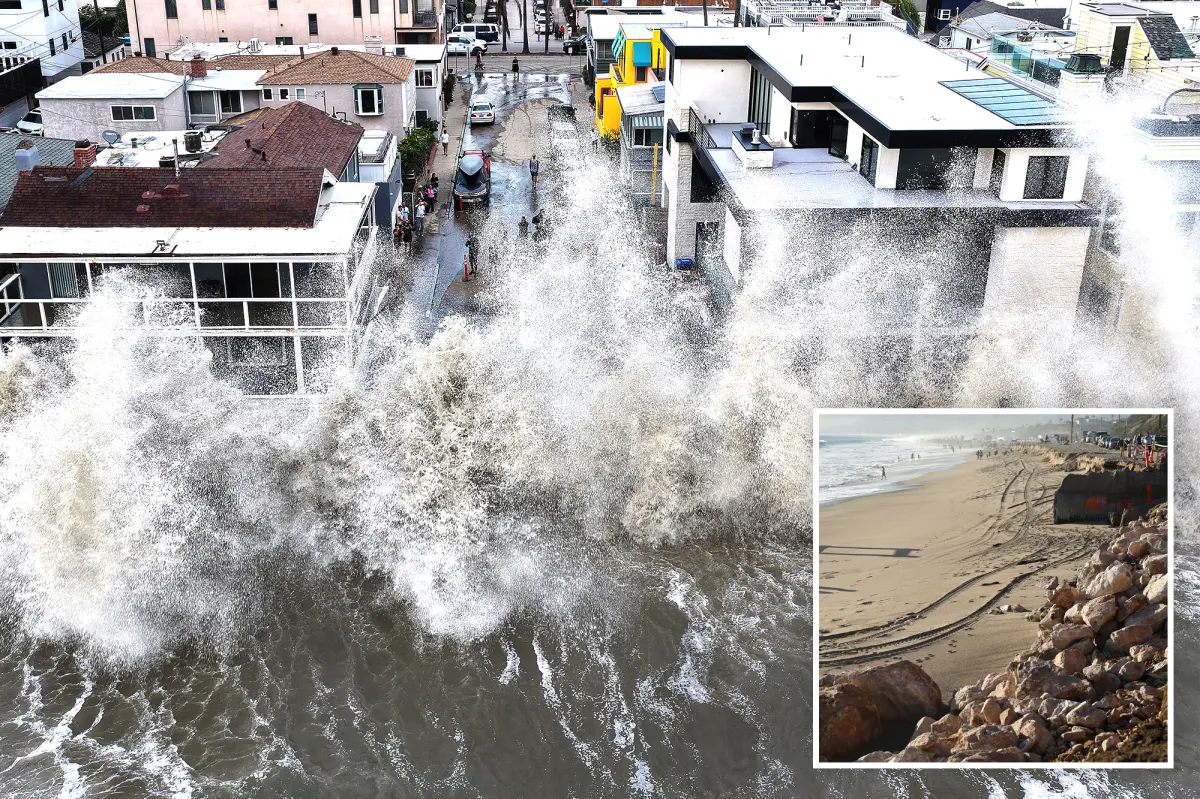

California’s coastline is preparing for a major rise in sea levels that could lift ocean waters by up to a foot in the coming days, adding pressure to beaches already damaged by recent storms and increasing the threat of flooding and erosion.
The phenomenon, called a “coastal trapped wave” or “Kelvin wave,” is linked to El Niño and has been developing along the California coast over the past several weeks.
This is far more than a typical ocean wave.
A Kelvin wave is a vast, persistent mound of seawater. It is expected to raise ocean levels across a zone extending roughly 12 to 18 miles offshore, potentially creating serious problems for communities along California’s coast.
The surge follows a series of unusual ocean events that have battered coastal areas, including waves that spilled across Pacific Coast Highway in Malibu last month.
California is already enduring a barrage of storms, and the higher sea levels could intensify both coastal flooding and beach erosion.
MORE ON THIS: Accused Killer Confesses to Murder 14 Years After Missing Georgia Boy Found Dead in Creek
“The general rule of thumb is that every two to four inches of sea level rise that we see in that background state essentially doubles your flood risk,” Dillon Amaya, an oceanographer at North Carolina State University, told AFP.
Kelvin waves are not unusual on their own. The heightened concern now stems from the way this surge is coinciding with several other forces affecting California’s coastline.
As those conditions converge, California could experience its highest sea levels ever recorded, Mark Merrifield, director of the Center for Climate Change Impacts and Adaptation at the Scripps Institute of Oceanography in La Jolla, told the New York Times.
Ocean temperatures are already running high, while several beaches in Southern California are coping with erosion and recovering from the impact of recent hurricanes.
Amaya said the Kelvin wave is both a driver and an indicator of El Niño.
As the enormous water bulge travels across the Pacific, it suppresses the cold water that would typically rise from the ocean depths. That process helps push surface temperatures higher, one of the defining features of El Niño.