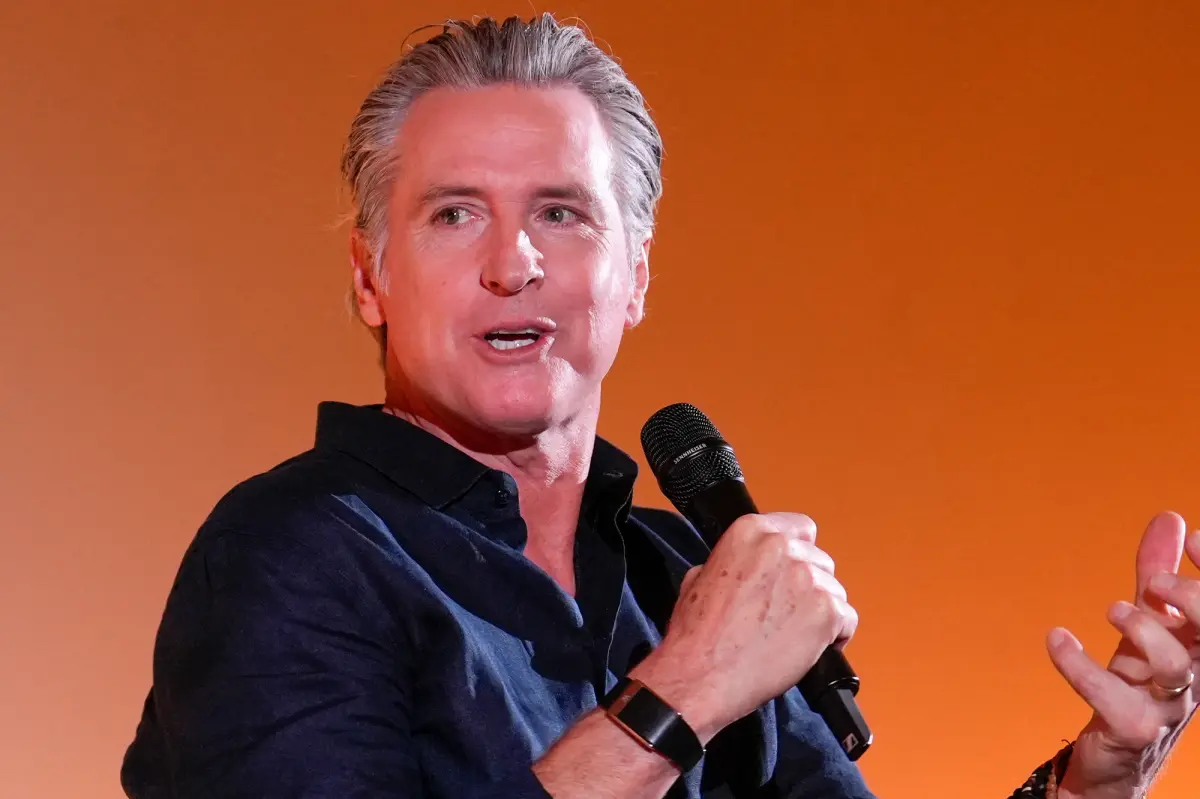

California Gov. Gavin Newsom is leaving office with only lukewarm approval from voters in his home state, a potentially troubling signal as he weighs a 2028 presidential campaign. The new poll highlights challenges the California Democrat could face as he seeks a national audience.
Newsom received a 45% approval rating for his job performance, while 46% of the 625 registered California voters surveyed said they disapproved, according to a poll released by NBCUniversal Local and the Telemundo Station Group.
The survey, conducted from Sept. 21 through Sept. 24, revealed a sharp partisan divide. Roughly 93% of Republicans said Newsom was doing a poor job, while 56% of independents also viewed his performance negatively.
Political consultant Matt Rexroad told The Post that Newsom’s greatest obstacle could be his weak standing outside California’s two dominant metropolitan regions: the Los Angeles area and the Bay Area.
In predominantly rural Northern California, excluding Sacramento and the Bay Area, just 28% of respondents approved of Newsom’s performance, compared with 60% who disapproved.
“This does not impact his Presidential campaign directly, but it does indicate that he does not know how to communicate with rural voters,” Rexroad said.
“The people of Iowa, New Hampshire, and South Carolina will not be impressed with a politician from California who wants to talk about being from 1) California 2) San Francisco and 3) now lives in Marin County,” he added.
Rexroad pointed to a new Republican Governors Association advertisement linking a Democratic candidate for governor in Kansas to California as an example of the Golden State’s politically polarizing national image.
The poll also found a significant gender divide: Most men disapproved of Newsom’s performance, while most women approved. By race, a majority of white Californians expressed disapproval, whereas Hispanics and Asians generally viewed the governor favorably.
Approximately 74% of California Democrats approved of Newsom’s job performance. However, that level of support may not be strong enough for a national campaign in an increasingly polarized political climate, said Morris Levy, an associate professor of political science at the University of Southern California.
“In short, Democrats mostly support Newsom, and Republicans are overwhelmingly opposed,” Levy said.
“Some Democrats are also lukewarm on Newsom, or dissatisfied with his performance, and this could become an issue if he seeks the nomination.”
Levy said the divide is driven in large part by partisanship, noting that President Donald Trump’s approval ratings appear to be a “mirror image” of Newsom’s.
Among surveyed California Democrats, 66% said they would be inclined to vote for Newsom as the Democratic presidential nominee, while 15% said they would not. Levy cautioned, however, that the question did not ask voters to choose Newsom over other potential candidates.
Newsom’s approval ratings were relatively consistent across age groups, but Levy said the poll may not capture the full range of challenges he would face in a presidential race.
“Newsom has sought to position himself as a mainstream Democrat — tussling with Trump but also tacking toward the center on issues such as transgender athletes’ participation in female sports,” he said. “That probably masks the opposition Newsom or Harris would face from the surging younger portion of their base that has shifted far to the left on economic issues, Israel, and more.”
In recent months, Newsom has traveled to early primary states, including Michigan and South Carolina, as he gauges his appeal beyond California.
The governor has also announced policies and taken positions that political observers have interpreted as efforts to connect with a more left-leaning Democratic primary electorate. This year, for instance, Newsom endorsed a national billionaire tax despite having long opposed a proposed billionaire tax measure in California.
The Post contacted Newsom’s office for comment on the poll.