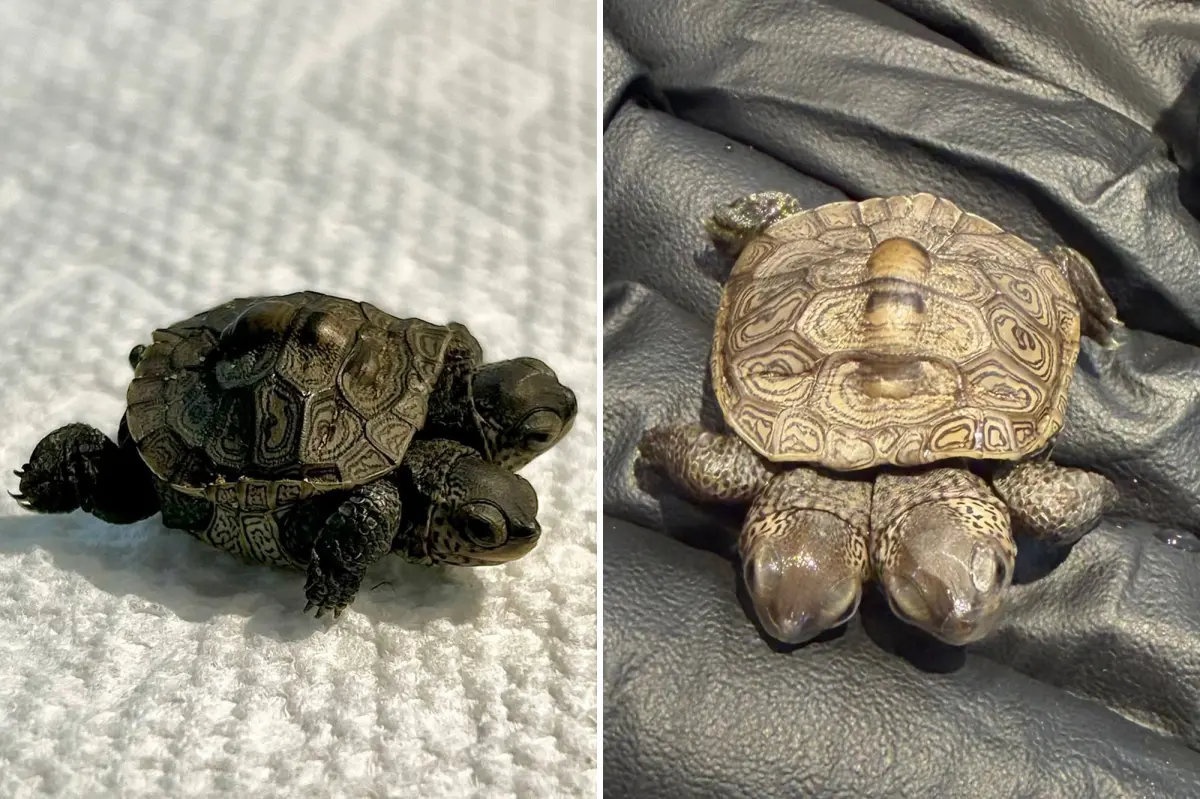

No, your eyes aren’t playing tricks on you.
A rare two-headed baby turtle was discovered last month at a protected nesting site on Cape Cod, Massachusetts — and the tiny hatchling is defying the odds by continuing to survive.
The diamondback terrapin weighs about as much as a nickel and has bicephaly, an uncommon developmental abnormality, according to the Cape Wildlife Center, which shared news of the hatchling on Facebook.
The pint-sized turtle was brought to the wildlife center by the Mass Audubon Wellfleet Bay Wildlife Sanctuary, where it will be closely monitored and cared for.
Bicephaly occurs when an animal develops two functioning heads on a single body. According to Live Science, the condition is generally linked to the incomplete splitting of one embryo as identical twins form.
Staff at the Cape Wildlife Center said they have documented only two other cases of bicephaly in the past five years, making this double-headed baby turtle “especially rare.”
“While we’ve encountered this unusual condition before, every case gives us another opportunity to learn more about these fascinating animals’ anatomy and physiology,” the center said.
“For now, our team is monitoring this little one’s (two’s?) appetite, growth, and behavior closely.”
The two-headed turtle represents an unusual example of bicephaly in the species, said Zak Mertz, CEO of New England Wildlife Centers, which includes the Cape Wildlife Center.
CONTINUE READING: Cornell Frat Members Accused of Sharing Snapchat Image of Alleged Rape
“It is fascinating and an area that certainly merits more study,” Mertz told the outlet. “We are excited to care for these two and learn as much as we can to inform future study in the process.”
Mertz said available research suggests the rare double-headed condition may result from both genetic and epigenetic factors.
“It may have to do with the relatively long lifespan of the turtles, their preference for returning to the same nesting sites, and a limited gene pool due to their conservation status,” he said.
Environmental conditions could also play a role, Mertz added. Potential influences include incubation temperature, humidity, the physical features of nesting sites and even substances to which the parents may have been exposed.
Although two-headed animals are rare, the phenomenon is not unheard of. Recent examples include a two-headed porpoise found off the coast of the Netherlands and a double-headed dolphin discovered on a beach in Turkey.
A 2021 study titled “Two heads are not always better than one” found that double-headed and partially duplicated sea turtles commonly have major craniofacial abnormalities, involving the skull, face, bones and soft tissue, as well as spinal defects.
The study also found that two-headed turtles are typically smaller than other hatchlings and face serious survival challenges because of their abnormal anatomy.
Because bicephaly can threaten a turtle’s ability to survive, researchers say closely observing these rare animals can provide valuable insight into the health of the species and its habitat.
Diamondback terrapins live in brackish marshes along the Atlantic and Gulf coasts of the United States. In Massachusetts, the species is classified as threatened under the Massachusetts Endangered Species Act, according to the outlet.