
In the end, I manage to surprise her, arriving at Stornoway Airport to wave goodbye after her four-week stay on the Isle of Lewis.
She can barely conceal how pleased she is. Her dark eyes remain as sharp as ever, framed by a beautifully tailored black outfit – a colour that has always complemented her – enhanced with sequins and jewellery.
She still makes or modifies many of her own clothes. During the years when we first knew each other, she wore a spectacular, towering hairstyle; people even whispered that she fashioned her own hats.
For a minute or two, we stand holding hands and catching up. A fortnight earlier, I had lent her the latest biographies of our late Queen, written by Hugo Vickers and Robert Hardman. She is carrying both books home, and we happily debate which author has produced the better account.
She is firmly on Team Vickers, declaring her choice with the infectious delight and playful mischief that have always been part of her character. Then, with considerable dignity, she is escorted on to her flight.
Only then does cianalas descend upon me. It is an almost overwhelming feeling, and one for which there is no perfect English translation. The closest comparisons may be the Welsh hiraeth or the Portuguese saudade – a wrenching longing not merely for a place, but for a time, perhaps even for a place and time that never fully existed.
I have no desire to abandon the conveniences of a world filled with USB-rechargeable gadgets, nor do I wish to see corporal punishment restored in schools.
Nor do I yearn for the island that still existed within living memory: a place where my grandmother washed clothes in the village river, women regularly died in childbirth and schoolchildren were lost to tuberculosis. If Norman left for Canada, he was unlikely ever to see his parents again.

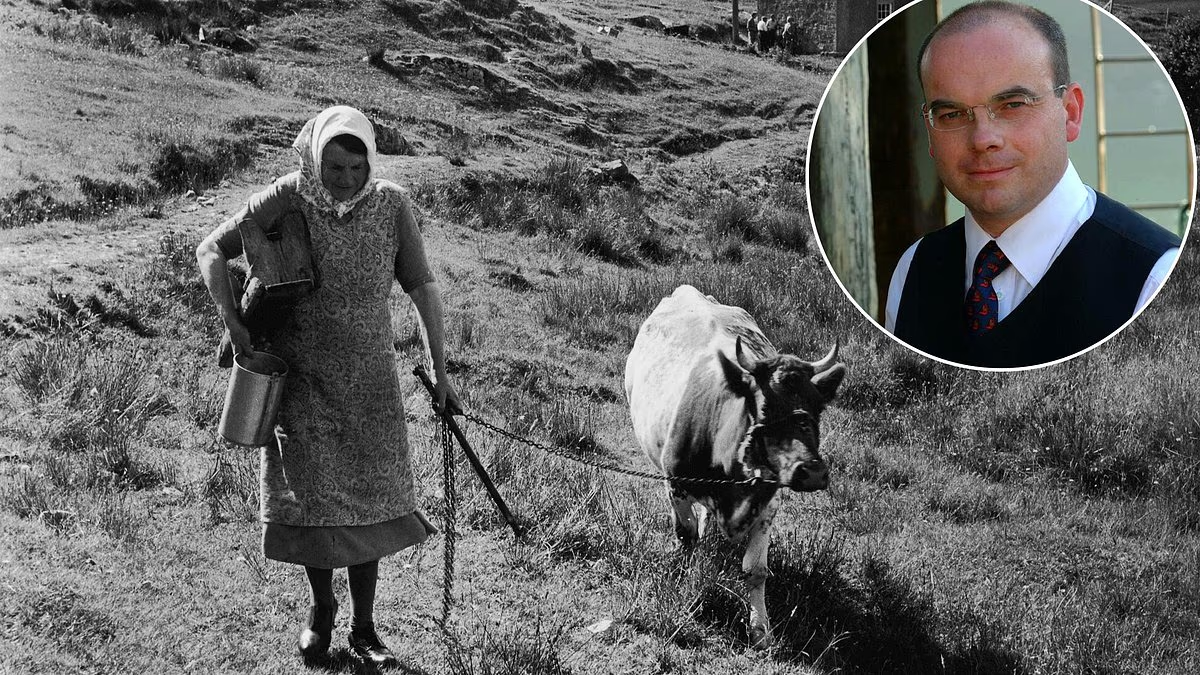
A woman guides her cow along a Hebridean track in 1955, carrying a milking stool and bucket
And yet I carry memories of countless other times and places. My earliest recollection is of lying in my pram, back when babies were routinely placed outdoors for a while, feeling warm and secure as rain tapped against the cover.
I remember my grandfather from Shawbost and the last cow he kept, a bad-tempered animal with enormous, floppy feet.
I remember being held in my father’s arms in 1970 while my bright-eyed great-grandfather, his hands as large as spades, welcomed my newest baby brother – the first child in the fourth generation to bear his name.
As a boy, I had the privilege of meeting people born in the 1870s and 1880s. They bore the unmistakable, melancholy imprint of the Great War, as well as the scars of those who had survived its 1939 sequel.
Once, I was alone in a manse with a very elderly minister who had been ordained in 1922. Silence suited us both, though I sensed the weight of memories he carried. More than a decade later, in another manse, I asked him about the Kaiser’s war.
He avoided my gaze and stared into the fire. ‘I came back,’ Reverend Professor Finlayson said quietly, ‘but many others did not…’
I was always comfortable in the company of older people, eagerly drawing out their stories and recollections. My fascination with the past even irritated my late father, who often found that I knew more about our family history than he did.
After my grandmother died in 1997, he asked for all the notes and documents I had gathered: military records, wedding telegrams and letters dating back to the 1910s. He took the collection south, but it did not outlive him. He threw it away or burned it.
The national struggles for survival left behind more casualties, even generations later, than we care to acknowledge. Several months ago, I visited an oak tree each day near my former school in Jordanhill. I would lie beneath its branches, looking towards the dignified Locharbriggs-stone building, every part of it alive with memories.
And with ghosts. There was the gentle, nervous French teacher, a man in his sixties whose ability to control a classroom seemed barely greater than that of a civilian facing the 101st Airborne Division.
One January, he failed to return to class. When he did not appear for work, the worried headmaster forced his way into the teacher’s home and found him dead – apparently for several weeks. We later learned that Mr Graveson had been captured and tortured by the Gestapo four decades earlier. He had never recovered from the experience and had overdosed.
Other ghosts, on that playing field before me, are rawer still. The girl killed in a car crash in her 20s. Another lass, felled by cancer before she made 40; the boy who, in the wake of a bad head injury, took his own life.
And here was I, decades hence, spared, 60, and faintly ridiculous, remembering them and many others under that oak tree. There are milestone events I am pleased to remember, like Richard Nixon leaving the White House in disgrace, or the April 1976 funeral of Montgomery of Alamein.
Others I wish I did not, like tightrope star Karl Wallenda’s fatal Puerto Rico plummet in March 1978. News coverage was far less herbivorous in those days: his scream as he fell haunts me still.
I saw things you are unlikely to see again.
An old woman on a three-legged stool hand-milking a cow. A whole village coming together to scythe one neighbour’s hay. I have in my day been roped in to help dig the odd grave; remember the soothing stillness of the past Lewis Sabbath when – save for sermon – no one ventured outside their house.
I have lived, too, into a era when sneerers and strangers have done their best to profane it. Many of the strongest memories involve food.
On August 12, 1977 – I can date it precisely because the broadcaster on the Scottish Home Service was enthusing about the Glorious Twelfth; it was a few days before Elvis died – we had a memorable extended-family outing to Dalmore beach, legendary for its thunderous breakers.
A peerless day. Glorious weather. We still talk about it. My wee brother and our cousin eventually trundled home, shrieking with joy, in an aunt’s orange Citroen Dyane – standing on the back seat waving through the sunroof.
There was only so much space around my grandmother’s table and (the firstborn often took one for the team) I was gently sent to eat outside. She had made the most delicious stew, with new potatoes scarce an hour out of the soil, and I sat on my haunches, wholly content, and savoured every mouthful in that distant golden evening.
And, just on Monday, the cianalas is again upon me. I am parted now from her; but I cannot part from Stornoway Airport. I loiter for nearly an hour, and find a convenient perch.
A grassy mound adjacent to the fuel compound and suspiciously similar to one on the other side: not so long ago, this was an RAF base and, should they explain it, they’d probably have to kill me.
Aircraft land or organise in rapid succession; at length, the largest takes off in a scream of jets.
Soaring south, and east, high, through the pillowy clouds, bearing my mother from her native island to Glasgow – her merriment a mist in my ears, though something blurs my eyes.