
For decades, the object remained hidden beneath a living-room sofa—a forgotten family heirloom brought to Britain from China by a long-lost relative.
Now rediscovered, the bowl has been identified as a Qing dynasty masterpiece created in Beijing’s Forbidden City to celebrate the birthday of a Chinese empress dowager.
The rare imperial artefact is expected to fetch between £20,000 and £30,000 when it goes under the hammer.
Measuring two feet around its circumference and weighing 30lb, the enormous porcelain dish was brought to Britain by Wing Lung Goo in the early 20th century before being passed through generations of his family.
For years, it sat beneath the sofa in the Barnet, north London, home of one of Mr Goo’s descendants.
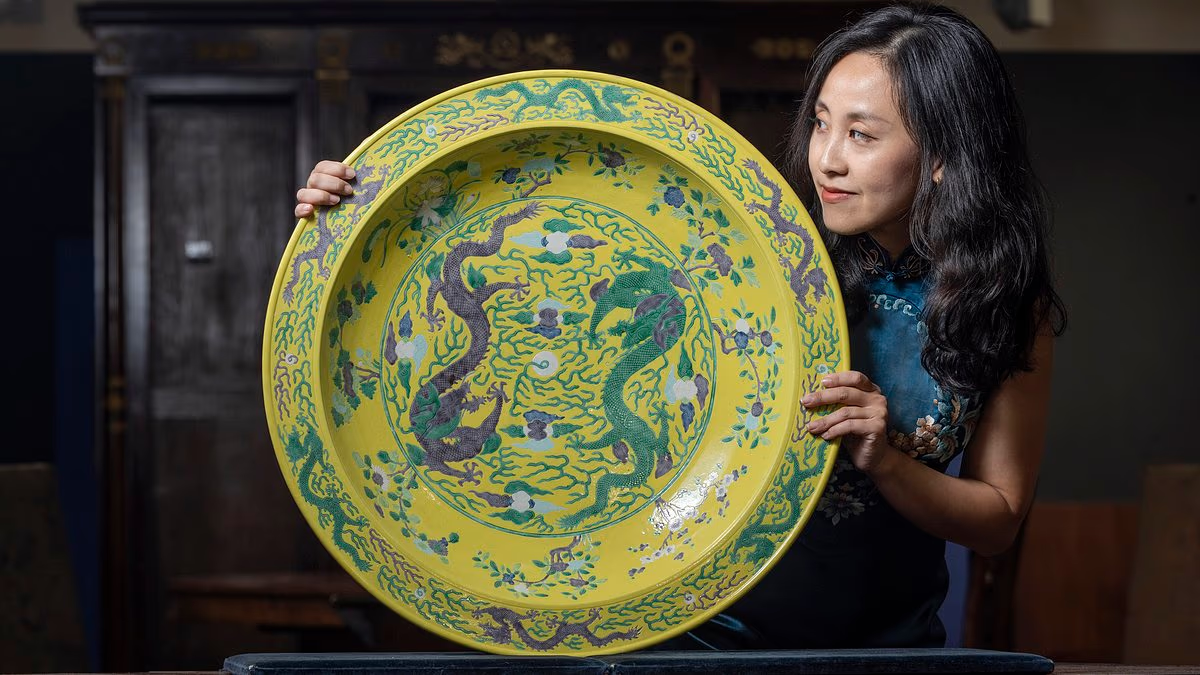
The family member suspected the bowl could be valuable after uncovering it and contacted auctioneers with photographs. The dish is decorated in imperial yellow, highlighted with green and aubergine enamel.
John Axford, an Asian art specialist who has appeared on the BBC’s Antiques Roadshow, was immediately intrigued by the dish’s exceptional size and arranged to inspect it at the townhouse.
On the underside, Mr Axford discovered a four-character seal mark reading ‘Chuxiugong zhi’, meaning ‘Made for the Chuxiu Palace’.
Also known as the ‘Palace of Assembled Elegance’, Chuxiu Palace was one of six Western palaces in the Inner Court of Beijing’s Forbidden City.

The rare Chinese imperial relic is expected to sell for up to £30,000 at auction

Created for a Chinese empress dowager’s birthday, the dish features imperial yellow decoration with green and aubergine enamel details

The dish was kept beneath the living-room sofa of a descendant of Chinese immigrant Wing Lung Goo, who brought it to Britain
CONTINUE READING: Christa Pike Lawyer Seeks Death Sentence Reversal Over Failed Execution
Mr Axford determined that the dish was made in the 1880s to mark the birthday of Empress Dowager Cixi. He believes the family may have tucked it away because its size and weight made it too difficult to display securely on a wall or shelf.
He said: ‘We are not exactly sure why the dish was kept under a sofa for decades, but it could be that it was simply too large to hang on a wall or put on display.
‘It is not necessarily the most sensible place to store an object like this, and when we received photographs of the dish it was covered in dirt.
‘However, its size made me feel it was worth visiting in person. When I examined it, I identified the highly unusual seal mark used specifically on dishes made for the empress’s birthday.’
Mr Axford, chairman and head of Asian art at auction house Woolley & Wallis, added: ‘Once it was cleaned, the dish emerged beautifully.
‘Finding an imperial dish of such monumental scale in almost pristine condition—and learning that it had been stored beneath a London living-room sofa—is truly extraordinary.’
Described as one of the ‘most significant examples’ of late Qing palace porcelain to appear at auction in recent years, the dish depicts two dragons facing one another as they compete for a flaming pearl amid clouds and flames.
Its exterior carries a floral band featuring lotus, prunus, peony, chrysanthemum and hibiscus blossoms, while a further six dragons and flaming pearls decorate the rim.
Woolley & Wallis said the ‘rare’ dish was the ‘only known example of this type, where the base is also glazed in a yellow colour’.
It added: ‘Combining imperial palace provenance, direct association with the court of the Empress Dowager Cixi, exceptional scale and a potentially unique yellow-glazed base, the dish ranks among the most significant examples of late Qing palace porcelain to appear on the market in recent years.’
The Qing dynasty, which ruled from 1644 to 1912 under the leadership of the Manchu people, was the last imperial dynasty of China.
The item is set to go on sale on November 10.