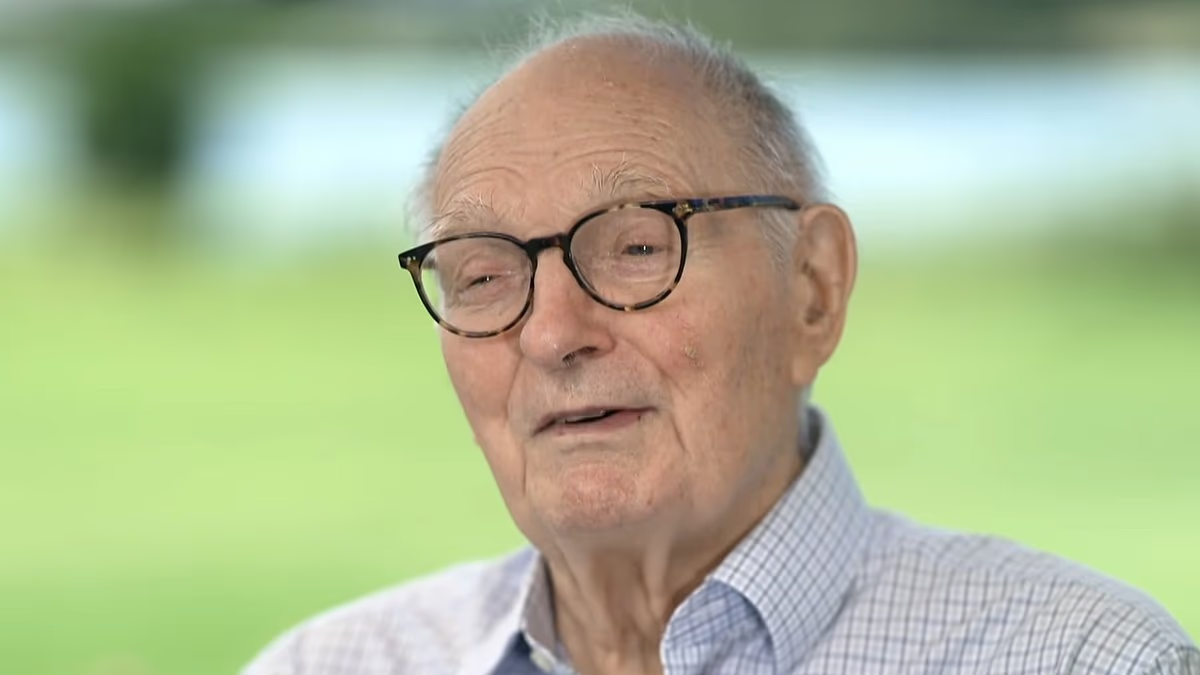

Alan Alda has spoken about the unusual sleep-related symptom that ultimately led to his Parkinson’s disease diagnosis.
The 90-year-old M*A*S*H star said he had begun physically “acting out [his] dreams” before being diagnosed with the neurodegenerative condition at 79.
During an interview with CBS Mornings’ Dr. Jon LaPook, Alda explained that dream enactment was not widely recognized as a possible warning sign at the time. “I had a symptom which was, at the time, not that well known – acting out your dreams,” he said.
He described one particularly vivid episode: “I had a dream that somebody was attacking me. And I picked up a sack of potatoes and threw it at ’em. What I was really doing was throwing a pillow at Arlene, my wife.”
The veteran actor, who recently mourned the death of a former M*A*S*H co-star, said he did not experience some of the symptoms more commonly associated with Parkinson’s disease.
“I had no twitch, no tremor, no problems with my voice,” Alda said.

Alan Alda has described the unexpected symptom that preceded his Parkinson’s diagnosis
![The 90-year-old M*A*S*H alum said he was physically 'acting out [his] dreams' before he learned he had the neurodegenerative disease at age 79; pictured in 2020](https://i.dailymail.com/1s/2026/10/05/21/111665567-16185177-image-m-9_1791233394781.jpg)
The 90-year-old M*A*S*H alum said he was physically “acting out [his] dreams” before learning he had the neurodegenerative disease at 79; pictured in 2020
The behavior Alda described is formally called REM Sleep Behavior Disorder. According to the Cleveland Clinic, the condition can cause people to talk, move or flail while asleep.
Alda received his Parkinson’s diagnosis in 2015, but waited until 2018 to publicly disclose his condition.
The longtime entertainer said he has relied on humor as a way of coping, explaining that “the best way to deal with anything that’s a little bit of a problem is to find out what’s funny about it and laugh at it.”
He joked with Dr. LaPook: “I don’t let Parkinson’s define me. It’s not who I am. It’s just a hobby.”
Alda offered another lighthearted example of how the disease affects his daily life. “I’ll be at the computer keyboard writing an email, and Dr. Parkinson is moving my hand all over the screen. I have the mouse, and he’s eliminating things and he’s deleting things that I need,” he said.
He acknowledged that the condition can still be frustrating. “Once in a while I get frustrated, but I find what makes me laugh about it and then I go tell Arlene,” Alda said.
The nonagenarian said he tries to remain grounded in the present rather than wishing his circumstances away. “I don’t want to wish it away. I can’t wish it away. I can’t hope for a better future. I gotta accept what is,” he said.
Alda began his acting career in local theater during the 1950s and landed his first Broadway role by 1964.

Alda portrayed the witty military surgeon Hawkeye Pierce in all 11 seasons of M*A*S*H from 1972 to 1983

The comedy-drama was set in a field hospital during the Korean War; L-R Alda, Wayne Rogers and Loretta Swit
Speaking to Our News Outlet in 2015, Alda said he had never set out to become famous. “I’d have been happy working in regional theatre for the rest of my life. I never sought fame,” he said.
Alda played the witty military surgeon Hawkeye Pierce in M*A*S*H for 11 series from 1972 to 1983.
The comedy-drama was set in a field hospital during the Korean War.
The show received 109 Emmy nominations and won 14.
In 2015, he confessed he struggled with fame and became unhinged for a while.
He explained: ‘When somebody is “hot,” people’s hunting instincts are aroused.
‘Members of the public would grab me and shout to their friends, “Look what I got!” so much I had night terrors.’
Alda added: ‘For about six months I’d see somebody in the room who wanted to strangle me. I’d actually see the person. I mean, it was a dream, or a hallucination. But it seemed real.’
The beloved performer suggested that actors on the verge of fame should be supported by vets.
He stated: ‘I’ve always thought that when actors are about to get famous, other actors should get a support group going. Too many people think [fame is] a good thing.’
He added: ‘I know rich people who wish they were also famous. But if you can be rich without being famous, you should go for that. A lot of people think fame will solve their problems. In fact, it gives you a whole new set of problems.’