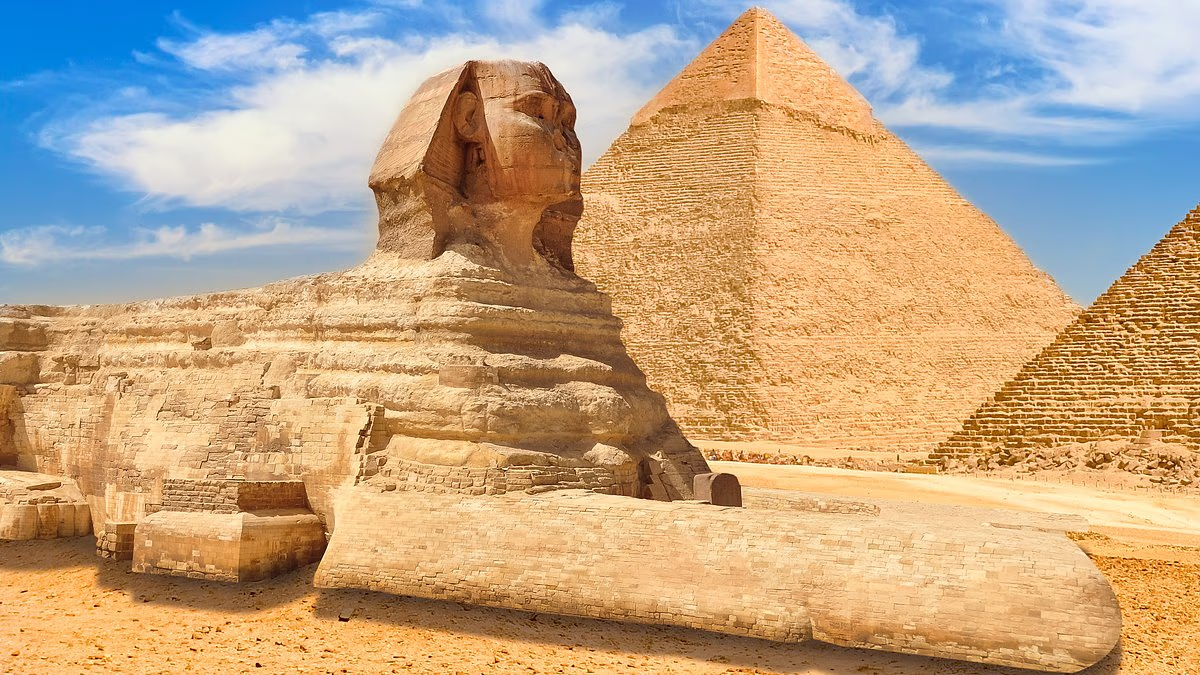

The Great Sphinx of Giza has puzzled researchers for centuries—and a new study suggests the ancient monument may hold an unexpected connection to a long-extinct predator.
Researchers say the half-human, half-lion monument was carved from limestone containing the fossilised remains of ancient crocodiles.
The discovery follows the identification of a previously unknown crocodile species in the Mokattam Formation of northern Egypt, a rock layer dating back 54 million years.
Named Herugavialis cairensis, the extinct animal takes its name from the Egyptian god Heru—believed by some to have inspired the Sphinx.
Its fossil was found in the same limestone deposits quarried more than 4,000 years ago for the construction of the Great Sphinx.
That geological link raises the intriguing possibility that fossils of the ancient crocodile remain embedded within the monument itself.
Lead author Dr Paul Burke, of the Swedish Museum of Natural History, told Our News Outlet: “It could! It was built from the same rocks where Herugavialis was found, so who knows.
“What I don’t recommend is tearing apart the Sphinx to see if there is!”

New research suggests that the limestone used to build the Great Sphinx of Giza may contain fossilised remains of ancient crocodiles

Scientists identified a new extinct crocodile species in the 54-million-year-old Mokattam Formation, whose limestone was later used to construct the Sphinx. The species was named Herugavialis cairensis (artist’s impression)
Co-author Professor Philip Mannion, of University College London, said: “Given this coincidence with the famously missing nose of the Great Sphinx, we decided to name the new crocodile after the Egyptian god Heru, who was possibly the inspiration for this iconic monument.”
Herugavialis belonged to the gavial family, a group of crocodilians recognised for their notably long, slender snouts.
Only two gavial species survive today, inhabiting freshwater ecosystems across the Indian subcontinent and Southeast Asia.
The fossilised skull of Herugavialis was first unearthed in the 1920s during excavations in the Mokattam Formation.
At first, researchers classified the specimen as belonging to the false gharial, or Tomistoma schlegelii, one of the living members of the gavial group.
Modern palaeontological techniques, including CT scans that reveal the skull’s internal structure, have since exposed important differences between the fossil and the false gharial.
The evidence showed that the skull represented a completely new species of extinct crocodile, detailed in a study published in Royal Society Open Science.
In another curious parallel with the Sphinx, the fossilised skull is also missing the end of its snout.

Researchers say the Sphinx could contain additional fossils of Herugavialis cairensis (artist’s impression), although they strongly advise against dismantling the monument to search for them

Like the Great Sphinx, which famously lacks its nose, the fossilised skull of the ancient crocodile is missing the tip of its snout
Even though that part of the fossil is slightly damaged, this distinctive skull shape gives palaeontologists a clue as to how the animal might have once lived.
Dr Burke says: ‘Herugavialis has a long, thin snout with razor-sharp, pointed teeth, similar to the extant Indian gharial, Gavialis.
‘The Indian gharial feeds primarily on fish, so we think that Herugavialis did the same. In addition, the Mokattam Formation where Herugavialis was recovered from, also preserves plenty of fish fossils, so we assume they fed on these species.’
While the gavials have now vanished from the Mediterranean, the fossil records show that these aquatic hunters once spanned nearly the entire globe for more than 100 million years, with many living in shallow marine habitats.
In fact, scientists think that Herugavialis would have once shared its home with at least two other species of long-snouted gavials.
Dr Paul Burke, of the Swedish Museum of Natural History, says: ‘Throughout much of the last 50million years, the Mediterranean region hosted a high diversity of crocodiles, including gavials.
‘However, this diversity fluctuated over time, seemingly corresponding to changes in global temperature and sea level, before the loss of all crocodiles in this region as a result of the drying of the Mediterranean approximately six million years ago.’