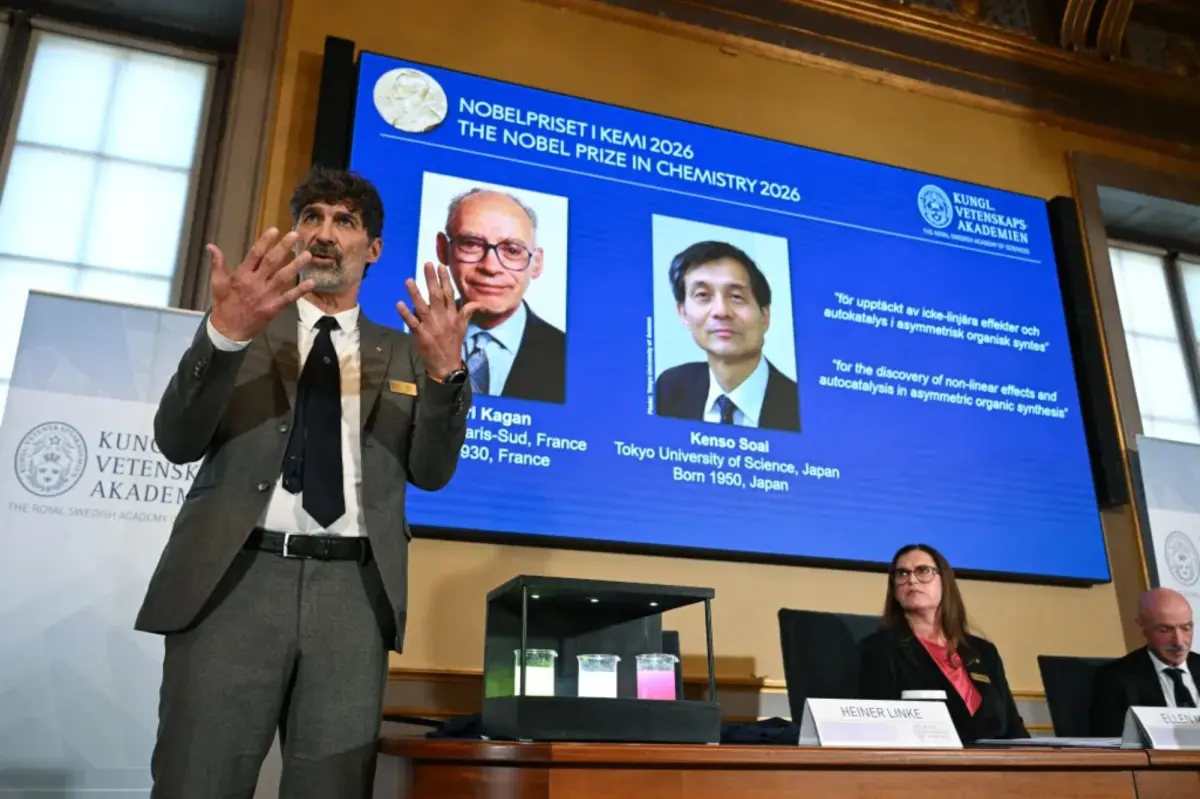

Henri B. Kagan and Kenso Soai were awarded the Nobel Prize in Chemistry on Wednesday for their groundbreaking work on the puzzling mirror-image behavior of molecules.
“Henri Kagan and Kenso Soai have provided a solution to a chemical mystery that is over a century old: how homochirality can emerge spontaneously,” Heiner Linke, chair of the Nobel Committee for Chemistry, said in a news release. He praised the pair’s work as “spectacular” for the extraordinary chemical reactions it made possible.
Kagan, 95, was born in France and is affiliated with Université Paris-Sud in Orsay. Soai, who was born in Japan, is associated with the Tokyo University of Science.
Soai said he was out shopping near his home when the Nobel committee contacted him with the news.
The Royal Swedish Academy of Sciences announced the chemistry laureates in Stockholm.
IN CASE YOU MISSED IT: Ohio Truck Factory Lays Off Nearly 1,400 Before Trump Rally
The previous year’s chemistry Nobel went to three scientists who created new molecular structures capable of holding enormous amounts of gas. Their research could eventually help capture greenhouse gases from the atmosphere and collect water from arid regions.
This year’s Nobel announcements opened Monday with the medicine prize, which honored three scientists whose research produced a light-based tool for exploring the workings of the brain.
On Tuesday, the physics Nobel recognized research that helped shed light on a rare class of neutrinos.
The Nobel Prize in Literature will be announced Thursday.

The week’s awards will continue with the Peace Prize on Friday, followed by the Nobel Memorial Prize in Economic Sciences on Monday.
This year, each prize carries a financial award of 12 million Swedish kronor, or roughly $1.2 million, whether it is shared by an individual, a group of laureates or an organization.