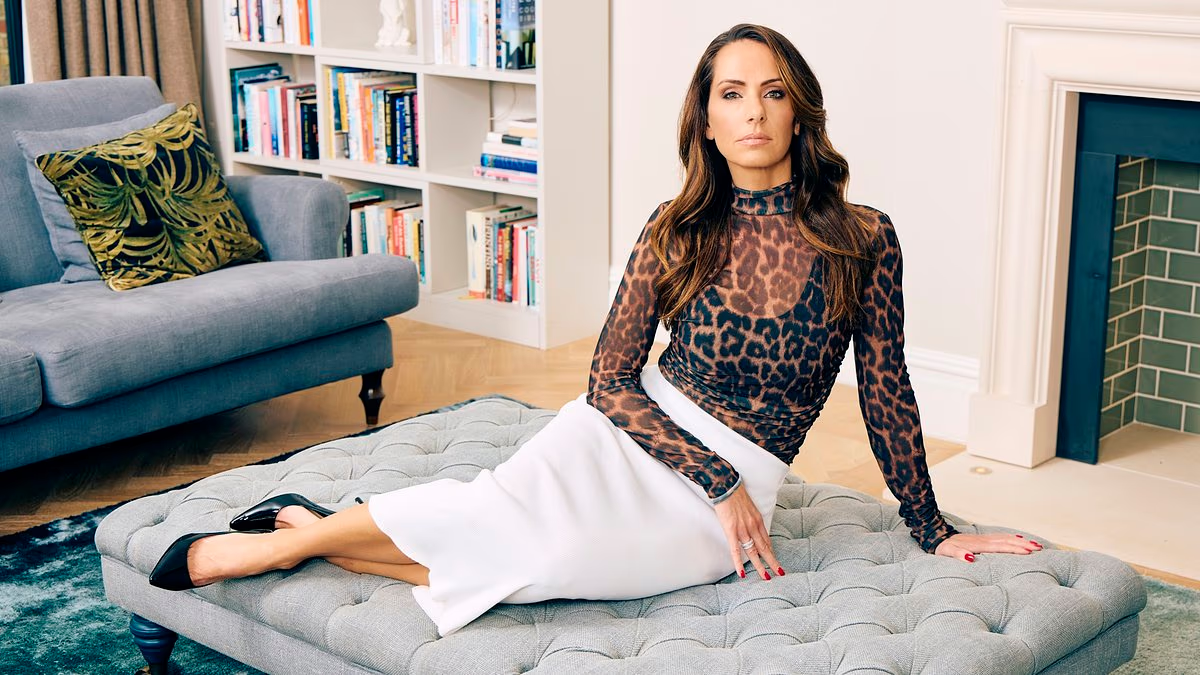
Every day of her holiday, Annalie Howling opened another email filled with personal attacks, hostility and legal threats. She had planned a simple trip overseas with her young daughter—a chance to pause during an exceptionally difficult period and enjoy the quiet pleasures of a mother-and-child getaway.
Instead, a relentless barrage of hostile messages followed her to Portugal, carefully timed to unsettle what should have been a peaceful week with her little girl.
‘My reaction, every time I read one, was to gasp,’ she says. ‘They were written to shame me and make me anxious.
‘I was alone with my daughter, who had just turned five. I needed to be present for her, and she needed me. Instead, I spent hours on the phone each day dealing with the letters. I was constantly close to tears.’
The identity of the sender might suggest a stalker or a bitter former partner determined to push her to breaking point.
But the reality was even more unsettling. The correspondence came from a prestigious London law firm representing Annalie’s wealthy husband—whom she calls Harry—in their high-net-worth divorce proceedings.
‘Divorce is a war of attrition, designed to wear you down,’ says Annalie, 45, a performance coach, author and podcaster. ‘I assumed our lawyers would be working towards the same goal and would not behave so aggressively. Ha!’ Her laugh is bleak.

Annalie Howling says her divorce was financially punitive—it cost her more than £100,000—and emotionally exhausting
“War” is a deliberate choice of word. It is also the title of a gripping eight-part legal drama that premiered on Sky TV last Friday.
The series stars Dominic West and Sienna Miller as a divorcing couple: philandering billionaire technology entrepreneur Morgan Henderson and his Hollywood-star wife, Carla Duval. Their mutual contempt is matched by the ferocity of two legal teams battling like scorpions in a jar.
‘We can play dirty if we have to,’ one lawyer says in the drama.
‘And if they play dirty, we will be total and utter filth,’ her opponent replies.
It is fiction, of course—but Annalie says it comes alarmingly close to her own experience. Her divorce was not only emotionally punishing but financially devastating, costing her more than £100,000.
She developed a close friendship with her own solicitor, the ‘very fair-minded’ Mark Gilmartin, with whom she now chats on her podcast, Happy After. Her view of her former husband’s legal representatives, however, is starkly different.
‘His barrister was truly horrific. At one meeting, he sexualised me in front of both legal teams. He seemed offended that I cared about my appearance and did not dress like a tramp.
‘He pointed at me and said, “Who do you think you are? Get a job.” It was as though he imagined I spent my days shopping at Hermès.’
‘He made me feel cheap, as though I were a gold-digger. I was shocked and could not believe it. The emails sent by Harry’s legal team while I was on holiday also seemed calculated to distress me. They were written in dense legal language, as if they wanted me to endure a Walk of Atonement—like the scene in Game of Thrones—with people shouting “shame” and throwing things at me.
‘They suggested I was profoundly irresponsible and might be left with nothing. Every message carried a threatening undertone, and I was genuinely frightened. It felt like a game of Buckaroo: how much could they pile on before I finally collapsed? The message was always the same—“You cannot have this. You are asking for far too much. We are being generous. You are completely unreasonable. Accept our initial offer.”’
Annalie describes that initial proposal as derisory. Her husband’s lawyers offered her less than £100,000, paid over two years, along with half the value of their home. Harry, she says, earned a salary placing him comfortably among the UK’s top one per cent of earners—a group whose threshold in the South-East, where the couple lived, was £240,000.

Annalie says she and Harry met at Royal Ascot in 2010, later enjoying relaxed lunches, country walks and adventurous holidays
Aside from this lump sum, there was to be no further maintenance for their daughter or payments to Annalie, who had given up a corporate role to concentrate on motherhood.
She was also told that she should foot half the bill for their daughter’s private school fees, ‘despite the chasm in our earnings’. ‘They said I should fund this by getting a full-time job. They’d calculated I’d be able to earn £150,000 just from my CV on LinkedIn.
‘Before I married, I’d had senior leadership roles in construction and property, but it was preposterous to suggest I could walk straight back into those jobs after such a long absence. They told me I should employ a nanny so I could work.
‘I felt terrified. I suffered from such chronic anxiety I was clenching my jaw all the time and had to have Botox to relax the muscles.
‘Every day, I was thinking, “What next?” I was gaslit to the point that I questioned my own sanity.’
Recognising her own vulnerability – she had a recurring nightmare that someone was breaking into her home, and stopped going out, even to the supermarket – she sought therapy.
‘I’d been self-harming in the early stages of my divorce. I’d habitually pick at my skin and stand in the shower scratching my face with my nails until the blood poured down my cheeks, then meticulously cover up the scars with make-up.’
It was a potent metaphor for her life: perfect on the outside, scarred just below the surface.
Today Annalie, legs toned and tanned in a tiny pair of shorts, is talking to me from the palatial open-plan kitchen/living room of her glorious home on a private estate in the affluent Surrey commuter belt. It was once the marital home – bought in 2014 for £1.65million – but she is now being forced to sell it to honour a debt to her husband, who retains a financial interest in it and also has his own luxury home.
Her cleaner, who once worked for actor Antonio Banderas at his home just up the road, vacuums upstairs. On the drive is Annalie’s five-year-old Porsche SUV.
If this seems like stupendous luxury to most of us, Annalie points out: ‘There is a huge disparity between the standard of living I was enjoying in my marriage – flying business class, luxury holidays, a new Range Rover every three years – and what I had during my divorce.
‘I thought hard before putting the heating on. I bought pre-loved clothes – or none at all. I had a strict groceries budget. Yet you’re supposed to be kept in a lifestyle you’re accustomed to. You’re not meant to be living in Belgravia one minute and Bognor the next.’
All seemed so different when she and Harry first met at Royal Ascot in 2010. He was ‘romantic, reliable; he never messed me around’. They enjoyed leisurely lunches, breezy walks, exciting holidays. After ten months, they moved in together.

Today, glossy and beautiful, she has a new partner, tech investor Alex, 54, whom she met online three and a half years ago
Harry held a very senior role in a multinational property company. Annalie – vivacious, articulate, glamorous – has an MBA in economics and had by then re-trained, earning accolades as a performance coach.
Their romance progressed seamlessly from his proposal during a holiday in Finland in 2013 to a lavish wedding in a castle two years later, and then the birth of their daughter Eleanor (not her real name) in 2016.
‘When you become a parent, your approach changes,’ says Annalie, who by then had accrued an enviable client list through word of mouth recommendations, and was guiding Hollywood actors, billionaires, Premier League footballers, Olympians and CEOs through a path of ‘healing and transformation’.
She continued to work as a performance coach but ‘my main role was to be a mum, and look after Harry’, she says.
She is reluctant to condemn her now ex-husband because – although she is the primary carer – they co-parent Eleanor amicably. However, she says they had become physically distant: ‘We hadn’t had sex for months, and he was incredibly stressed and anxious, but he wouldn’t talk about it.’
The premature death of a close friend of Harry was a catalyst. ‘I wanted Harry to have medical checks and a doctor told him, “You need to exercise, cut out junk food and see a therapist.”
‘Although we’d had couples counselling, Harry refused to see the therapist, so I went on my own. It became a lifeline, a temporary escape. So much had been swept under the rug, I could no longer walk on it.’
There was no infidelity; no climactic betrayal, but she realised she had to call time on their marriage. It seems even her body was rebelling against it: she developed an allergy to the ‘exquisite, very expensive diamond and platinum rings’ her husband had bought her. When steroid creams failed to cure the angry, painful sores on her fingers, she removed the rings. This symbolic gesture seemed to imbue her with the strength to split.
‘I’d been deeply unhappy for a long time, manically running around fanning the flames of what was left of our relationship. It was time to stop before either of us said anything that could never be unsaid or unheard. I didn’t want us to hate each other.
‘I thought, “There is no right time for this”, but in the car coming back from a friend’s art exhibition one night [in December 2019] I said to Harry, “We’ve both got to accept it is over.”
‘He tried to talk me round for a couple of days, then said, “I’d never have done it. I would have kept my head in the sand, but you’re right.” ’
To begin with, Annalie felt ‘terrified’ by her decision. But the rules of civility were observed. She spent Christmas Eve with Eleanor in the family home. Once their daughter had opened the presents Santa had left, Harry spent Christmas Day with her.
Annalie went to a friend’s empty flat to while away Christmas Day alone. They had planned a family holiday in Mauritius for the New Year, but Annalie and Eleanor went together, leaving Harry to move out of the marital home.
Then, in 2020, when they had aligned themselves with separate legal teams, the gloves came off.
Annalie believes her husband’s legal team initially tried to fob her off with a ‘derisory’ sum of money.
‘His lawyers made their first offer to me: £100,000 and we’d have to sell the house and I’d move into one of less than half the value. I was horrified. My team said, “This is the kind of offer you’d agree to if you’d been married 18 months, had a flat-share and no kids.”
‘His side seemed so aggressive and acerbic. I felt as if I was the most appalling person and that they were trying to make me feel ashamed. My husband had always dealt with the finances. I didn’t get involved. I didn’t see what bonuses he was paid or know what he earned. But I made it my job to know after that. I went on a treasure hunt and discovered every penny my husband had.’ She believes that his assets were then more than £5million.
She came to dread a ploy common to divorce lawyers, the ‘Friday 5pm email’ invariably containing contentious questions. ‘A horrendous strategy designed to make you feel really anxious for the whole weekend when you can’t seek advice from your own lawyer.’
In November 2021 she, her husband, and their lawyers, attended a private financial dispute resolution in which a judge gives a frank indication of what they think is a fair outcome. Most cases reach an agreement at this point. Annalie’s did not. Harry’s side did not settle and the pressure on her only ramped up.
‘I felt overwhelmed. There was such a disparity in our wealth. During Covid I probably earned £60,000 a year gross, yet his barrister was dissecting my social media accounts, alleging that if I could afford to travel and stay in nice hotels, I didn’t need any financial help.
‘Actually, the hotels and travel were free or heavily discounted because I was promoting them as an unpaid hotel inspector for [the boutique hotel brand] Small Luxury Hotels.’
‘I also deleted my LinkedIn account because there were insinuations that, because of the strength of my network, I’d easily get a full-time job. But I hadn’t actually worked in the corporate world for eight years.’
She felt ‘violated’, too, by the intrusive nature of the financial statement – a document setting out assets and spending required in UK divorce cases – which she felt was more closely scrutinised in her case because she was self-employed.
‘You buy new underwear and six people know about it. You give them every single one of your bank statements. But you can’t win. They either say everything is unnecessary and you’re financially irresponsible or, if you spend nothing, you’re absolutely fine and you don’t need any help.’
She remembers, as divorce proceedings dragged on for three years, both unexpected kindnesses and unaccountable unpleasantness in the wealthy social milieu in which she moved.
‘I went to a party where someone was deliberating on which Ferrari they’d sell to finance the purchase of a flat. It was very upsetting. All I wanted to do was keep my little girl in our house for Christmas. It was, at best, insensitive, at worst nasty.’
Finally, their decree absolute came through in December 2022. Annalie declines to reveal the exact sums involved in her settlement, ‘but it was much more than the initial ridiculous offer’.
The trade-off, of course, was the trauma of her experience at the hands of the lawyers – a trauma which afflicts many divorcees.
Today, glossy and beautiful, she has a new partner, tech investor Alex, 54, whom she met online three and a half years ago. ‘He is exuberant, optimistic and energetic; an incredible guy,’ she says. Eleanor calls him her “bonus dad”. ‘And he’s been through divorce himself,’ she adds.
So they’re both members of the ‘exclusive club no one wants to belong to’ and, as Annalie attests, it really is all-out War.