
With Election Day approaching, Democratic Senate candidates are continuing to generate attention with memorable, highly shareable campaign ads.
In Texas, James Talarico’s campaign gave Ken Paxton’s real estate portfolio the House Hunters treatment. The satirical video showcased the Republican’s 15 properties and quickly drew millions of views.
Michigan Democrat Abdul El-Sayed took aim at another popular reality format with “Senate Island,” a playful parody of Love Island. In the video, El-Sayed presents himself like a contestant searching for the right political match.
In Ohio, meanwhile, Sherrod Brown’s campaign targeted Republican Jon Husted with a far more aggressive spot. The ad showed voters reacting angrily to Husted’s remarks about poverty, while an uncensored version included profanity.
Despite the Democrats’ success in creating viral moments, Republicans have opened a commanding spending lead in the most competitive Senate contests, investing millions more as the 2026 election enters its final phase.
According to AdImpact, more than $935 million had been spent on advertising across nine competitive Senate races from January through September 30. Republican campaigns and aligned groups accounted for 60 percent of that total, outspending Democrats by $188 million.
The fiercest financial battles are taking place in Texas and Ohio, which together represent nearly half of all advertising spending in the battleground races.
Texas has emerged as the largest Republican advertising target, with GOP campaigns and allied organizations spending approximately $61 million more than their Democratic counterparts.

Democratic ads may have captured the viral spotlight, but Republicans have spent substantially more in the most competitive Senate races. More than $935 million was spent across nine contests from January through September 30, including Abdul El-Sayed’s Michigan race.

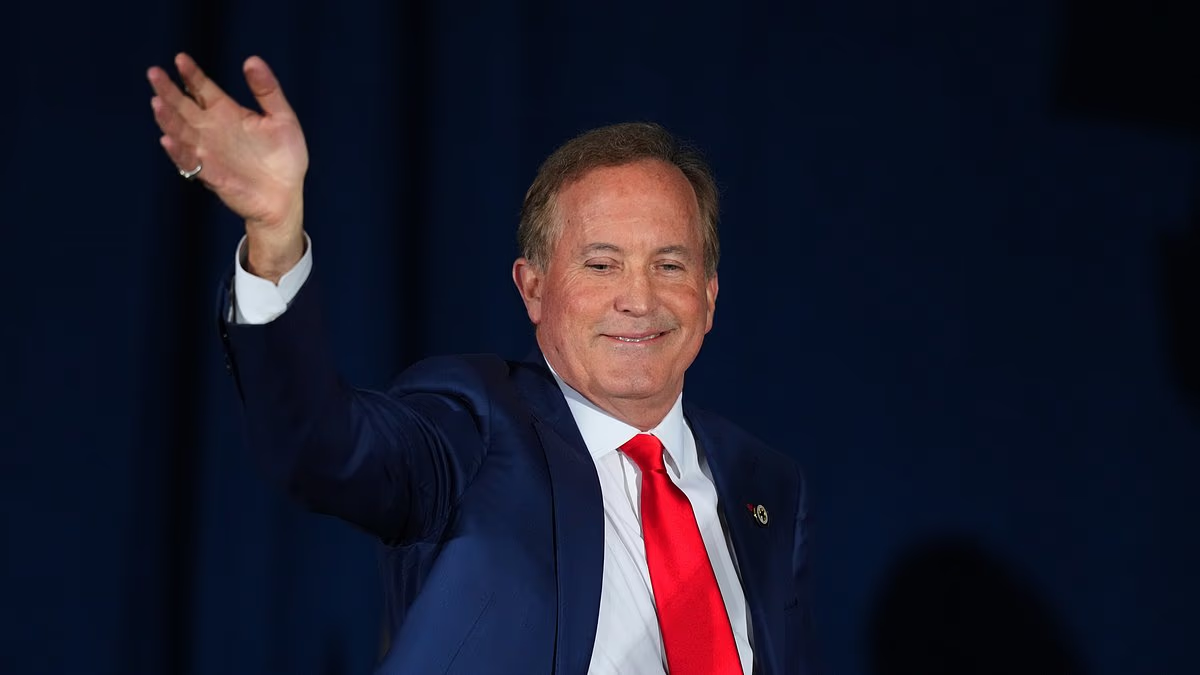
Republican Senate nominee Ken Paxton has benefited from overwhelming outside backing, with issue groups responsible for more than 98 percent of Republican advertising activity in Texas.
The Texas contest is one of nine Senate races rated by the Cook Political Report as either Toss Up, Lean Democrat or Lean Republican.
Paxton, the Republican nominee, has received particularly strong support from outside groups. More than 98 percent of Republican advertising activity in Texas has come from issue organizations rather than the campaign itself.
Texas PAC, a group connected to Senate Republican leadership, had directed about $131 million toward the race by October 1.
Even with that financial advantage, recent polling shows Talarico leading Paxton.
A New York Times/Siena poll conducted from September 21 through 30 found Talarico ahead among likely voters, 49 percent to 43 percent—a six-point margin.
A Fox News survey conducted from September 24 through 28 showed a closer contest but still gave Talarico the edge, 51 percent to 49 percent.
As the campaign moves into its closing stretch, Paxton appears to be receiving several badly needed boosts.
Sen. Ted Cruz has been working behind the scenes to support Paxton’s Senate campaign, Politico reported. Cruz is using his extensive donor network and Washington relationships to connect Paxton with wealthy backers, attract financial support and direct resources toward his fellow Texas Republican.

A New York Times/Siena poll conducted from September 21 through 30 showed Texas Democratic Senate nominee James Talarico leading Paxton among likely voters, 49 percent to 43 percent—a six-point advantage.

Texas Sen. Ted Cruz is backing Paxton behind the scenes, Politico reported, drawing on his powerful donor network and Washington connections to open doors, mobilize wealthy supporters and channel money to the Texas Republican’s Senate campaign.

At a rally in Denton on October 1, Trump urged Republicans to send Paxton to the Senate and praised his longtime ally, with another joint appearance planned in San Antonio on October 7
President Donald Trump is now taking the fight directly to Texas voters.
At a rally in Denton on October 1, Trump urged Republicans to send Paxton to the Senate and praised his longtime ally, with another joint appearance planned in San Antonio on October 7.
The Democratic spending push is also reaching into states that would normally sit well outside the Senate battleground map, according to Politico.
American Bridge PAC is putting $2.1 million behind Democrat Scott Colom’s challenge to Republican Senator Cindy Hyde-Smith in Mississippi.
The group has also committed $2.5 million in Florida, $630,000 in South Carolina and more than $410,000 in Kansas.
The investments are part of a broader $22.7 million advertising and billboard effort focused on the cost of living across dozens of House and Senate races.
Kansas has become one of the party’s most closely watched long-shot opportunities, with Democrat Adam Hamilton receiving nearly $700,000 from a new group connected to former Vice President Kamala Harris’ super PAC.
Another outside group backed by a Kansas attorney has recently spent nearly $5 million in the race.

Despite that huge spending gap of $80 million, Republicans have secured only an 8 percent advantage in broadcast airings, after spending 44 percent more

Ohio is the second-biggest advertising battlefield, with Republicans holding an approximately $41 million spending advantage

A Marist poll conducted September 24-27 found Brown ahead 51 percent to 43 percent among Ohio registered voters
Democrats are also putting serious money behind Annie Andrews in South Carolina, with 314 Action bundling about $3.6 million for her campaign.
Sanders has separately moved $250,000 toward Florida Democrat Angie Nixon. And the spending war is far from over.
Republicans have approximately an $80 million advantage in future advertising reservations for the final weeks of the campaign.
MORE ON THIS: 2,000-Year-Old Chest Hailed as First Direct Link to Jesus
Despite that huge spending gap, Republicans have secured only an 8 percent advantage in broadcast airings, after spending 44 percent more.
Ohio is the second-biggest advertising battlefield, with Republicans holding an approximately $41 million spending advantage.
The state also has the largest amount of future advertising reservations outside Texas, with Republicans holding a roughly $32 million edge.
But Democrats have managed to stretch their dollars further.
They’ve secured more broadcast airings in Ohio despite being outspent.

Republicans have spent approximately $27 million more than Democrats in Maine, making the state another major target in the GOP’s effort to reshape the Senate map
And recent polling has Brown leading Husted.
A Marist poll conducted September 24-27 found Brown ahead 51 percent to 43 percent among Ohio registered voters.
Republicans have spent approximately $27 million more than Democrats in Maine, making the state another major target in the GOP’s effort to reshape the Senate map.
Democrat Troy Jackson holds a slim lead over incumbent Republican Senator Susan Collins, according to a Marist poll conducted from October 1 through October 4.
Jackson is backed by 51 percent of registered voters compared with 47 percent for Collins, giving the Democrat a four-point advantage.
The race is part of a broader Republican spending surge that has seen the party lead advertising expenditures in eight of the nine competitive Senate contests.
The GOP also holds significant spending advantages in several other battlegrounds.
Iowa Republicans lead by approximately $17 million, Michigan Republicans lead by approximately $15 million, and Alaska Republicans lead by approximately $12 million.

According to a Marist poll conducted from October 1 through October 4, Democrat Troy Jackson holds a slim lead over incumbent Republican Senator Susan Collins, 51 percent to 47

In Iowa, Democrat Josh Turek is also narrowly ahead of Republican Ashley Hinson in the latest polling average. A September Marist poll had Turek ahead 50 percent to 42 percent
In Iowa, Democrat Josh Turek is also narrowly ahead of Republican Ashley Hinson in the latest polling average.
A September Marist poll had Turek ahead 50 percent to 42 percent.
Alaska remains similarly close.
A late-September Quantus Insights poll had Republican Dan Sullivan at 47.8 percent and Democrat Mary Peltola at 47.2 percent.
The Republican ads are largely fueled by outside groups, rather than Republican candidates themselves.
Republican issue groups have spent about $487 million, representing 87 percent of Republican battleground advertising.
Democratic candidates, on the other hand, have been spending aggressively from their own campaign accounts.
Talarico has spent about $59 million, while Brown has spent $41 million.

A late-September Quantus Insights poll had Republican Dan Sullivan at 47.8 percent and Democrat Mary Peltola at 47.2 percent

Talarico has spent about $59 million on ads from his own campaign account

WIN SENATE, an arm of the Senate Democratic super PAC, pulling roughly $50,000 in digital ads and another $500,000 from television, as Cooper maintains a lead in recent polling
North Carolina’s Roy Cooper has spent $19 million, followed by Michigan’s El-Sayed at $18 million, Maine’s Troy Jackson at $13 million and Iowa’s Josh Turek at $11 million.
That spending has helped Democrats offset some of the GOP’s enormous outside-group advantage.
And Democrats appear to be easing off the gas in North Carolina, with WIN SENATE, an arm of the Senate Democratic super PAC, pulling roughly $50,000 in digital ads and another $500,000 from television, as Cooper maintains a lead in recent polling.
A six-poll average compiled by 270toWin, conducted between September 23 and September 30, has Cooper leading Republican Michael Whatley 51 percent to 42 percent.
The Republican surge represents a striking change from recent elections.
Democrats accounted for 53 to 54 percent of battleground Senate advertising through September 30 in each of the past three cycles.
They also led spending in most competitive races, eight of 12 in 2020, six of 10 in 2022 and six of eight in 2024.
There’s also another $513 million in advertising already reserved for the final 34 days, with Republicans accounting for 61 percent.


