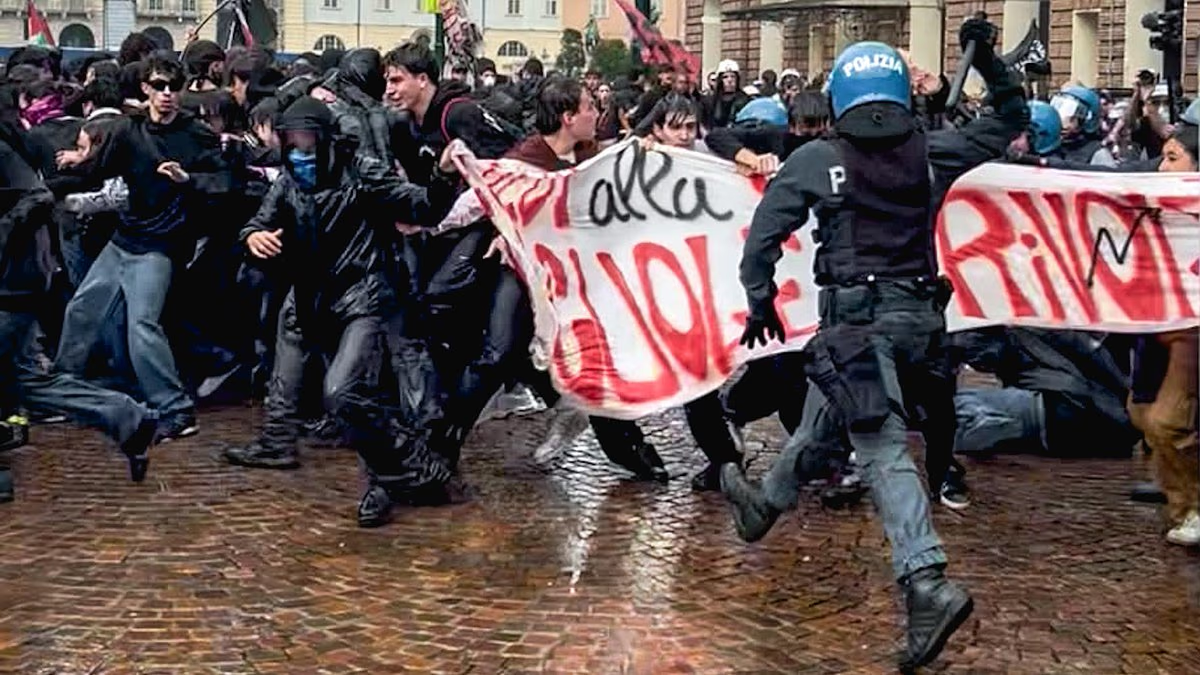

A wave of student unrest spreading across Europe has reached Italy, with clashes reported between police and masked protesters in several cities.
Demonstrators protesting deteriorating school conditions and the rising cost of living reportedly hurled petrol bombs, firecrackers and glass bottles at officers.
In scenes cheered by parts of the crowd, hooded students sprayed fire extinguishers towards riot police during the confrontations.
The nationwide action follows similar student protests in France and Belgium in recent weeks, where demonstrators have also voiced anger over the state of education.
Some protesters additionally demanded limits on the number of international students allowed to study in Italy.
Others criticised Italy’s expanding defence spending, arguing that more public money should be directed towards schools and education rather than the military.
In Rome, students marched towards the Ministry of Education, where firecrackers and smoke bombs were thrown at the building.
Protesters repeatedly targeted Education Minister Giuseppe Valditara with chants of: “Valditara, get out of the building!”

Anti-riot police clash with protesters at Piazza Castello during students protests in Turin, Italy, October 16 2026

Students burn a cardboard tank during a national day of marches across Italyin Turin on October 16, 2026

Riot cops clashed with protesters across the country today
On Rome’s Via Marmorata, several protesters were seen wearing balaclavas and hooded tops.
Local reports said about 50 people erected makeshift barricades using rubbish bins in the centre of the road.
Rome police said video footage would be examined to identify those involved in violent incidents. Officers added that “the actions of this minority group” had not undermined the wider public-order operation.
Demonstrations targeting Mr Valditara and Prime Minister Giorgia Meloni were also held in Genoa, where protesters threw eggs at posters bearing their images.
Police in Turin deployed water cannon when protesters refused to move back, with demonstrators responding by throwing rocks at officers.
Thousands marched towards the city’s Regional School Office. After eggs were thrown at police, protesters set fire to a small cardboard tank in a demonstration against using taxpayer funds for weapons.
Teachers were also seen taking part in the Turin demonstrations, positioning themselves between students and police in an attempt to separate the two sides.
In Treviso, students at one high school reportedly climbed through windows to join the march, according to local media.
La Repubblica reported that students from Canova High School jumped from windows and climbed over gates after claims that school authorities had locked exits to stop them from attending the protest.
In Bari, students said they were rallying against poor schooling conditions that they said were unacceptable in the face of increased funding for ‘warmongering’.

Demonstrators carry a banner calling for a general strike on October 30 as they march during a student protest in Rome, Italy, October 16, 2026

Students take a part of school strike on October 16, 2026 in Turin, Italy

A student jumps over the fire on October 16, 2026 in Turin, Italy
The marchers said in a statement: ‘In our schools, every day we see dilapidated buildings, cancelled school assemblies, and a lack of spaces for social interaction and democracy, with all the consequences of the funds invested in the war sector and diverted from schools, universities, and healthcare due to the policies of this warmongering government.’
According to Nato data, Italy has been increasing its defence spending year on year since 2019.
2025, the latest budget, saw the country spend more than €45billion on defence – an increase of nearly 40 per cent compared to 2024.
Meanwhile, the country shrank education spending between 2024 and 2025, going from 4.3 per cent of GDP to 4.1 per cent.
It comes as France is set to be swept by broader, nationwide demonstrations on Saturday over the cost of living, setting up a potentially fraught period ahead of presidential elections next year.
The prospect of the two movements merging, perhaps with outbreaks of violence, poses a big challenge to the government – and an opportunity for far-Left and far-Right presidential candidates jockeying for power.
The country’s Yellow Vest movement, which eight years ago staged street protests against President Emmanuel Macron and his government, called Saturday’s ‘yellow and youth’ demonstrations and urged millions to turn out.
It has appealed to teachers, workers, pensioners and farmers, as well as students, in an online call spread through social media.
‘I have a feeling that (Saturday) will be a sort of culmination,’ 18-year-old Marie-Lou, a protesting university student in the city of Lille, told AFP.
‘We’ll be joined by workers and by the Yellow Vests, who are also mobilising again. There’s a sense of hope that all these different struggles might converge.’

A masked demonstrator raises an arm amid smoke and overturned rubbish bins at a student protest during clashes with police in Rome, Italy, October 16, 2026

Teachers stand between students and police as a national protest takes place in Turin on October 16, 2025

Masked demonstrators stand behind overturned rubbish bins as coloured smoke rises at a student protest during clashes with police in Rome, Italy, October 16, 2026
Prime Minister Sebastien Lecornu on Friday ordered a crisis cell be set up to monitor the demonstrations in real time. On Thursday he said he feared clashes after what he called ‘urban violence’ during the student protests.
Mr Lecornu is under pressure to get a cost-cutting budget through parliament. It aims to tackle France’s growing public debt by raising more tax revenue and reducing expenditures.
Yet the Yellow Vest and student movements are demanding the government spend more money.
They want protection from inflation, which has surged above three per cent because of the Middle East war, and a boost to public services, particularly education.


