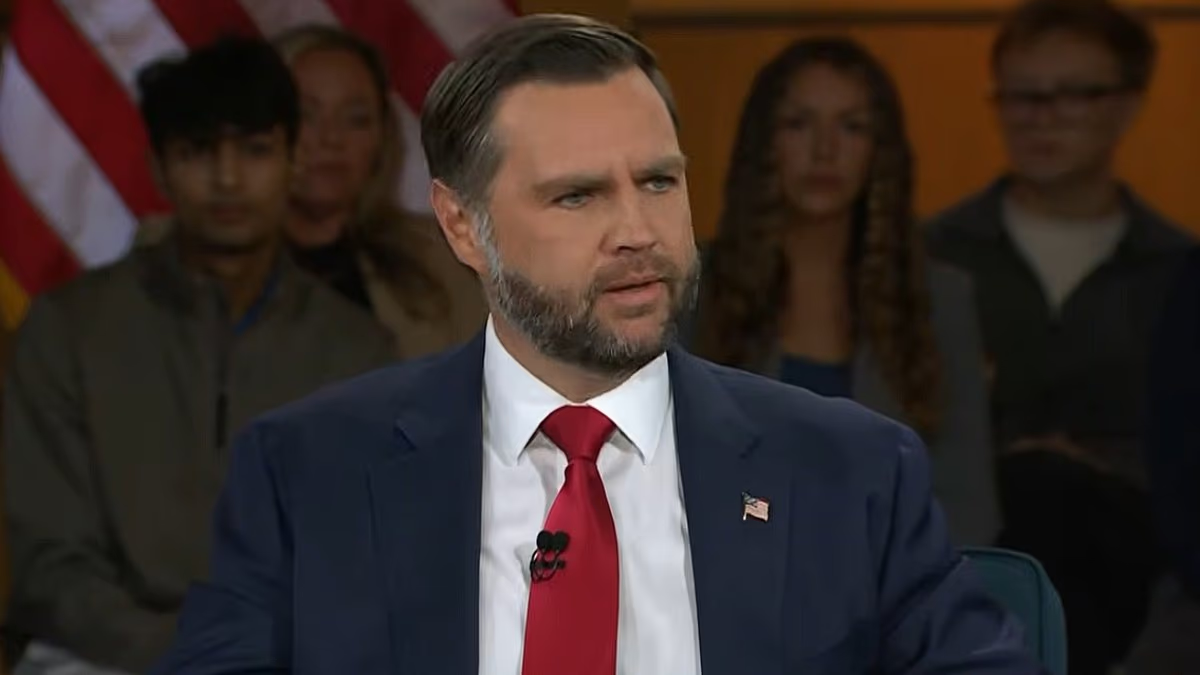

Vice President JD Vance has acknowledged that he may decide against running for president in 2028, as a new poll raises questions about whether Americans believe he and President Trump are taking the country in the right direction.
Vance, 42, made the comments during an hour-long town hall hosted by CBS News on Saturday. Asked whether he might seek the presidency after Trump, Vance said there was “certainly” a possibility that he would not enter the race.
‘Of course there’s a chance,’ Vance said. ‘We’ve got four little kids, my wife has never loved politics. She loves public service.’
His remarks came after a bleak NBC News poll found that 71 percent of adults believe the United States is moving in the “wrong direction,” with Election Day little more than two weeks away.
Vance said he plans to wait until after the midterm elections before deciding whether to launch a campaign for the White House.
The vice president described himself as reluctant to confront major personal decisions, saying his wife would agree that he tends to procrastinate.
“The way that I think about life, big life decisions — my wife will tell you this: I’m a procrastinator. I hate thinking about it,” Vance said.
He said the election would force him to consider the question more seriously. “After the election, I’ll have to think about it, then I will actually have to make a decision,” he said.

“You know, anything can happen, man,” Vance added.
Vice President JD Vance said during an hour-long CBS News town hall on Saturday that he may not run for president in 2028

Vance said he may choose not to seek the presidency after President Trump, as polls suggest Republicans could face major losses in the midterm elections
Several polls have identified Vance as the leading potential Republican candidate for the 2028 presidential election, with Marco Rubio ranking behind him.
However, his standing among Republican voters may not translate into broad support. NBC News polling indicates that many Americans remain deeply dissatisfied with the Trump administration.
Just 28 percent of respondents said Trump’s policies are benefiting the country, while 58 percent said they are causing harm. The remaining 14 percent said the policies were having no meaningful effect.
A separate survey found that Democrats would receive 55 percent of the vote if elections for Congress were held today.
Democrats have forecast a “blue wave” — or even a “blue tsunami” — that could give them control of both chambers of Congress. Such an outcome would leave Trump facing two years of legislative gridlock and congressional investigations.
Most political experts expect Democrats to win the House, with the main uncertainty being the size of their majority. The Senate race, however, is considered far less predictable.
Republicans currently control 53 seats in the Senate, compared with 47 held by Democrats.

‘Of course there’s a chance. We’ve got four little kids, my wife has never loved politics. She loves public service,’ Vance said when asked whether he might decide not to run for president

A woman at the Lincoln Memorial in Washington DC encourages Democrats to turn out for the midterm elections
Thirty-five Senate seats will be contested on November 3, including 22 currently held by Republicans.
Democrats need a net gain of four seats because, in a Senate split 50-50, Vance would hold the tie-breaking vote.
As Election Day looms closer, the vice president has repeatedly shut down questions about his political future.
But on October 1, he eagerly dished out an obvious jab at one of his potential 2028 GOP rivals, Ted Cruz.
‘It is really obvious to me that, at this very moment, Ted Cruz is running for president,’ Vance told NBC News.
‘At this moment, I’m not. I’m trying to help elect Republicans. That’s what I’m going to keep on doing.’
Vance and Cruz were Senate colleagues before Vance was nominated to become Trump’s running mate.
Cruz was Trump’s most formidable GOP challenger in the 2016 campaign and was the last to drop out, after Trump received 45 percent of Republican support while the Texan received just 25 percent.
While Cruz is not on the ballot this year – his term runs through 2030 – he has been campaigning in swing states, including Iowa and South Carolina, both early presidential primary states, to fundraise for the GOP ahead of this year’s elections.
The Texas senator’s presidential ambitions are seen as a long shot.