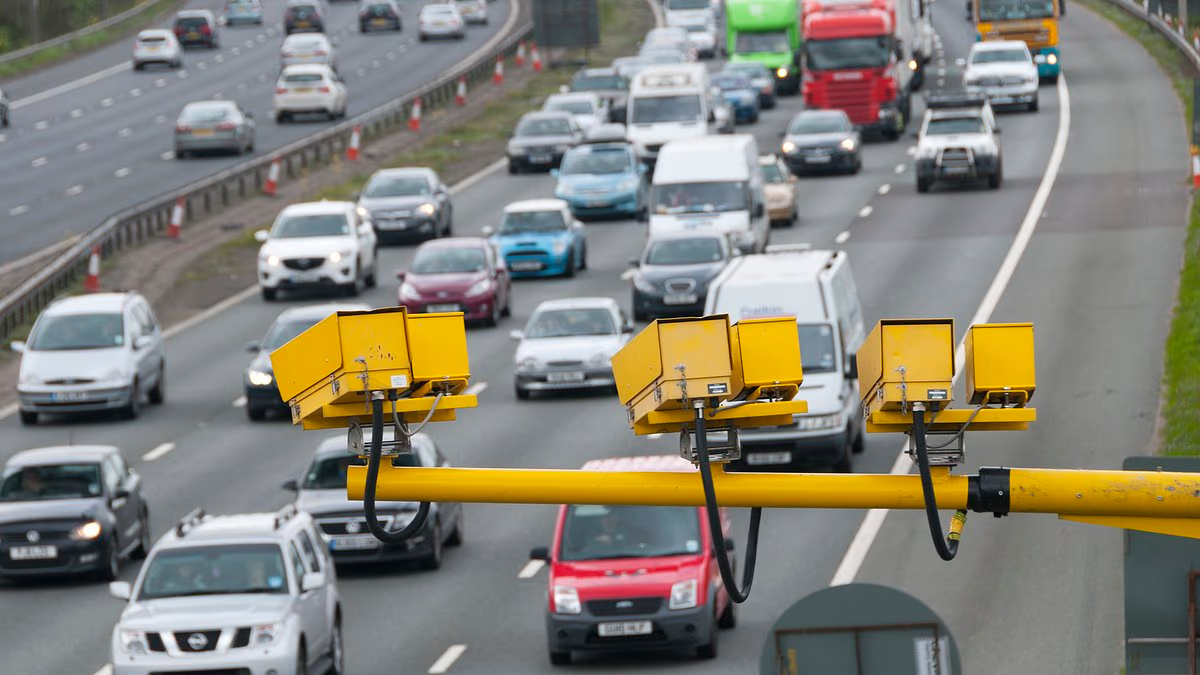

Smart motorways may have become more dangerous after highway authorities failed to repair more than 150 speed cameras for almost a year, according to newly revealed details.
Ministers have acknowledged that cameras used to enforce speed limits across 440 miles of England’s major roads have remained offline since December last year.
The affected stretch accounts for roughly one in every ten miles of the Strategic Road Network, which covers the country’s motorways and principal A-roads. It also represents more than a third of the approximately 400 speed cameras installed across the motorway network.
Officials described the problem as an “anomaly” that has hit numerous sections of smart motorway. The cameras are considered especially important on these routes, where changing speed limits are used to manage traffic and reduce the risk of serious collisions, injuries and deaths.
The Labour Government ordered an independent investigation after the faults affecting 154 cameras came to light in December 2025.
Transport Secretary Heidi Alexander considered the breakdown serious enough to commission the review the following month.
The inquiry was expected to deliver its findings within 18 weeks, but its report has still not been released.

Ministers have confirmed that 154 speed cameras covering 440 miles of major roads in England, including smart motorways, have been out of service since December last year

Transport Secretary Heidi Alexander launched a review in January after judging the camera failure to be a serious issue, but its findings have yet to be published

Tory shadow transport minister Greg Smith warned that the failure had potentially made smart motorways even more dangerous
Opposition figures have urged ministers to take immediate control of the situation, arguing that a functioning enforcement system is essential to road safety and the prevention of avoidable deaths and injuries.
Greg Smith, the Conservative shadow transport minister, said the Government’s smart motorway policy was difficult to defend while as many as 440 miles of road had no working speed cameras.
He called on ministers to accept responsibility, provide a full explanation and ensure the enforcement network was restored to proper working order.
Smith also warned that the prolonged failure may have made smart motorways more hazardous and accused Labour of losing control of the issue.
Edmund King, president of the AA, said motorists were still waiting for answers almost ten months after the review was commissioned in January.
He said drivers need complete confidence that motorway technology is accurate, dependable and properly tested—particularly on smart motorways, which rely heavily on electronic systems and variable speed limits.
King said it was troubling that the technical fix was reportedly still being tested nearly a year after the fault was first identified.
He called for clear action to establish what went wrong and to introduce safeguards capable of preventing a similar breakdown in the future.
RAC road safety specialist Rod Dennis said failed speed cameras do more than allow some motorists to escape penalties for speeding. In his view, they also weaken public trust in smart motorways, a form of road infrastructure that already attracts significant concern from drivers.
MORE STORY: Gypsy Rose Blanchard Slams Ken Urker’s Sister, ‘Tired of Silence’
He stressed that the safety of everyone travelling on smart motorways depends on motorists following the changing speed limits.
The shocking failure was laid bare in an answer to a written Parliamentary Question last week, in which transport minister Justin Madders was asked how many speed cameras had been fixed since the problem first emerged last December.

President of the AA, Edmund King, said the disclosure was ‘particularly concerning’ as ‘the technical solution is apparently still undergoing testing almost a year after the problem was identified’

Thousands of drivers were wrongly issued speeding tickets before the faults were publicly declared last December
Confirming it still hadn’t been fixed, he said: ‘The anomaly impacts 154 cameras on 10% (440 miles) of the Strategic Road Network (4,500 miles)…A solution to the technical anomaly has been developed and is undergoing thorough testing.’
He added that police were enforcing ‘speed offences on the network via a range of tactics’.
However, critics point out that teams of officers cannot police the affected road stretches with mobile cameras to the same extent as 154 fixed cameras rolling 24/7.
When National Highways first announced the problem last December, it said it was down to how variable speed cameras were interacting with speed signs on A roads and motorways.
But it didn’t reveal that the affected M-roads were smart motorways.
A software synchronization delay meant there was a delay of around ten seconds between speed cameras and variable speed signs on overhead gantries, meaning some drivers were incorrectly identified as speeding after the limit had changed.
It meant that on a road where the speed limit increases, a driver may see a sign saying 60mph, but the camera recording it was still working on the basis of a previous 40mph speed limit.
As a result, thousands of drivers were being wrongly issued speeding tickets. But nearly a year on, the problem hasn’t been fixed and the cameras remain out of action.
Variable speed limits are used on smart motorways to slow down traffic during busy times to prevent collisions.
Enforcement is particularly important for preventing collisions on the roads because some smart motorways have their hard shoulder permanently removed to create an extra lane, meaning drivers who break down can be smashed into from behind.
Our News Outlet has campaigned for better smart motorway safety for several years, highlighting several arguably preventable deaths after motorists became stranded on the roads in live lanes of traffic.
A spokesman for National Highways, the quango responsible for running England’s SRN, said: ‘Speeding offences continue to be detected and prosecuted.
‘A range of enforcement measures are in place to help keep road users safe.
‘A fix for the impacted cameras is going through rigorous testing.’
EXPLORE MORE: Read the Jaw-Dropping New Letters From the Alexander Brothers