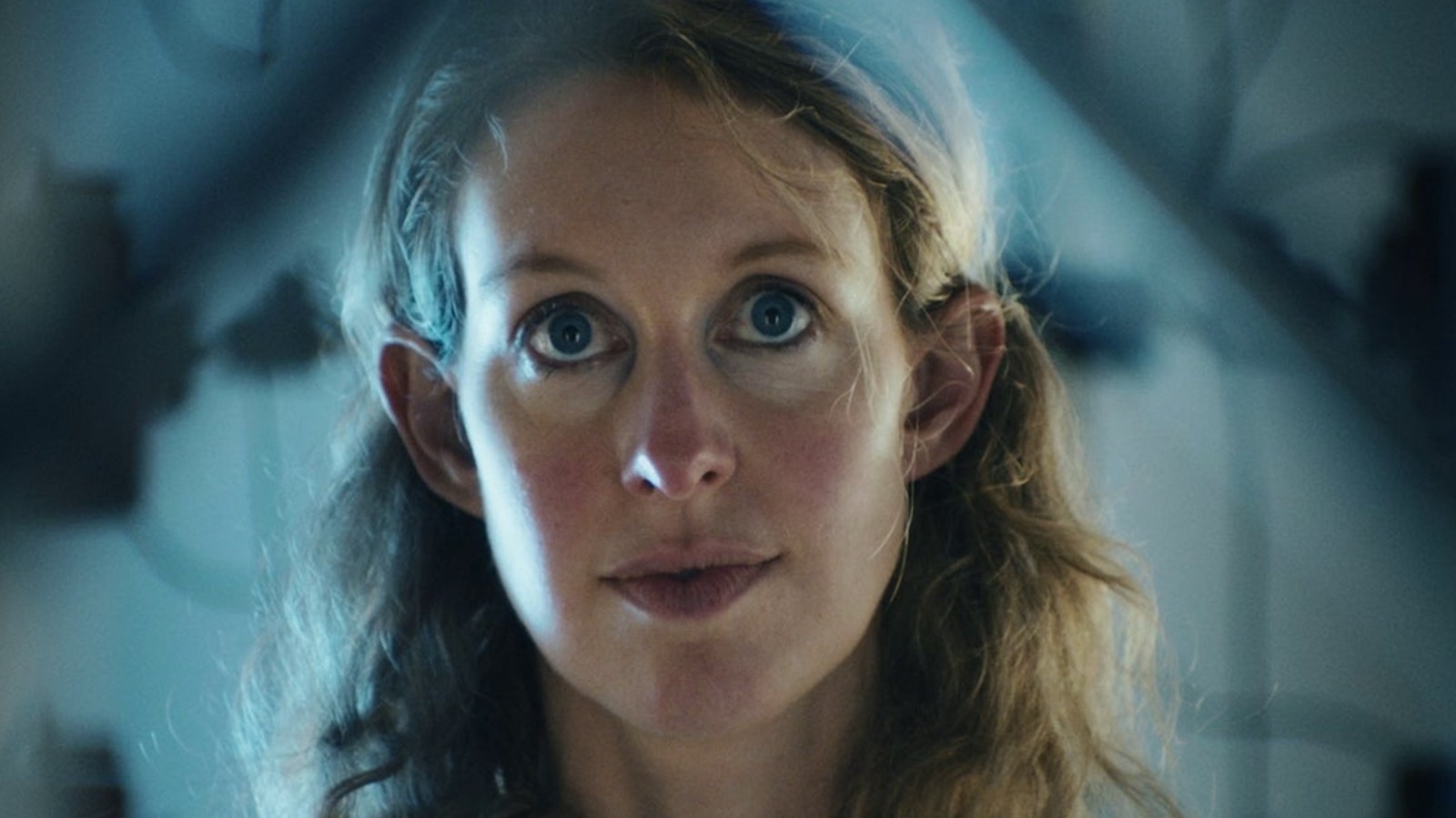

A three-hour documentary about a disgraced tech executive would hardly seem like a recipe for box-office success. Yet Lance Oppenheim and Nathan Fielder’s unconventional Elizabeth Holmes film, You Can See Everything, has defied expectations with an impressive limited-release run. So what fueled the movie’s unlikely theatrical performance? Watch the video above, then read on.
A24 made two bold moves in early September 2026: It unveiled You Can See Everything without warning at the Telluride Film Festival and released an equally strange teaser. In the trailer, Holmes—currently serving a prison sentence for defrauding investors through her failed blood-testing company, Theranos—asks Fielder why he would deceive her. The footage instantly became a major talking point. During a Q&A, Fielder admitted that he was still trying to understand what had happened to him, telling Vanity Fair, “I really am struggling to this day to understand exactly what I experienced.” That level of mystery proved difficult to ignore.
Audiences clearly wanted to find out more. According to Variety’s box-office analysis, the film earned $15 million in limited release. It also set a notable benchmark: You Can See Everything delivered the biggest opening for a movie playing on fewer than 1,000 screens since 2006’s Borat.
Several elements appear to have driven that result. For starters, this is far from a conventional documentary. The first half offers a relatively direct portrait of Holmes, her partner Billy Evans, and their children before she begins her prison sentence. The following 90 minutes, however, take the film in an entirely different direction. Add in the project’s extraordinary secret cast member, and moviegoers had plenty of reasons to see what You Can See Everything was hiding.
You Can See Everything is one of the most ambitious movies in recent memory, and audiences loved it

A24
The film’s unusual creative partnership was another major draw for cinephiles. Fielder has built a devoted following through Nathan For You and The Rehearsal, projects that blur the boundaries between documentary, performance, and social experiment. Oppenheim also arrived with momentum. His other acclaimed 2026 release, Primetime, examines Chris Hansen during the height of the To Catch a Predator phenomenon and has quickly earned attention as one of the year’s standout films. Viewers who caught Primetime in theaters may have been especially eager to add Oppenheim and Fielder’s collaboration to their watchlist.
The film’s secrecy certainly helped generate curiosity, but its appeal goes beyond a carefully guarded release. You Can See Everything is the kind of movie that invites debate, drawing audiences who want to participate in the conversation as much as they want to watch the film itself. In a post-release interview with Wired, Fielder explained that the project changed dramatically during production, eventually placing him in front of the camera and introducing an unexpected new dimension. He said:
“But with this, we’re really trying to give the viewer everything. We’re trying to focus on these moments that we couldn’t really make sense of fully. Like I was saying, still to this day, I’m debating. Why are me and my editor talking, two days ago, about trying to understand certain things? I’ve talked to people who have seen it, and they’re all bringing out new ideas that I would never even consider.”
You can decide for yourself: You Can See Everything is now playing in theaters.


