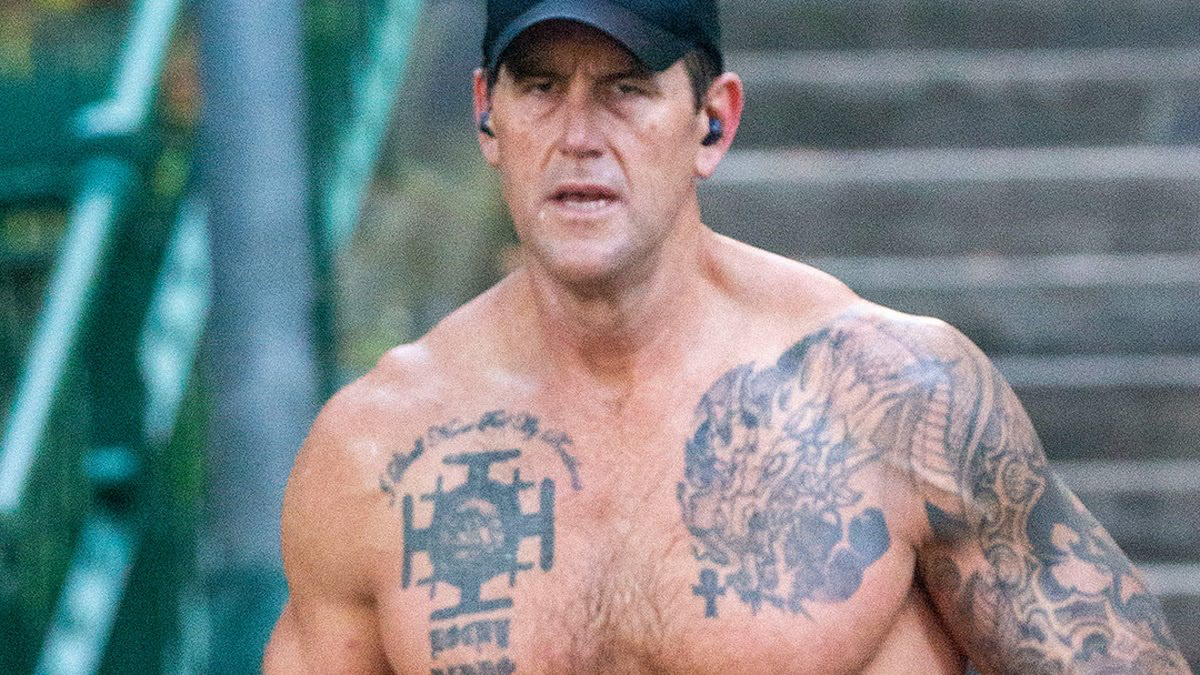

Ben Roberts-Smith has denied shooting prisoners or seeing other Australian soldiers do so, insisting he would not change anything about his military career.
In an interview with 2GB host Ben Fordham, which he described as his first since charges were laid, Australia’s most decorated living soldier said he had never breached the rules of engagement while serving in Afghanistan.
The 47-year-old received Australia’s highest military honour, the Victoria Cross, for his service in Afghanistan. He now faces allegations that he murdered five unarmed detainees during his deployment.
Roberts-Smith denies all of the allegations.
Asked whether he had ever shot prisoners, he replied: “No.”
When asked if he had witnessed anyone else shooting prisoners, he answered: “No, I did not.”
“I didn’t bloody murder anyone,” he said.
Roberts-Smith said he understood why the questions needed to be asked, although he found the allegations deeply hurtful.
“I’m not going to say I enjoy it, but I told you that I would accept the fact they have to be asked, and I don’t like it. I’ll put myself in this position because I want the facts out there as best I can put them. So I accept it needs to be done.”

Roberts-Smith has rejected claims of a “cowboy culture” within the Australian Defence Force and said Australian soldiers can no longer behave as larrikins.

Ben Roberts-Smith has denied shooting prisoners or witnessing fellow Australian soldiers do so, saying he would not change anything about his military career.

Roberts-Smith was charged with five counts of murder over alleged incidents in Afghanistan between April 2009 and October 2012.
Fordham also questioned Roberts-Smith about “throwdowns”—weapons allegedly placed on dead bodies to make those killed appear to have been armed.
Roberts-Smith said military leaders had directed soldiers to collect weapons and equipment alongside bodies for intelligence photographs.
“But the interesting part of that question is that we were told to put weapons on the bodies for the photographs because they wanted it all in one photo, so we could send it back.”
“It was actually a directive, right, from the leadership that if you had an engagement and you needed to take a photo of it for intelligence purposes, put their equipment together, put the weapon on the body, you know, and then that was sent back because that was just the process of the day.”
The allegation is that some soldiers carried weapons specifically to plant them on the bodies of dead civilians and portray the victims as enemy fighters—a practice that would imply premeditated murder.
During the defamation trial, several SAS witnesses said soldiers carried “throwdown” items in their patrol equipment, including folding-stock AK-47s, Russian grenades, spare webbing and handheld radios.
Two witnesses at the trial testified that Roberts-Smith had personally instructed others to take part in the practice.
Roberts-Smith also denied that soldiers “blooded” inexperienced colleagues by encouraging them to carry out their first kill.
He agreed that loyalty to fellow soldiers could not override the laws of armed conflict and that shooting a prisoner was a war crime.
Asked what should happen to a soldier who murdered a prisoner, he said: ‘If you murder a prisoner, then you’re going to be charged and go through the process.’
He said soldiers who witnessed such conduct were obliged to report it.
‘Well, immediately you have to report it. So it’s not something that you can ignore. That’s for sure.’

Roberts-Smith poses for the cameras in front of his Victoria Cross at the Australian War Memorial in 2011
Asked whether he had reported unlawful conduct by fellow soldiers, Roberts-Smith said: ‘I didn’t witness any unlawful conduct by any of my fellow soldiers.’
He also rejected Fordham’s suggestion there had been a cowboy culture in the SAS, describing some behaviour as a way of letting off steam.
‘I don’t think that’s a fair assessment. You know, I’ve seen videos that have come out, things like that, and about people on the ground behaving in particular ways. Well, I think the guys let off steam and take the piss, and you know.
‘We’re Australian soldiers. You want to talk about being larrikins? I know that’s not accepted in the military anymore. You can’t be a larrikin, but the fact of the matter was, it’s just how blokes let off steam. But the one thing I do know is when it was game time, when it was actually happening, the majority of guys were the most professional soldiers you’ll ever meet.’
The interview also turned to his upbringing, with Fordham asking whether his parents had taught him right from wrong.
‘They did, mate. And that’s one of the sad parts of this whole experience for me, because I know that they know they instilled in me the values that they live by and the behaviours that are respected of a good Australian.’
He spoke about his father’s legal work and contribution to the Indigenous community.
‘My dad did it because he believed in it, and he did a lot of pro bono work. He did a lot for the Indigenous community. He founded Legal Aid in Western Australia. It was a big part of his life.’
Asked whether he regretted anything about his military career, Roberts-Smith said he remained certain he had done the right thing.
‘And the answer to that question is no. I wouldn’t change a single thing. I would do it all exactly the same way because I know that I did the right thing.
‘I know that I was prepared to die for this country every time I went outside the wire, and I know I did whatever I could to keep my mates alive. But I never broke the rules of engagement, and I get up every day and am able to fight this fight and live a normal life because in here I know that to be true.’
Roberts-Smith said the first rumours about him centred on whether he deserved his military awards, rather than allegations of war crimes.
‘It was actually, you know, people say you don’t deserve your rewards, and I was like, OK, fair enough. Do I think a lot of other people should have got more rewards? Absolutely,’ he said. ‘When it started, it had nothing to do with war crimes.
‘For some reason, it’s always coming from people who think they’ve been deliberately missed or haven’t had enough acknowledgement,’ he said.
He said he first learnt of a war crime allegation when a journalist contacted him about bullying, before raising a claim that he had killed a child in Afghanistan in 2006.
‘That particular allegation was the start of all of this, and that allegation, funnily enough, was one of the ones that was completely disproven during the defamation, and is not even on the table anymore because it wasn’t – it was just completely fabricated and false,’ he said.
Roberts-Smith also revealed that fellow soldiers nicknamed him ‘Front Dagger’, saying it reflected his willingness to confront people directly.
‘Because I don’t stab people on the back. I just give it to them straight in the chest,’ he said.