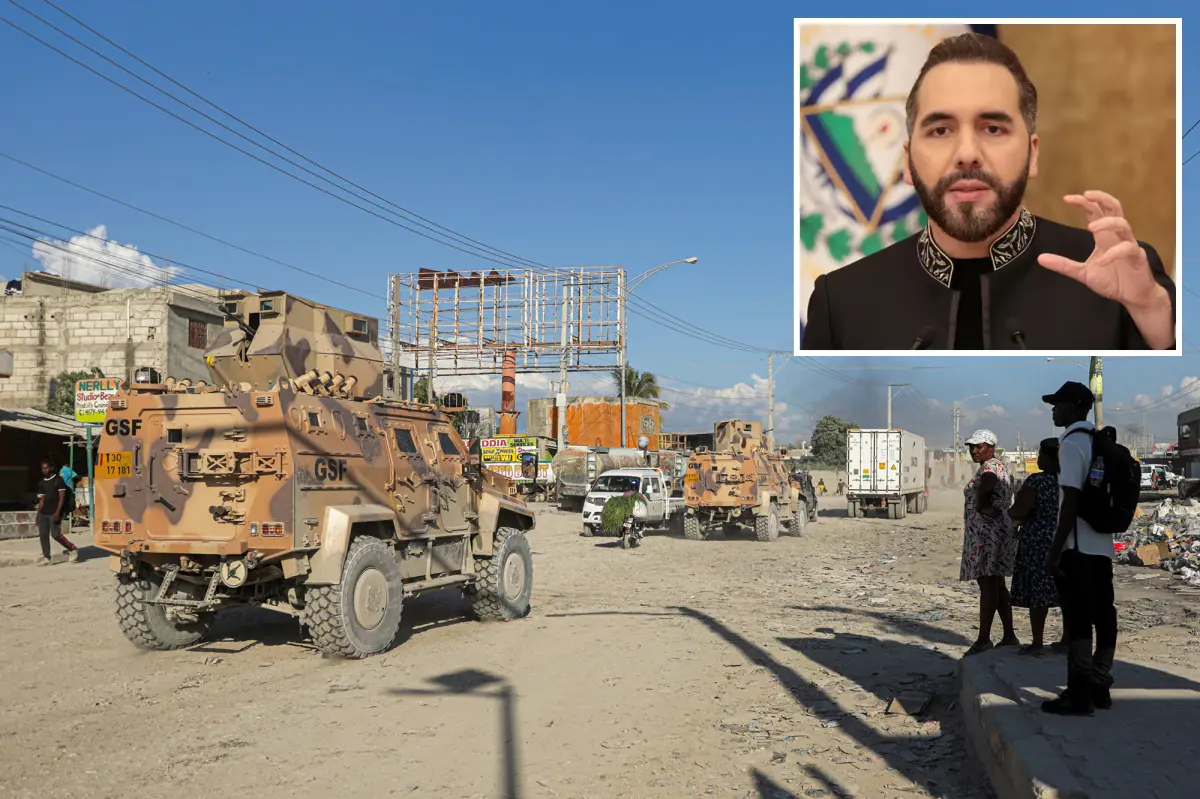

El Salvador’s President Nayib Bukele said Wednesday that he had launched a military operation to rescue four Salvadoran aviation technicians kidnapped by gangs in Haiti. He warned that a far more forceful response would follow if the men were not returned alive and unharmed.
The announcement came three days after gangs opened fire on an armored vehicle in Haiti, the first major assault since an international gang suppression force began operations in the violence-plagued Caribbean nation. The four men disappeared after escaping the burning vehicle in the Santo area of Croix-des-Bouquets, near Port-au-Prince.
Addressing Haiti’s gang leaders, Bukele demanded that the Salvadorans be released “alive, unharmed.” He said that if the men were returned, “everything will go back to the way it was before the kidnapping.” Otherwise, the Salvadoran president — whose controversial campaign against gangs at home has drawn international attention — said a more powerful operation would be launched.
“Today’s attack is nothing compared to what is coming if they do not release the four hostages alive. And do not take our words as empty threats,” Bukele said.
It was not immediately clear whether Bukele was referring to additional action by Salvadoran troops or to a broader operation involving international security forces already deployed in the area.
The Haitian government said Wednesday evening that the “abduction” of the Salvadorans was an “absolute priority.”
The government said senior officials had met at the prime minister’s office “to assess the ongoing interventions and determine the necessary measures to strengthen operations, in close collaboration with the Gang Repression Force.”
“The release of the abducted soldiers is an absolute priority, and all necessary resources are being mobilized to achieve this goal,” the statement said.
Haitian authorities had not immediately confirmed whether the abducted men were still alive.
CHECK THIS OUT: Trump Rally Disrupted by Multiple Protesters Within Minutes
A spokesperson for the international gang suppression force did not immediately respond to a request for further information.
Bukele said the victims are aviation technicians and that El Salvador’s mission in Haiti “consists only of pilots and technical personnel.” Their primary role, he said, is conducting medical evacuations, “not to wage war.”
The U.N.-backed force continued battling gangs in the community where Sunday’s attack took place, urging residents to stay indoors as the operation continued.
No group has claimed responsibility for the assault on the Salvadoran personnel. The attack comes as Haiti prepares for its first general election in more than a decade and highlights the reach of gangs that control an estimated 70% of Port-au-Prince.
El Salvador is one of several countries contributing to the multinational gang suppression force in Haiti, alongside Chad, Jamaica and Guatemala. More than 2,000 troops are currently deployed in the country.
In 2025, El Salvador initially sent 5,550 security personnel and more than 50 civilian staff to help dismantle armed gangs in Haiti.
In early October, El Salvador approved legislation extending its military participation in the force for another year. The law also authorized the mission to “deploy civilian and military personnel according to the mission’s needs,” broadening its mandate beyond medical evacuations, as outlined in the previous decree.
The United Nations Security Council granted the multinational force at least a six-month extension, keeping the mission in place through March 2027.
Gang violence has displaced nearly 1.5 million people in Haiti in recent years. The United Nations reported that more than 5,700 people were killed or injured between January and mid-September, while more than 230 people were kidnapped.
The area where the armored vehicle was attacked is controlled by several gangs, including Chèn Méchan, Kraze Barye — led by Vitelhomme Innocent — and 400 Mawozo, headed by Lanmo Sanjou. The United Nations and the United States have sanctioned both gang leaders.