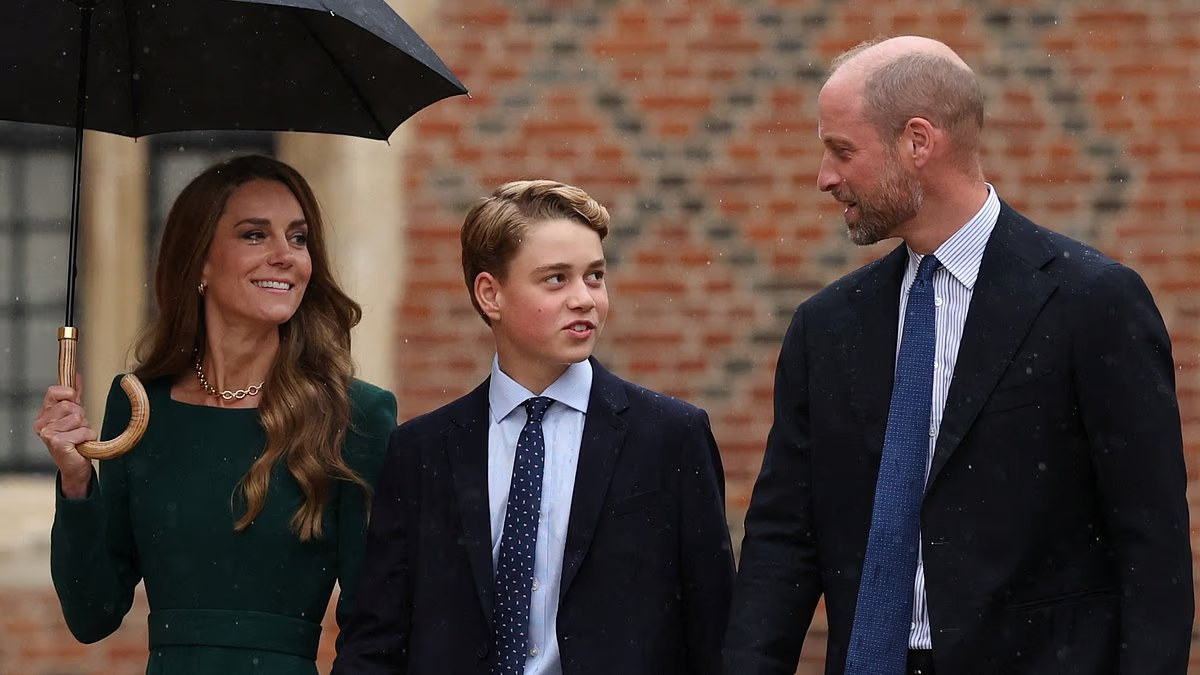

The scene was warmly welcomed by anyone who admires the close bond between the Prince and Princess of Wales and their children.
During his half-term break from Eton College, Prince George took a scheduled British Airways flight to Barcelona seated beside his father, Prince William.
Passengers were reportedly delighted to see the 44-year-old heir to the throne travelling with his 13-year-old son, who is second in line and destined to become king, rather than taking a private jet for the two-hour journey to Spain’s second-largest city. The pair were said to be animated as they discussed the event that had brought them to Barcelona: a Champions League match between the Spanish club and their much-loved Aston Villa at Spotify Camp Nou.
Although I share the pleasure inspired by the affectionate relationship between father and son, the arrangement also raises a serious concern.
Royal convention generally advises against two senior figures in the line of succession travelling together. The reasoning is straightforward: the succession must be protected above all else. If an aviation disaster were to occur, several future monarchs could be lost in a single incident, placing the monarchy’s future at risk.
Prince William and Prince George not only travelled together on the flight to Spain; they are also understood to have returned on the same aircraft.
That marks a notable break with the practice followed when William turned 12, after which he stopped travelling with his father, King Charles.
Graham Laurie, a former pilot to the late Queen Elizabeth, said William travelled with his parents and his brother, Prince Harry, until his 12th birthday in 1994. “After that, he had to have a separate aircraft,” Laurie recalled during an interview on Hello! magazine’s A Right Royal Podcast.

Prince William and Prince George watched a Champions League match between Barcelona and their beloved Aston Villa at Camp Nou

The Barcelona trip coincided with Prince George’s half-term break from Eton College, where he began as a student in September this year
Laurie said the only exceptions came when the Queen gave written permission for William to fly alongside his father.
More concerning still is the claim from Palace insiders that William and his immediate family frequently travel together by helicopter, an aircraft generally considered riskier than a conventional passenger plane.
William earned his general RAF pilot wings in 2008 after completing initial training on fixed-wing aircraft and basic helicopters. By 2012, he had qualified as a Search and Rescue Operational Captain, giving him full command of RAF helicopters.
A year ago, he confirmed that he continued to fly, describing the cockpit as his “happy place” while speaking with former air force colleagues.
During a visit to RAF Benson in Oxfordshire, the Prince said the sound of Sea King helicopters still went “straight to my heart”.
Asked whether he still spent time flying, William replied: “I do still fly, yeah – I keep my hours going. When you learn that skill set, you just don’t want it to go.”
Helicopters carry greater risks than passenger aircraft. In June this year, three Royal Navy personnel died when a Merlin Mk4 helicopter crashed during a training exercise in Devon.
The concerns about William travelling with George may also be shared by the King. In his 2024 book, Catherine, the Princess of Wales: The Biography, respected royal biographer Robert Jobson wrote that Charles had questioned his elder son’s “stubborn refusal” to follow advice intended to protect the succession.
Jobson reported: “Earlier this year, the King had raised concerns with his son about the wisdom of William using his helicopter to fly his entire family around the country.
“An experienced pilot, William had upset the late Queen when he defied her request not to pilot his family the 115 miles from Kensington Palace to Anmer Hall, their home in Norfolk. The Queen, haunted by the 1967 crash that killed the Captain of the Queen’s Flight, Air Commodore John Blount DFC, although no royals were on board, ‘did not hold back’, one aide said.”

Prince William takes part in a Sea King helicopter training exercise in March 2011
Jobson continued: “After being diagnosed with cancer, King Charles – perhaps reminded of his own mortality – echoed his late mother’s concerns.
“And when William refused to stop flying with his family, Charles insisted that he sign a formal document acknowledging the risks involved and accepting full responsibility for his actions.”
Monarchists need little reminding that, after Prince William and his children, the Duke of Sussex is next in line to the throne.
For some critics of the Sussexes, the prospect of Prince Harry becoming king and Meghan becoming queen is deeply unsettling. They argue that the couple’s past criticism of the Royal Family could make even committed monarchists question the institution.