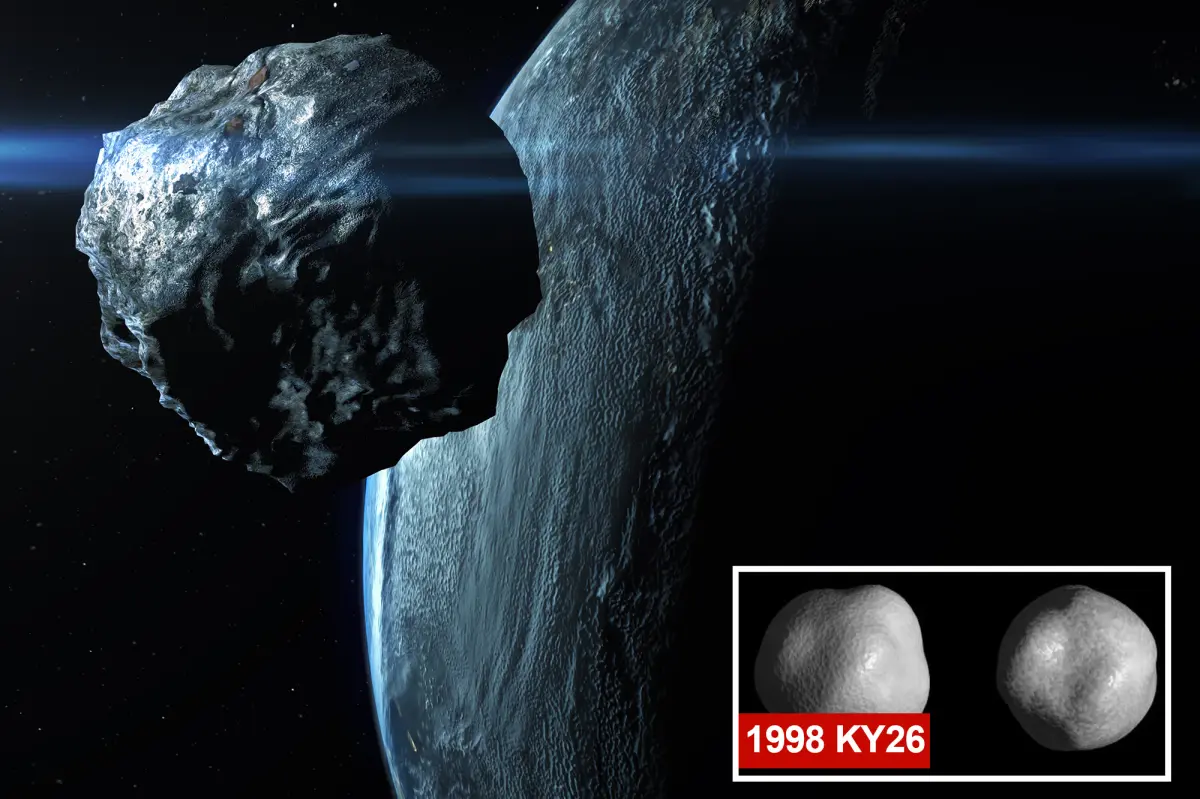

A puzzling object racing through the solar system is accelerating in a way that standard gravitational forces cannot fully explain—raising speculation that it may be a Soviet spacecraft that vanished nearly 40 years ago.
Designated 1998 KY26, the object measures about 36 feet across and is generally classified as a near-Earth asteroid. Yet its trajectory appears to be influenced by an additional force. New research has challenged one of the leading explanations for that unexplained motion.
NASA Administrator Jared Isaacman addressed the speculation Thursday on “Fox & Friends.” He acknowledged that some members of the UAP community believe KY26 is behaving strangely, but said he has seen no evidence that it is anything other than an asteroid.
“First of all, nothing is about to hit us, to be very clear on this,” Isaacman said. “I’ve not seen any evidence to suggest this is a threat to our planet or anything other than an asteroid.”
Astronomers describe KY26’s unusual trajectory as “nongravitational acceleration,” a term for movement affected by forces beyond the gravitational pull of the sun, planets and other bodies.
One proposed explanation classifies KY26 as a “dark comet.” Under that theory, water trapped beneath its surface turns into gas and creates a subtle thrust, despite the absence of the bright cloud or tail typically associated with comet activity.
However, a new peer-reviewed study from Georgia Institute of Technology researchers Korbin Hansen and Masatoshi Hirabayashi casts doubt on the dark-comet theory.
Published in the journal Icarus, the study concluded that KY26 is probably too warm for buried water ice to remain intact long enough to produce the observed acceleration.
The researchers wrote that their calculated water-loss rates “preclude 1998 KY26 being a dark comet at present.”
Other natural explanations remain possible. Earlier research suggested that sunlight striking KY26 and heat radiating from its surface could generate the additional force without requiring subsurface water.
Still, another research team has proposed a much more unconventional possibility.
Harvard astrophysicist Avi Loeb, along with researchers Adam Hibberd and Adam Crowl, has investigated whether KY26 could be Phobos 1—a Soviet unmanned spacecraft that lost contact with Earth while en route to Mars in 1988.
KY26 is approximately 36 feet wide, reflects about 52% of the sunlight that reaches it and rotates once every 5.35 minutes.
The researchers created a simplified model of Phobos 1 and compared its projected sunlight reflections during rotation with observations of KY26. Their spacecraft model closely matched eight separate observation sets.
They also examined whether sunlight exerting pressure on a cylindrical body or solar panels could account for the object’s acceleration. That model produced a closer fit to hundreds of telescope and radar observations.
“Although an investigation of this kind cannot be conclusive,” the researchers wrote, the results “add strong weight to the Phobos 1 hypothesis.”
Even so, the team emphasized that the model does not establish KY26 as the missing spacecraft. They characterized the idea as “strongly plausible but presently unproven.”
Other findings point toward a far more ordinary explanation.
A separate study published this year in Astronomy & Astrophysics analyzed light reflected from KY26 and found that its composition appears consistent with a rocky asteroid. The researchers concluded that the object likely originated in the inner asteroid belt.
Isaacman said NASA is continuing to track KY26, but stressed that there is no reason for the public to be concerned.
“I have no reason to believe this is in any way remotely a threat to our planet or anything other than just an asteroid,” he said.
A definitive answer could eventually come from a close-up visit.
The Japan Aerospace Exploration Agency’s Hayabusa2 spacecraft is scheduled to rendezvous with KY26 in July 2031, according to a 2025 study published in Nature Communications.
Loeb believes that mission could offer the strongest test yet of the Phobos 1 theory.
“Our prediction is that instead of an iceberg, Hayabusa 2’s cameras will reveal the label ‘Made in the U.S.S.R.,’” Loeb wrote.