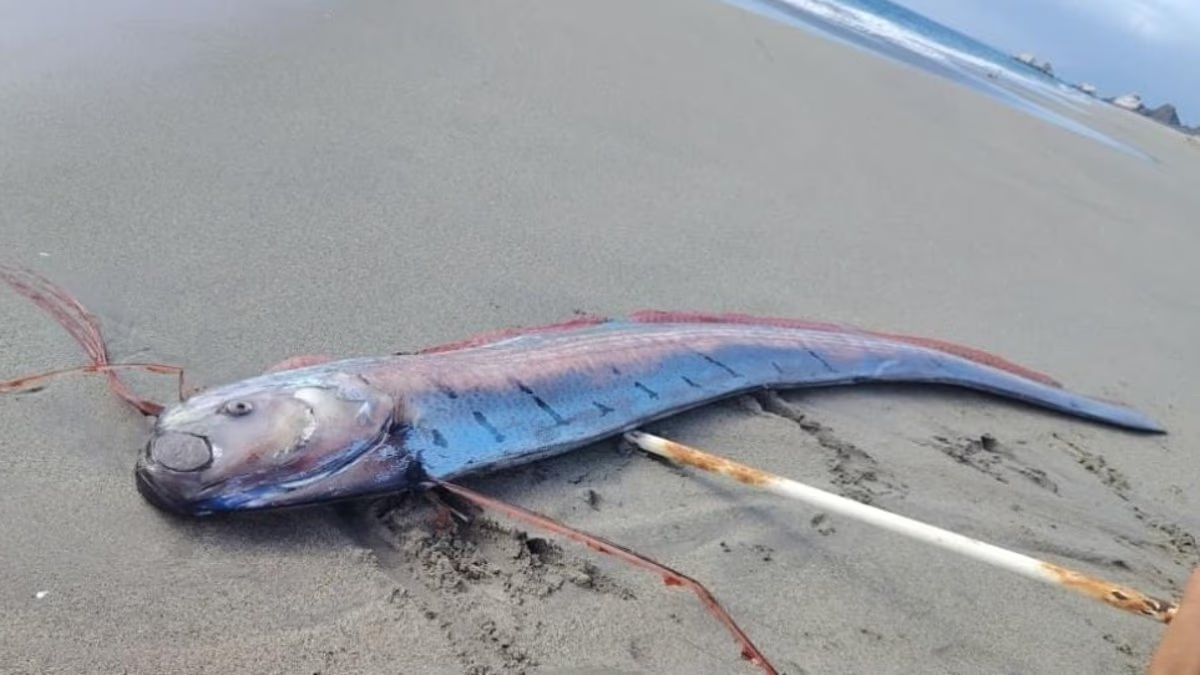

A rare 16-foot sea creature linked in folklore to natural disasters has washed ashore in South America, prompting online speculation that a powerful earthquake could strike the seismically active region.
The giant oarfish, known in Japanese folklore as a “Doomsday fish,” was discovered on Tuesday on a beach in Mejillones, northern Chile.
The elusive, serpent-like fish is rarely seen by people. Sightings have featured in Asian legends since the 1600s, when they were often viewed as warnings from mythical deities.
Scientists have found no significant evidence linking oarfish appearances to earthquakes, tsunamis or other natural disasters. Nevertheless, beach strandings have repeatedly been associated with deadly events that occurred weeks or months later.
The latest oarfish sighting comes after a series of major earthquakes across South America and the Caribbean. That timing has fueled fears that Chile—or even the vulnerable US West Coast—could be next.
“Not a good omen,” one person claimed. Another wrote: “An earthquake is coming to the north.”
Geophysicist Stefan Burns, who has predicted that a major earthquake could hit the California coast by 2030, also reacted to the discovery. “Here we go again,” he said.
At least two other so-called Doomsday fish sightings have been reported in 2026, and both were followed by earthquakes or volcanic eruptions within days, according to claims circulating online.

A 16-foot oarfish, also known as a Doomsday fish, was discovered on a beach in northern Chile on October 20

Oarfish, sometimes called Doomsday fish or sea serpents, usually live about 3,000 feet beneath the ocean surface, making shore sightings exceptionally rare (File Image)
On August 25, a dead oarfish washed ashore on an Indonesian beach along the southeastern coast of Komodo Island.
Six days later, six volcanoes across Indonesia either erupted or displayed signs of eruptive activity at the same time.
In early October, a magnitude 5.2 earthquake also struck the area. No deaths or injuries were reported after any of the incidents.
In late February, two American tourists described a “one-in-a-billion chance” encounter when two live oarfish came ashore at a beach in Cabo San Lucas, Mexico.
Finding two oarfish together is considered extraordinarily unusual because the species inhabits the deep ocean, generally at depths exceeding 3,000 feet in the so-called “Twilight zone”—one of the least explored regions on Earth.
DON’T MISS: Rep. Ilhan Omar Addresses Claims She Married Her Brother
After the discovery, a magnitude 4.1 earthquake was recorded less than 15 miles from Cabo San Lucas on March 23. There were no reports of injuries or significant damage.
The region has since been hit by several hurricanes, including Polo, Simon and Rachel in September and October. The storms caused flooding, landslides and fatalities along the Pacific coast.
Chile’s most recent major earthquake struck just over a year ago, on October 10, 2025. The magnitude 7.6 earthquake occurred in the Drake Passage, south of the country, triggering tsunami alerts along the coasts of South America and Antarctica.

The oarfish’s appearance quickly sparked ominous claims online that it signaled an approaching natural disaster or another catastrophe
Join the discussion
Do deep-sea creature sightings really warn us of disaster, or are we just seeking meaning in coincidence?
‘The earthquake is coming!’ one commenter claimed after the Marine Fauna Research and Cetacean Watching Center in Chile announced the discovery on social media Tuesday.
Despite the coincidental timing of the sea serpent’s arrival on beaches, a 2019 study found no legitimate connection to the creatures being a herald of doom.
A team from Tokai University in Japan examined 336 reports of deep-sea fish appearances and 221 earthquakes stronger than magnitude 6.0 around the country between 1928 and 2011.
Their findings, published in the Bulletin of the Seismological Society of America, did not find a statistically significant link between the appearances of Doomsday fish and natural disasters, calling the myth an ‘illusory correlation’ rather than a reliable warning sign.
In the US, a 2018 study published in the Bulletin of the Southern California Academy of Sciences had found that there were only 19 oarfish strandings or sightings along the California coast over the last century.
Although scientists have claimed there is no connection to a future earthquake along the South American coast, Chile sits along one of the world’s most active tectonic boundaries capable of producing massive shockwaves.
The oceanic Nazca Plate has been steadily sliding under the South American Plate, which continues to build up the Andes Mountains, fuels volcanic activity and stores enormous stress along the two connecting plates.