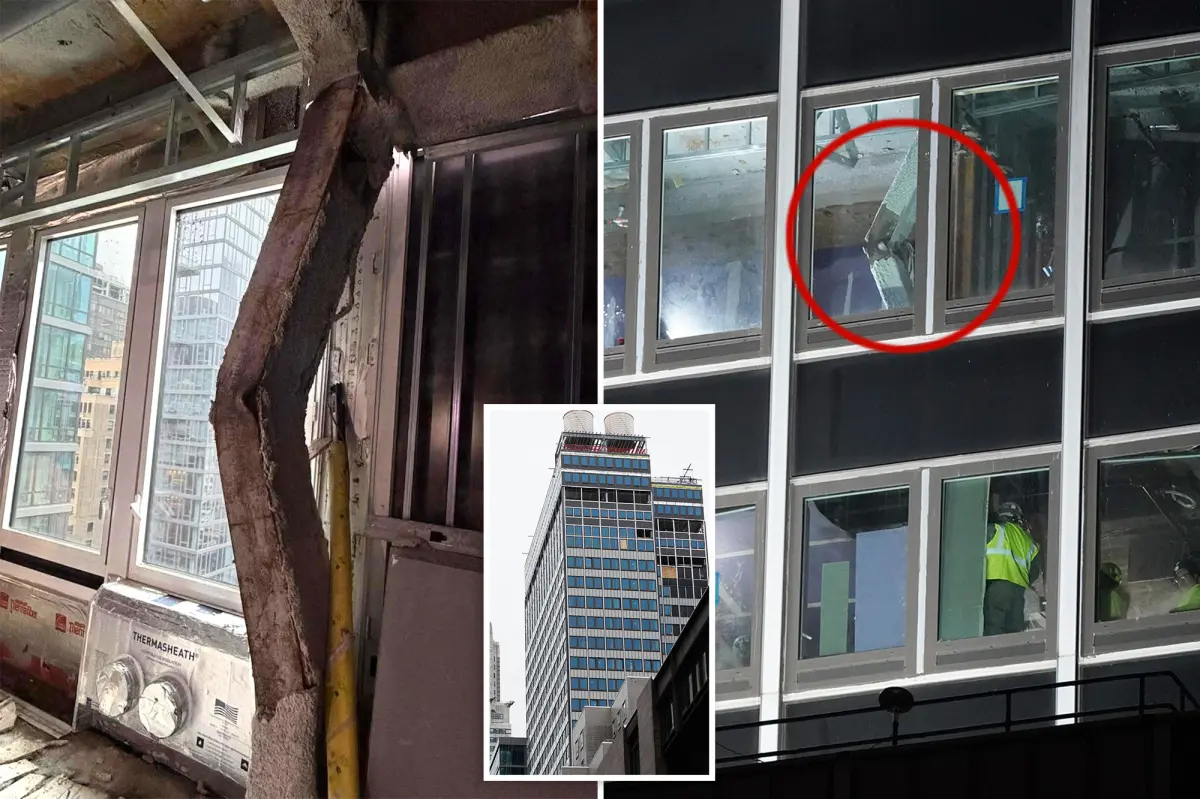

Stabilization work at a Midtown Manhattan skyscraper that buckled dangerously over the summer began Wednesday, with crews lifting the sagging floors just 1/64 of an inch at a time.
The repairs at 235 E. 42nd St., the former Pfizer headquarters, got underway more than three months after structural problems forced the dramatic evacuation of the building.
According to newly filed engineering plans cited by Gothamist, workers used hydraulic jacks to raise the damaged floors in extremely small stages. Each lift is roughly the thickness of a guitar pick.
By the time the operation is complete, the floors are expected to be elevated by approximately 6 inches.
The New York City Department of Buildings told The Post that the jacking operation had already been completed.
“The project team was able to successfully raise the floors with the jacks without incident,” said Andrew Rudansky, the department’s chief communications officer. “Preliminary observations and inspections at the building have found no concerns with the structural integrity of the building as a result of this work.”
Nearby properties did not have to be evacuated. During the lift, crews relied on extensive force, optical and tilt-monitoring systems to track the building’s movement, Rudansky said.
Further inspections of the high-rise were scheduled for Thursday, according to Rudansky.
Several floors of the 37-story commercial tower collapsed under intense pressure, sending bricks tumbling onto the street. The property is at the center of what is expected to become New York City’s largest office-to-residential conversion.
Emergency crews initially reinforced the structure. At a July 8 news conference, Buildings Commissioner Ahmed Tigani said an independent engineer had been hired to provide an additional safety review before emergency personnel entered the affected floors, where beams were reportedly “bending like cigarettes.”
CHECK THIS OUT: My Wife Wanted One Thing for Our Anniversary—Now She Avoids Me
MetroLoft, the tower’s developer, initially said it planned to reconstruct the damaged portion soon after the summer incident, according to the outlet.
That approach has since been revised, based on engineering plans and other documents submitted to the Department of Buildings and obtained by Gothamist.
Engineers who examined the updated proposal said the plan to slowly lift the affected floors appeared to be a safe, measured way to address the problem.
“The threat is going too fast and missing a problem, like something that is causing damage somewhere else,” Eric Cowley, president of Cowley Engineering, told the local outlet.
Cowley said he believed the repair plan was sound and saw no reason to rebuild the entire section above the damaged columns.
When the publication visited the site Friday, crews were already working on upper floors near the location of the collapsed column.
Gothamist reported that city records showed columns had been removed the previous month, while a Buildings Department spokesperson confirmed that the floor-jacking operation was expected to begin during the week.
“We would not allow any work to proceed in the city if we thought it was posing a hazard to the public,” David Maggiotto of the Department of Buildings said in a statement to the outlet.
“These plans to effectuate permanent structural repairs to the building were approved by DOB following an extensive vetting and review process by senior department engineers, as well as from an independent third-party engineering firm.”
The former office tower is planned for conversion into a 1,600-unit residential complex, a project described as the largest office-to-housing transformation in New York City.
MetroLoft did not immediately return The Post’s requests for comment.