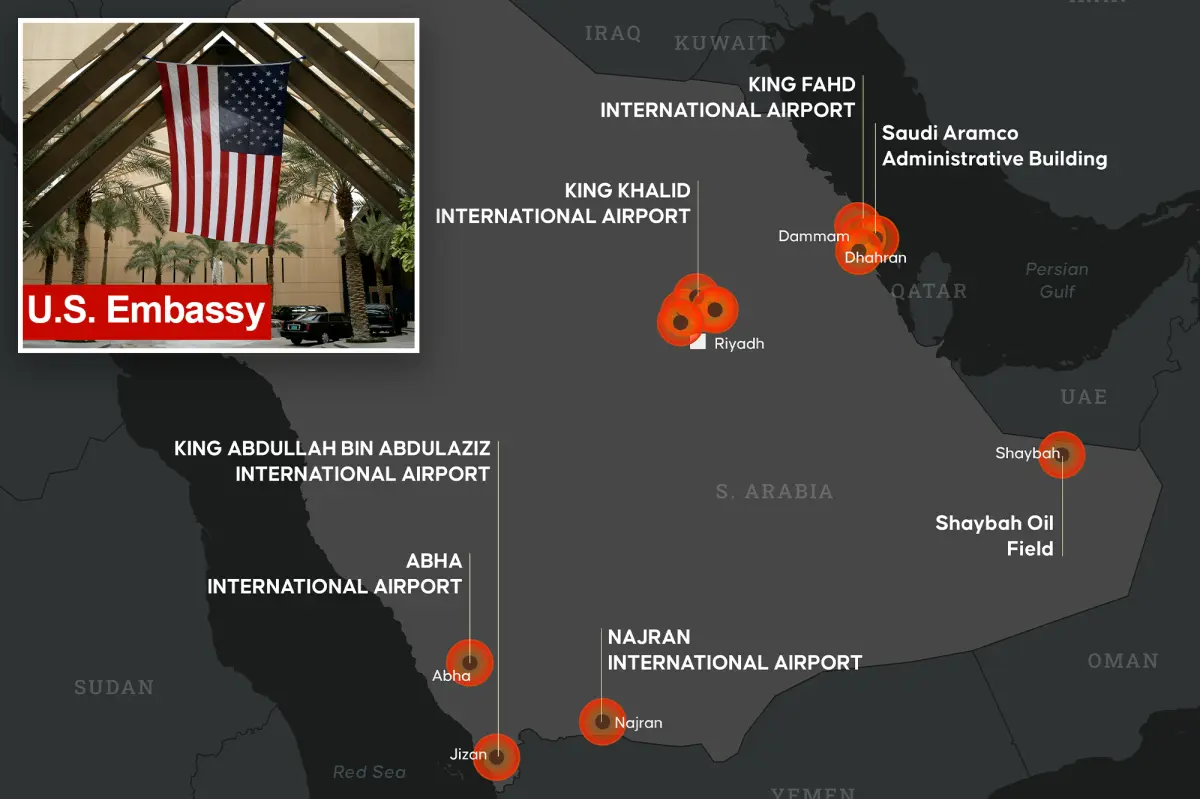

The Trump administration has directed non-emergency U.S. government personnel and their family members to leave Saudi Arabia as a deadly wave of Houthi attacks spreads across the kingdom. The move comes as President Trump considers whether to authorize direct American military action against the Iran-backed group.
State Department spokesman Tommy Pigott said Wednesday that the mandatory departure order is limited to Saudi Arabia, disputing reports that the United States was preparing a wider evacuation of diplomatic staff from the Gulf.
“The US Department of State issued an ordered departure for non-emergency US government employees and their family members in Saudi Arabia only,” Pigott said.
The warning follows a sharp increase in Houthi missile and drone attacks, which have killed civilians, disrupted air travel and pushed Saudi authorities to seek more missile-defense capabilities.
“Iranian-supported Houthis have increasingly engaged in hostilities against Saudi Arabia, including attacks on civilian airports and other critical infrastructure resulting in civilian casualties and severe travel disruptions,” Pigott added.
Trump is weighing direct U.S. strikes on the Houthis as the group’s expanding missile and drone offensive places Saudi cities, airports and energy facilities under growing threat.
Houthi attacks and attempted attacks on Saudi Arabia more than doubled in one week this month, according to the Armed Conflict Location & Event Data Project. Airports in Riyadh, Jizan, Najran, Dammam and Abha have been targeted since Oct. 5.
The most lethal attack hit King Khalid International Airport in Riyadh, killing at least 13 people and injuring more than 300 others.
The intensifying campaign has led Riyadh to request greater military assistance from its partners. Britain said Tuesday it would send Typhoon fighter jets to help protect Saudi cities and key infrastructure. Egypt is also supporting the kingdom, while Israel has offered assistance.
CHECK THIS OUT: Ukrainian Soldier Survives 491 Days Stranded Before Amputating His Own Leg
Saudi Arabia has additionally asked Washington for more missile interceptors, but U.S. officials caution that worldwide demand is putting pressure on limited supplies.
“I also talked to Saudi Arabia today; they’d like interceptors. Israel would like interceptors. We would like interceptors. Every country in the world would like interceptors,” Secretary of State Marco Rubio said Tuesday.
Rubio called the systems “probably the most in-demand product right now in the defense field,” underscoring the challenge of meeting allied requests while preserving America’s own military stockpiles.
The crisis has highlighted how difficult it is to shield Saudi Arabia’s expansive territory from comparatively cheap missiles and drones, even with some of the most advanced air-defense systems in the world.
“Saudi Arabia is a huge geography to protect, and this speaks to a larger threat we’re facing globally: a relatively small nonstate actor can pose a serious challenge to even a sophisticated and extremely expensive military,” Farea Al-Muslimi, a research fellow at Chatham House, told Fox News Digital in an interview published Wednesday.
“The Houthis can impose enormous costs without having to spend very much themselves,” he said.
Trump has not ruled out intervening directly against the Houthis. Earlier this month, he told reporters that the United States could join Saudi military operations against the group.
“We may. We’re gonna look at it,” Trump said. “We’ll make a decision. We move very quickly.”
In 2025, the United States carried out an approximately two-month bombing campaign against Houthi positions in Yemen. Trump ended the operation after Oman helped broker an agreement.
The United States continues to provide Saudi Arabia with intelligence and targeting assistance while Trump considers whether to order a new round of strikes against the Houthis.