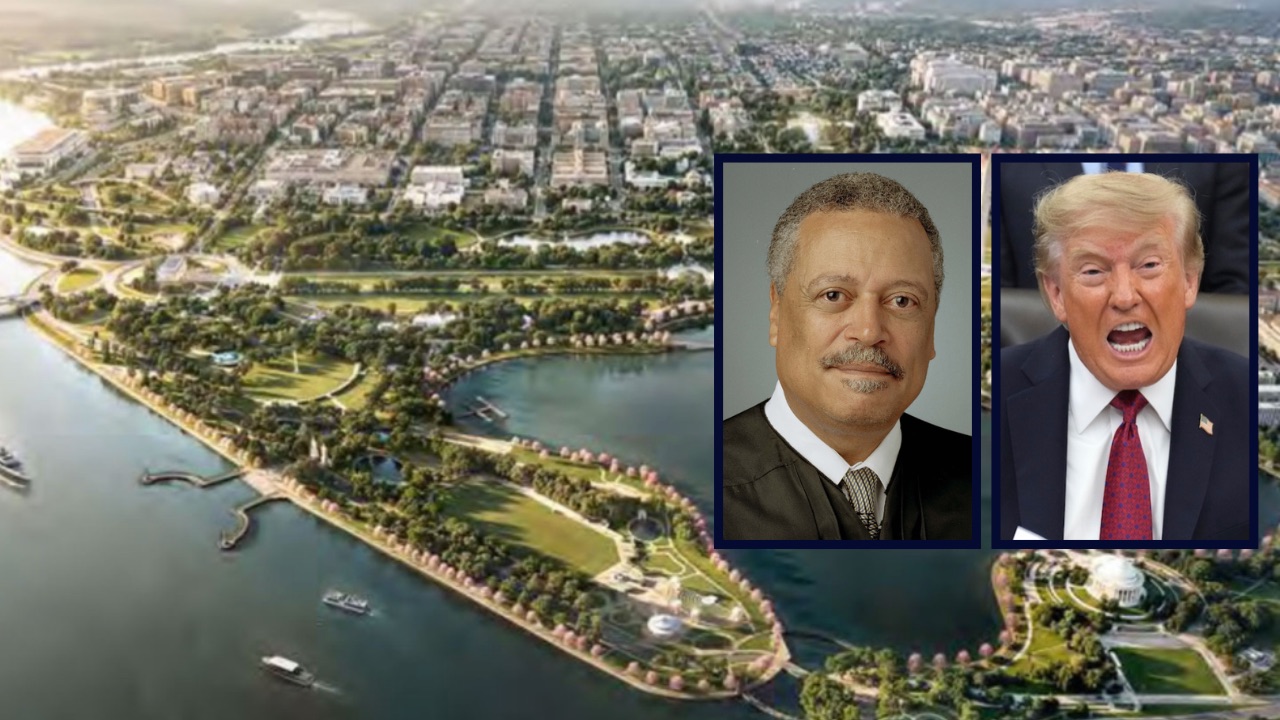

Main: An aerial view of West Potomac Park, shown in a court exhibit. Inset left: Senior U.S. District Judge Emmet Sullivan of the U.S. District Court. Inset right: President Donald Trump speaks at a campaign rally for Sen. Darline Graham, R-S.C., at the Myrtle Beach Convention Center in Myrtle Beach, S.C., Friday, Aug. 21, 2026. (AP Photo/Jacquelyn Martin).
A weekend uproar over the mass removal of trees at a Washington, D.C., golf course produced an unusual confrontation between a senior Justice Department attorney and a federal judge. The judge refused to recuse herself from the case and declined to disregard President Donald Trump’s social media posts outlining his plans for East Potomac Park.
Now, another judge on the same court is considering whether to halt the Trump administration’s proposed construction of the “National Garden of American Heroes” at West Potomac Park.
Senior U.S. District Judge Emmet Sullivan, a familiar figure in both past and current legal disputes involving Trump, has been asked to “preliminarily enjoin or stay” the government’s implementation of the so-called “West Potomac Plan.” The request echoes an earlier effort urging U.S. District Judge Ana Reyes to stop the administration, before it was too late, from replacing East Potomac Park’s “historic, recreational-style design” with a “championship-style venue for professional tournaments.”
Like the D.C. Preservation League, the National Parks Conservation Association argues that it has standing because the administration’s adoption of the plan qualifies as “final agency action.” As in the golf course litigation, however, the government maintains that the work at the site is unrelated to any broader plan.
Judge Reyes repeatedly said she did “not want to be the overseer of Parks and Rec” and did not want plaintiffs returning to court every time the government carried out “routine” tree maintenance at East Potomac Park. But hundreds of trees were cut down with little notice over a holiday weekend. Reyes then said the events had “cost the government all of its credibility with me in this case.”
After that hearing, the government sought to disqualify Reyes, a judge appointed by Joe Biden. The administration argued that she had “allowed her disdain for the Trump Administration to influence how hearings unfold, and systematically disregarded basic separation of powers principles and Article III constraints on judicial authority” while criticizing DOJ attorneys for doing their “absolute worst.”
Reyes promptly rejected the recusal motion. On Monday, she pressed Associate Attorney General Stanley Woodward for answers, saying she did not believe the tree cutting and the golf course renovation were unrelated.
Woodward told the court that the tree removal did not constitute “final agency action.” Instead, he said, it was intended to ensure compliance with a 2019 Cultural Landscape Report. His explanation was consistent with testimony from National Mall and Memorial Parks Superintendent Kevin Griess and National Park Service Deputy Director for Operations Frank Lands.
Reyes, meanwhile, indicated that she could block further tree removal. It remains unclear, however, whether such an order would affect the plaintiffs’ standing to challenge the larger West Potomac Plan.
Sullivan was assigned to the National Parks Conservation Association’s lawsuit in mid-June, before the U.S. Supreme Court cleared the way for construction of Trump’s ballroom.
The association argued that the administration’s “disregard for legal requirements” reflected “the same playbook the administration has used to pursue other recent vanity projects.” The complaint cited Trump’s demolition of the White House East Wing to make room for the ballroom, the “paving over” of the Rose Garden and the “unlawful[] emblazoning” of his name on the John F. Kennedy Center for the Performing Arts, which a court later ordered halted.
“At every turn, the President and his administration have shirked congressionally required procedures, cut the public and groups with relevant expertise out of their renovation plans, and obfuscated the source of funding for these projects,” the complaint stated.
By mid-September, following the ballroom decision, the plaintiffs feared they “apparently would not suffer Article III injury until construction of the garden complex is substantially or entirely complete.”
“Of course, at that point, the government is likely to argue—as it has in other litigation—that the project is too far along for Plaintiffs’ injuries to be redressed,” the group wrote in a filing supporting its request for a preliminary injunction.
The organization also pointed to Uzbek gazebos, or aywans, that were already being built at the site.
“In a meet-and-confer, counsel for Defendants represented that the Uzbek gazebos currently under construction are not part of the Garden of American Heroes. That explanation conflicts with the understanding of the Uzbekistan ambassador, who said his country had gifted the gazebos as ‘part of the Garden of American Heroes,’” the filing stated.
As recently as Oct. 13, the plaintiff’s reply again asked Sullivan to “prevent irreparable injury before it occurs.”
“Defendants still do not dispute that the West Potomac Plan is illegal. Instead, their defense boils down to the repeated assertion that they are not ‘currently building’ the National Garden of American Heroes,” the court filing said. “Plaintiffs have demonstrated imminent, irreparable harm from the adoption and implementation of the West Potomac Plan, regardless of whether the Court credits Defendants’ assertions that construction of the garden complex has not begun. Preliminary relief is necessary to forestall those harms now, rather than at some future, unidentified point in time when Defendants can claim it is too late to redress Plaintiffs’ injuries.”
The post Judge weighs whether president’s “Garden of American Heroes” is “illegal” while Trump DOJ defends mass tree removal at nearby golf course as normal first appeared on Law & Crime.